The Cincinnati May Festival has announced that the celebrated tenor Matthew Polenzani is ill and unable to perform in Verdi’s Requiem to open the festival this Friday.
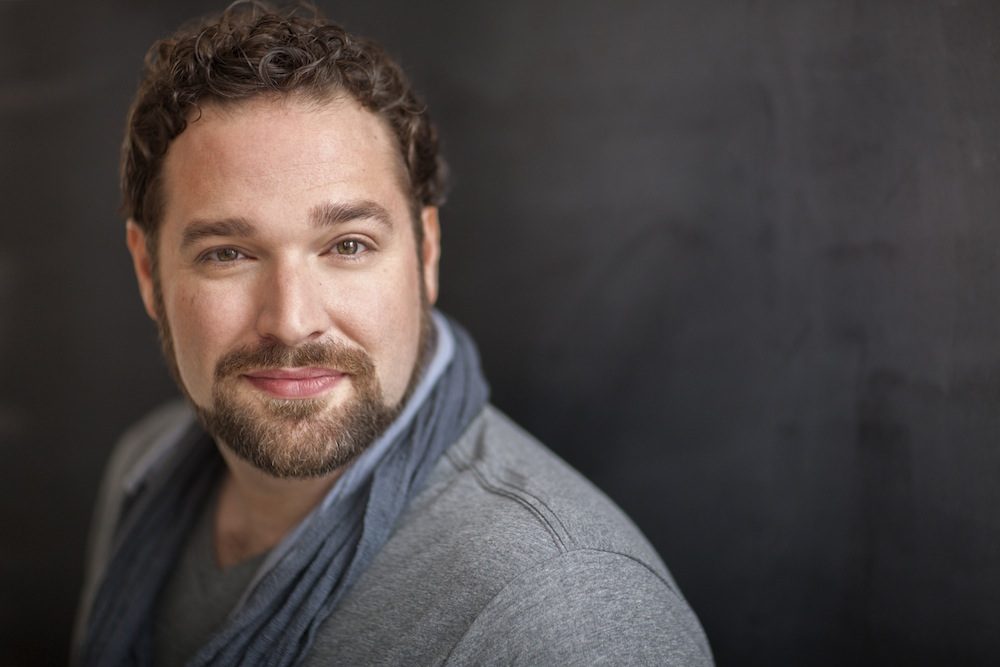
Bryan Hymel will replace Polenzani as tenor soloist on May 18. Hymel regularly appears with the Metropolitan Opera, Covent Garden, Opéra National de Paris, and La Scala.
He has performed the roles of Don José in Carmen, Pinkerton in Madama Butterfly and as tenor soloist in the Verdi Requiem. He has been the recipient of the opera world’s most prestigious awards including the Olivier Award, the Metropolitan Opera’s Beverly Sills Artist Award, and the George Thill Prize, and has been the top prize winner in the Lissner, Albanese, Zachary, Gari and Metropolitan Opera National Council competitions.
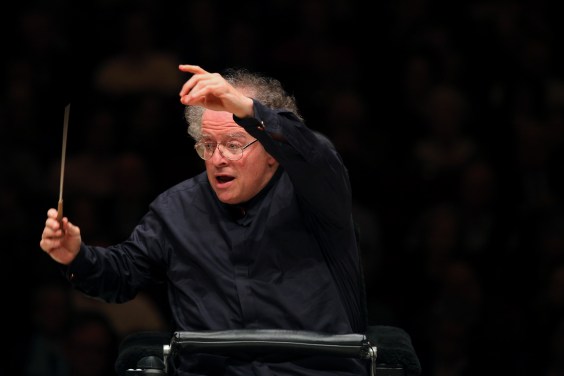
Rising star Eun Sun Kim will conduct the opening night performance, replacing James Levine.
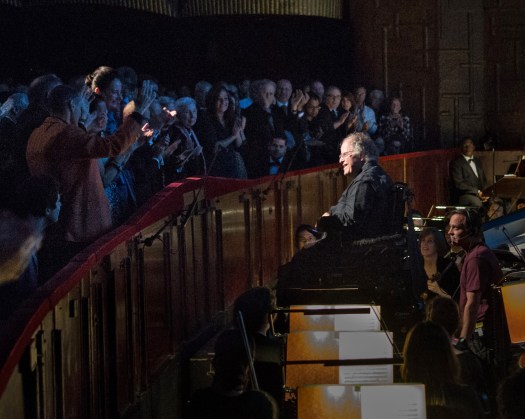
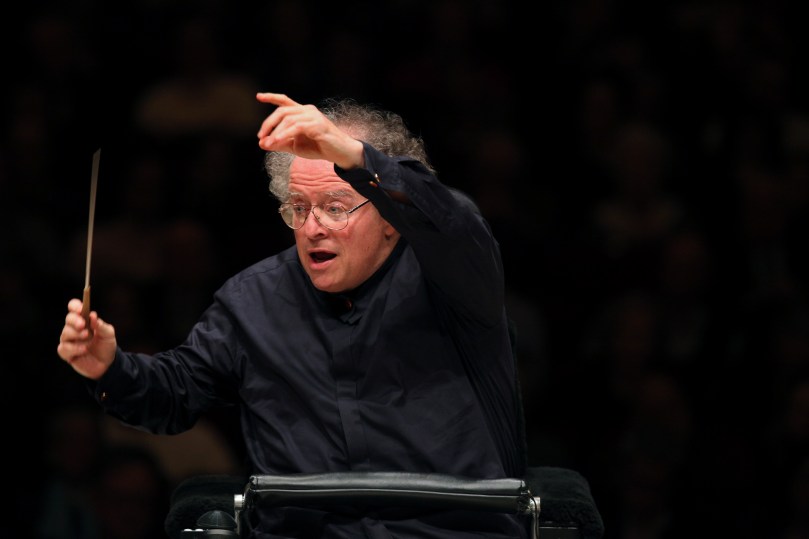
James Levine, being applauded at the Metropolitan Opera, was fired by the company, citing “credible evidence” for sexual abuse. Photo by Naomi Vaughan
By now you’ve read, or you’ve heard about, Metropolitan Opera conductor James Levine’s fall from grace. Yesterday, the Metropolitan Opera fired the maestro, a Cincinnati native, citing “credible evidence” for sexual abuse allegations that go back decades.
Levine was one of the most powerful people in the opera world. He was revered as a conductor who rivaled legends such as Herbert von Karajan and Leonard Bernstein. In Cincinnati, Levine’s talent is a part of local lore. He made his Cincinnati Symphony Orchestra debut as piano soloist at age 10 under Thor Johnson. As a pre-teen, he would sit for hours at Cincinnati Opera rehearsals at the zoo, inhaling opera scores and imitating Italian conductor Fausto Cleva.
He was music director of the Cincinnati May Festival in 1974, before he turned 30, and served for five seasons. (The May Festival has canceled his planned appearance this season.)
In Cincinnati, he conducted his first performances of Wagner operas Lohengrin, Tannhauser and Parsifal, in concert version for the May Festival. Levine hand-picked his successor, James Conlon.
He was a personal champion of opera soprano Kathleen Battle, a graduate of the University of Cincinnati College-Conservatory of Music.
And his mentor from an early age into adulthood was Walter Levin, the late first violinist of the LaSalle Quartet, the distinguished former quartet-in-residence at CCM.
One of Levine’s honorary doctorates was from the University of Cincinnati.
I’m reposting the Met’s entire statement here:Read More »
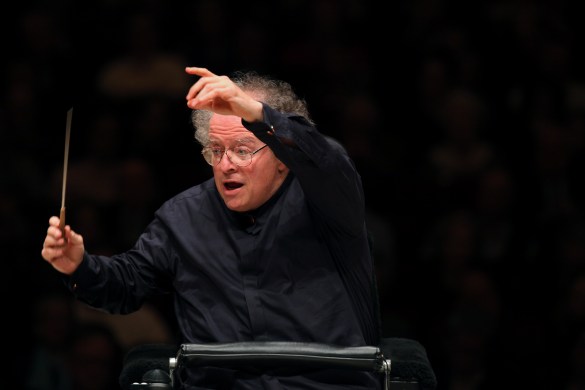
James Levine. Photo courtesy of the Met Orchestra.
The Cincinnati May Festival has canceled the appearance of James Levine this May following allegations over the weekend of sexual misconduct that began in the 1960s.
The festival announced on Monday that the performance of Verdi’s Requiem will take place as scheduled on May 18, 2018. A replacement conductor will be announced at a future date.
The festival’s decision followed news that the Metropolitan Opera has suspended Levine after reports surfaced that he had allegedly molested at least three young men for years, according to the New York Times.
Levine, now 74 and suffering from Parkinson’s disease, is a native of Cincinnati, where he began his musical training and was a graduate of Walnut Hills High School. He was scheduled to open the festival on May 18 with Verdi’s Requiem, a work that he conducted in New York on Saturday, which was broadcast live over public radio from the Met.
Levine was May Festival music director from 1973 to 1978. His last appearance at the festival was in 2005. His appearance was to have celebrated the return of the May Festival to Music Hall after its $143 million renovation.
The New York Post broke the news on Dec. 2 about a 2016 Illinois police report detailing the allegations of sexual abuse of a then-teenage musician in 1986, while Levine was music director at the Ravinia Festival outside of Chicago. Peter Gelb, general director of the Met, told the New York Times that, at the time, Levine had denied the accusation and the Lake Forest Police Department did not follow up.
However, in graphic accounts reported by Michael Cooper in the Times online edition on Sunday, two more men have come forward to allege sexual misconduct with Levine when they were teenagers.
Levine is one of the most celebrated conductors in America. Salacious rumors have swirled around his private life for decades, but he has consistently denied any wrongdoing. According the Times, Gelb said that the Met had investigated allegations twice previously during Levine’s 40-year tenure at America’s most important opera house.
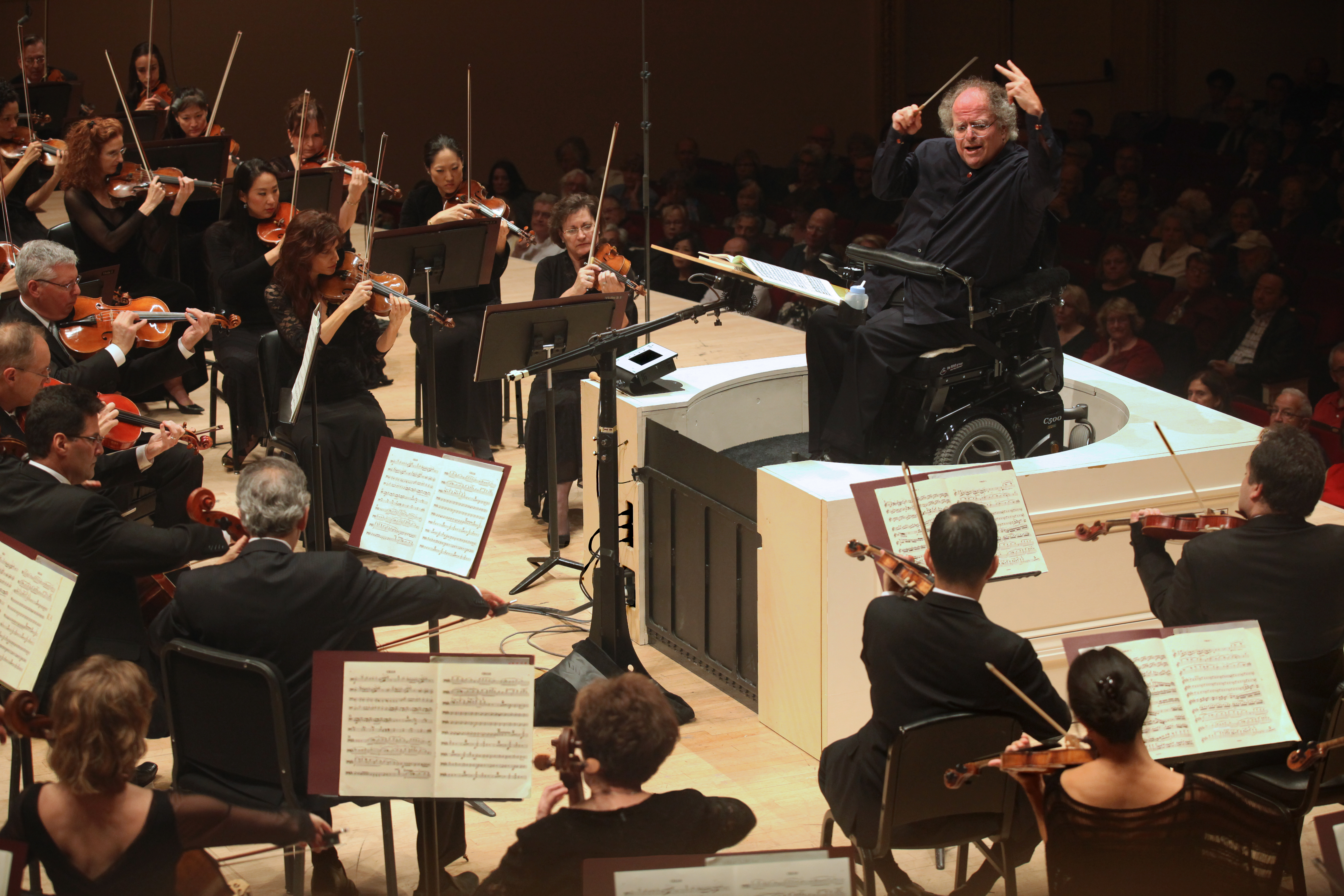
Levine has been a beloved figure at the Met, where he has conducted more than 2,500 performances. Now confined to a motorized wheelchair after widely-publicized health problems, he stepped down to become music director emeritus last year.
The Met has canceled his upcoming conducting engagements.
Juanjo Mena leads his first season as May Festival principal conductor this May.James Levine. Photo courtesy of the Met Orchestra.
Maestro James Levine, a Cincinnati native, will return to conduct Verdi’s Requiem for the Cincinnati May Festival opening night in May, as part of principal conductor Juanjo Mena’s first season. It will be Levine’s his first appearance in Cincinnati’s Music Hall since he conducted at the festival in 2005.
In addition, the season will feature tributes to Leonard Bernstein, whose centennial is being observed around the world in 2018. The celebrated countertenor David Daniels, a graduate of the University of Cincinnati College-Conservatory of Music, will be featured in Bernstein’s Chichester Psalms in one of the programs.
Mena’s debut festival, to take place May 18-26 in the newly renovated Music Hall, was announced on Monday via Facebook Live — a first for the festival. Dr. Rollo Dilworth, a Temple University conductor composer and choral music champion, will serve as Mena’s creative partner, as part of the festival’s new artistic model. The third member of the creative team is Robert Porco, longtime director of choruses.Read More »
It’s been a privilege. I can truthfully say I have loved every minute of writing about the arts in Cincinnati for the Cincinnati Enquirer. I am thankful to you, the readers of both print and digital, the people who have called me, written letters, followed me on social media, come up to me at Music Hall to say hello or to talk about music, and who have taken my OLLI class, “Behind the Scenes in the Arts.”
It has been a wonderful, totally unexpected ride that became 26 years almost overnight.
From the first day that I walked into the newsroom, never having taken a journalism course, I was starstruck by the people who worked there. What talent and creativity! In those days, I filed a review right after the symphony concert on Friday nights, which meant I raced to my car behind Music Hall, tore Downtown to the Enquirer building while forming the opening lines in my head, and wrote on a deadline of 45 minutes with a copy desk editor barking, “Where’s that review?” Loved those late-night editors, who would fix my typos and write the headlines. The best one described a pianist, to be nameless here, who slogged through a bizarre performance of Rach 2: “(Pianist) phones it in — From Mars.” I was usually home by 2 a.m. and the review was in the morning paper.
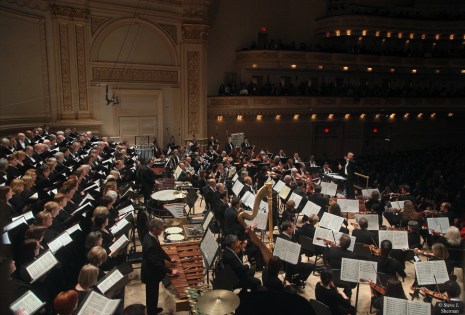
With James Conlon and the Cincinnati Symphony Orchestra and May Festival Chorus at Carnegie Hall, May 2014; photo provided by Spring for Music, Steve Sherman
But besides the reviews, I have loved writing stories about people. Sometimes I think that the whole artistic world has passed through Cincinnati. I’ve interviewed and met opera stars, violin legends, conductors, composers, crooners, rockers and movie stars. I couldn’t believe going backstage at the Met to interview Cincinnati’s own James Levine, who had pictures of his childhood home behind his desk. He knew everything happening in the Queen City. His mother, Helen, it turned out, had been sending him all of my clippings.
Then there was Rosemary Clooney. Driving down to Augusta, Kentucky, with photographer Craig Ruttle to spend time in her home was unforgettable. Later, John Kiesewetter, Jim Knippenberg and I covered her funeral. Yes, there were Hollywood stars. But more touching were the folks of Maysville who came out to bring their “girl singer” back home.
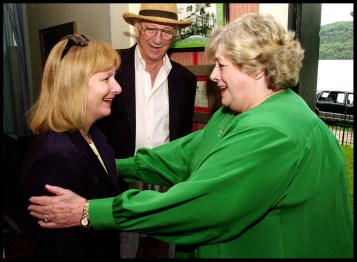
With rocker Peter Frampton in his studio at his Indian Hill home talking about his gig with the Pops.With Rosemary Clooney and her husband, Dante DiPaolo
When Erich Kunzel died in 2009, I was proud that Reds announcer Marty Brennaman mentioned during the game the next day that The Enquirer had done a nice job on his obituary. Early that morning, I was interviewed on NPR about the Cincinnati Pops maestro, and the force of nature that he was. And about a week later, I was on tour in Japan with the CSO. On a day off at the mountainous shrine of Nikko, a man in my tour group said as we ate lunch, “Cincinnati. I heard you just lost a conductor there.” He’d heard my interview, 6,000 miles away.Read More »
You probably saw the news that James Levine, 72, is stepping down as music director of the Metropolitan Opera after 40 years, for health reasons. He will finish the remainder of his very busy season, and continue as music director emeritus, the first ever position at the Met. He has struggled with Parkinson’s Disease for some time, and has had other severe health issues, as well.
Levine is a Cincinnati native, and having lived in Cincinnati for most of my adult life, I have learned that just about everyone here a) knew his parents b) heard him play piano as a child, or c) went to Walnut Hills High School with him. Read More »
James Levine leading the Met Orchestra in Carnegie Hall last May
The Cincinnati Symphony’s “Russian Hallows’ Eve” was an entertaining brew. Here’s the review. I was especially impressed by the soloist, Benjamin Schmid, an Austrian violinist.
The concert was led by guest Andrey Boreyko. As I was leaving a gentleman came up to me and asked, “What makes a great conductor?”
That’s an intriguing question, and I’ll bet a lot of musicians could weigh in — not always positively! It’s definitely a different experience for the audience, which only sees the performance. A conductor who is charismatic on the podium doesn’t always mean greatness; lots of work and communication with the players takes place during rehearsals. (Look at James Levine, now confined to a wheelchair, who barely moves as he conducts.)
For me, I look for expressive phrasing, a sense of direction over the arc of a piece, respect for the composer and period and musicianship. A great conductor takes the listener on a journey, and conveys a specific point of view. And I enjoy it when a conductor is spontaneous (but I know that musicians hate that).
There is something about being a conductor that is indefinite –a chemistry happens between orchestra and conductor that results in an inspiring experience.