
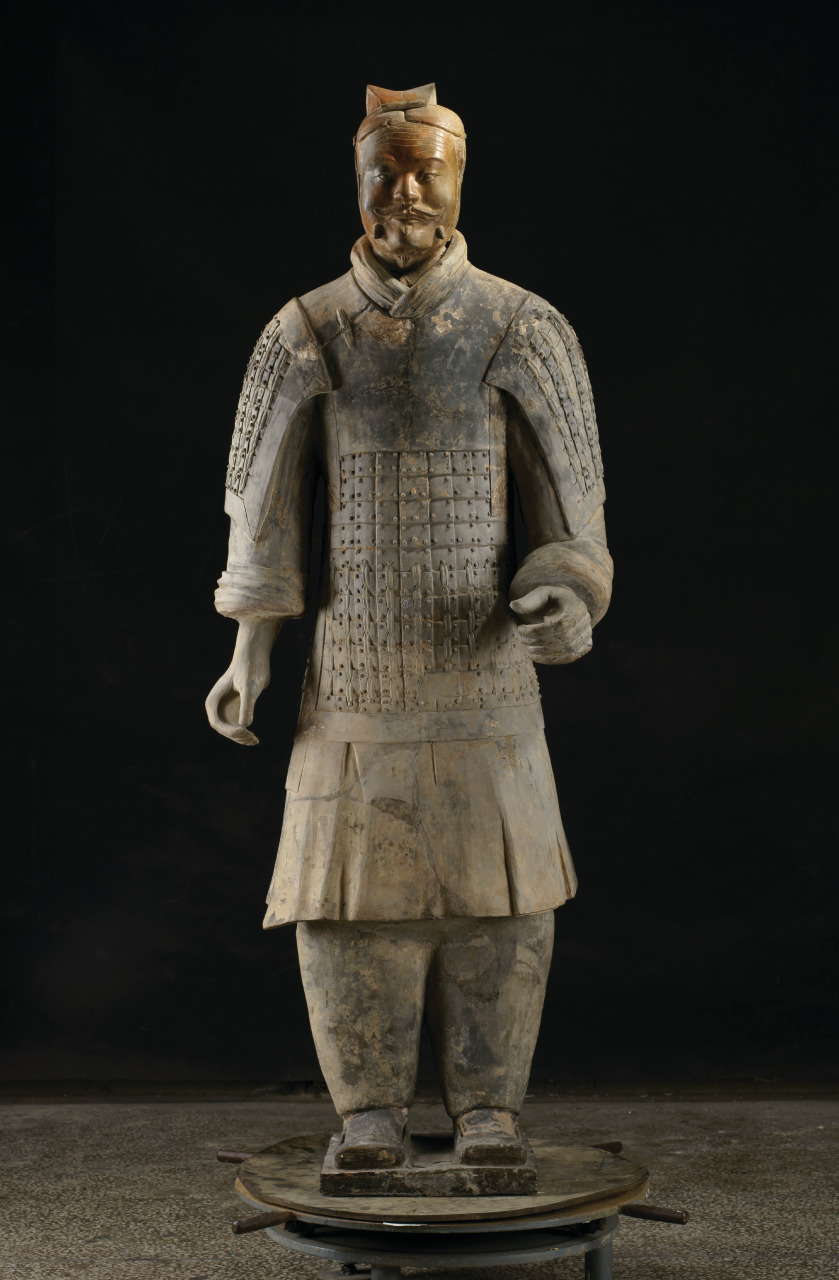
Perhaps you saw the news this week that Chinese officials are angered that someone has vandalized a Chinese terracotta warrior currently on display at the Franklin Institute in Philadelphia. Although the incident occurred in December, museum officials didn’t become aware of it until January.
It is not the same exhibition that will travel to Cincinnati Art Museum, “Terracotta Army: Legacy of the First Emperor of China” (April 20-Aug. 12).
According to reports, a 24-year-old Delaware man was attending an after-hours “Ugly Sweater” Christmas party at the Philadelphia museum, when he managed to take a “selfie” and allegedly also break off and steal the thumb of one of the statues. The FBI tracked him down and charged him with theft. That particular warrior is estimated to be worth $4.5 million.
The warriors are part of a vast trove of standing soldiers, one of the world’s most important archeological finds discovered in 1974. Created more than 2,000 years ago for a tomb in tribute to China’s first emperor, Qin Shi Huang, it is a UNESCO world heritage site outside of the city of Xi’an.
I decided to ask Cincinnati Art Museum what, if any, extra security precautions will be taken to protect these cultural treasures when they arrive in April from the Virginia Museum of Fine Arts, a partner in Cincinnati’s Terracotta Army exhibition.
Without revealing what security measures will be taken, Cincinnati “had a full security plan in place well before anything happened at the other exhibition,” says Jill Dunn, director of marketing and communications. “In addition, our exhibition is insured by U.S. Government Indemnity, which holds us to a higher standard for everything from security to climate control.”
In addition, she added that CAM has the ability to gate and lock the gallery exhibition space when not in use.
CAM’s exhibition is organized by the Virginia Museum of Fine Arts and the Cincinnati Art Museum, in partnership with Shaanxi Provincial Cultural Relics Bureau, Shaanxi Provincial History Museum, Shaanxi Cultural Heritage Promotion Centre, and Emperor Qin Shihuang’s Mausoleum Site Museum of the People’s Republic of China. For information about the exhibition, click here.
Discover more from janellesnotes
Subscribe to get the latest posts sent to your email.
