
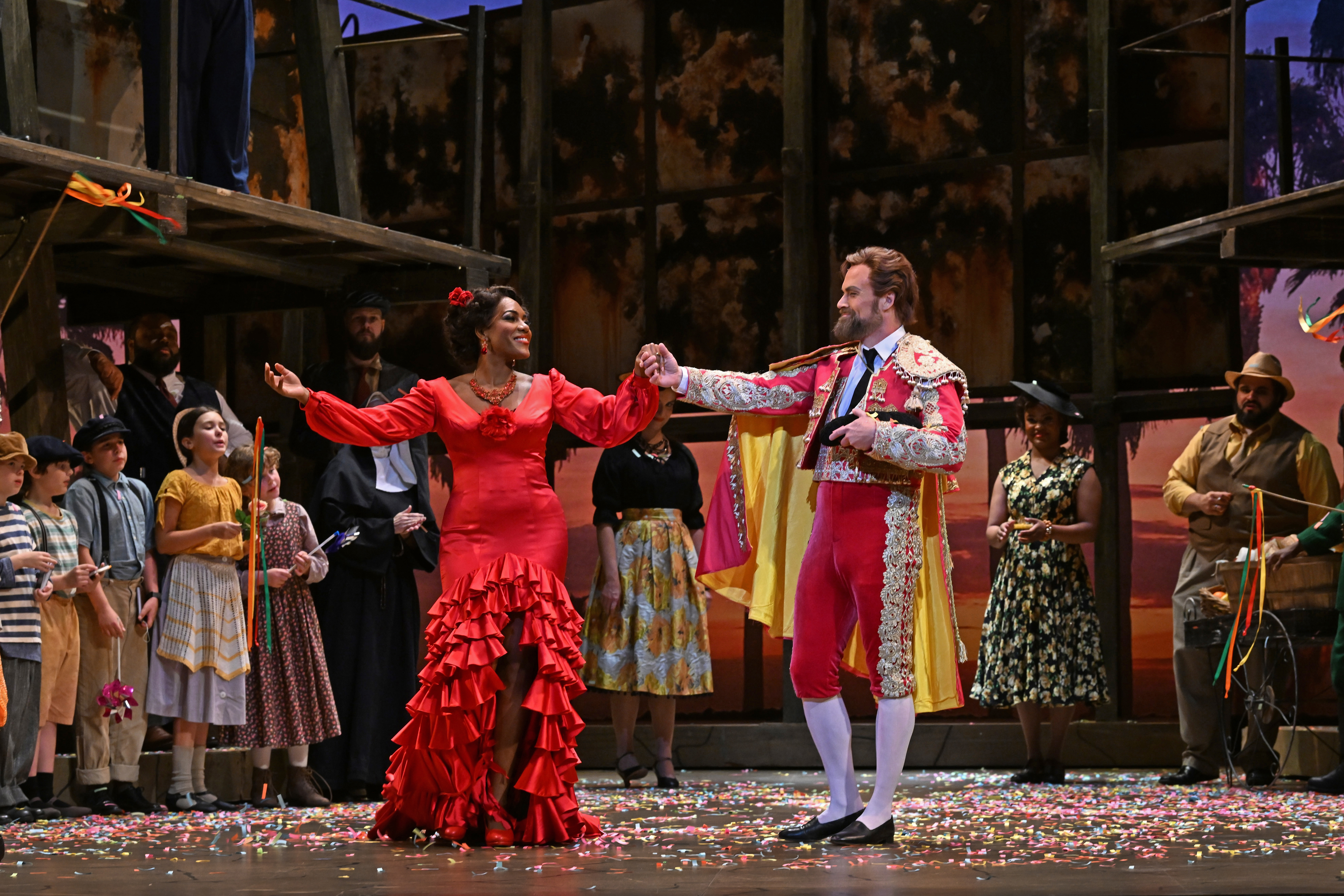
Georges Bizet’s “Carmen” is possibly the most popular opera ever written. Besides its dramatic story, you are left humming its gorgeous, unforgettable tunes days later. Cincinnati Opera has mounted productions of “Carmen” since it’s second season,1921, in Cincinnati Zoo Pavilion.
On July 25 in Music Hall, I saw the 179th performance of “Carmen,” opening night of the final opera of its mainstage season, with a fine cast and an engagingly updated co-production. Although the performance was sometimes uneven, there were many standout moments. For me, the highlight was Bizet’s musical score, given a spirited reading by the Cincinnati Symphony Orchestra in the opera pit under the baton of Spanish conductor Ramón Tebar.
Tebar led the orchestra briskly through the Prelude’s bright opening themes. When the music arrived at the “Fate” theme, the lights dimmed theatrically (Thomas C. Hase). The curtain rose on 1950s Havana, where the cigarette girls had to be unlocked from cage-like doors in order to take their factory break, perhaps a nod to Havana just before Fidel Castro came to power. The set designs by Gary McCann, who also designed the wonderful midcentury costumes, were charmingly evocative of old Havana. The heat was almost palpable in the saturated red lighting that simmered in the background against a painterly blue sky. The smuggler’s mountaintop hideout was a gloomy, abandoned warehouse with looming windows and a large doorway, through which the smugglers loaded their loot.
The title character, Carmen, performed by mezzo-soprano J’Nai Bridges, is a free-spirited femme fatale who seduces Don José and then dumps him for the toreador, Escamillo. In 2021, Bridges provided a glimpse of her gifts in an abridged “Carmen” with Cincinnati Opera. It was performed outdoors at Summit Park in Blue Ash, amplified and with Covid protocols in place.
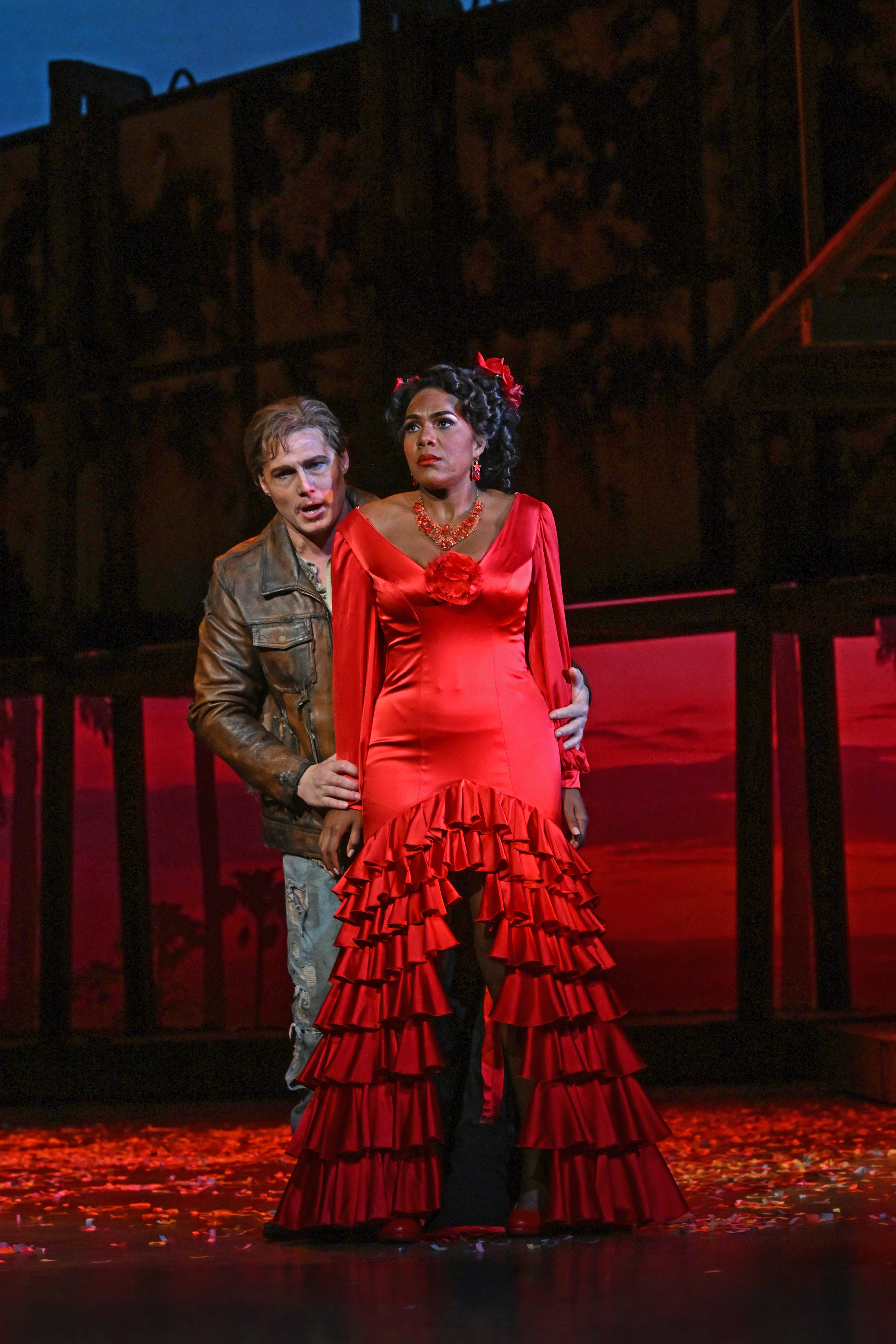
In this production, originally staged by Paul Curran and locally directed by Anderson Nunnelly, Carmen was more defiant than flirty or sensual. Bridges’ rich mezzo-soprano was pleasing in the upper register, although her lower phrases did not project well in the “Habanera.” Her Carmen had an edge – the director brought the factory spat vividly outdoors, as Carmen slapped a woman and yanked her hair. It was clear that men were putty in her hands as she tore off her apron down to a red dress for her sizzling “Seguidilla.”
Lillas Pastia’s Tavern was a cabaret, and Carmen was part of the show. She performed her “Chanson Bohème” with a microphone on a small stage, joined by her friends in stylized girl group pantomimes. Bridges’ finest moment was the Act 3 “Card Aria,” which she sang with chilling expression as she pulled the card of death. She defiantly stood up to a crazed Don José in her final scene until her inevitable death, which caused an audible gasp in the audience. (Spoiler alert: The libretto by Henri Meilhac and Ludovic Halévy is changed to make a shocking ending for Don José, too.)
Matthew White, who possesses an attractive, romantic tenor, was not entirely convincing as the besotted corporal Don José in his journey to complete obsession. There was little chemistry between the two lovers. But musically, he provided some of the finest moments of the evening, including the “Flower Song” (“La fleur que tu m’avais jetée”) where he poured out his heart with beautiful line all the way up to his exciting high notes. His Act 1 duet with Micaela was so touching, you almost wished there could be hope for them.
In her company debut, soprano Teresa Perrotta (who earned two degrees at the University of Cincinnati College-Conservatory of Music) was a sympathetic, sweet-toned Micaela, who embodied the ideal of the woman Don José’s mother wanted for her son. She sang ravishingly in her Act 3 air, “Je dis que rien ne m’épouvante,” a prayer for strength. It was an emotional performance, and the listener could revel in the orchestra’s accompaniment with softly-sounding horns.
Ryan McKinny was a charismatic Escamillo. The bullfighter made his entrance on a motorcycle wearing a leather jacket, and took the microphone to sing the “Toreador Song” in a firm bass-baritone voice. Sam Smith was excellent as Zuniga, communicating with a clear bass and a blustery presence.
Thomas Dreeze (El Dancairo) and Jack Keller (El Remendado) provided some comic relief as the smugglers. They were delightful in the patter quintet with Carmen and her friends, singing the praises of smuggling. Other standout performances included the witty card scene of Frasquita (Jeysla Rosario Santos) and Mércèdes (Kayleigh Decker) as they told their own fortunes.
The static direction of the some of the crowd scenes was enlivened by dancers from Cincinnati Ballet, choreographed by Cervilio Amador, artistic director of Cincinnati Ballet (who incidentally defected from Cuba). The updating worked to a point; some operagoers were confused by references in the libretto to Seville.
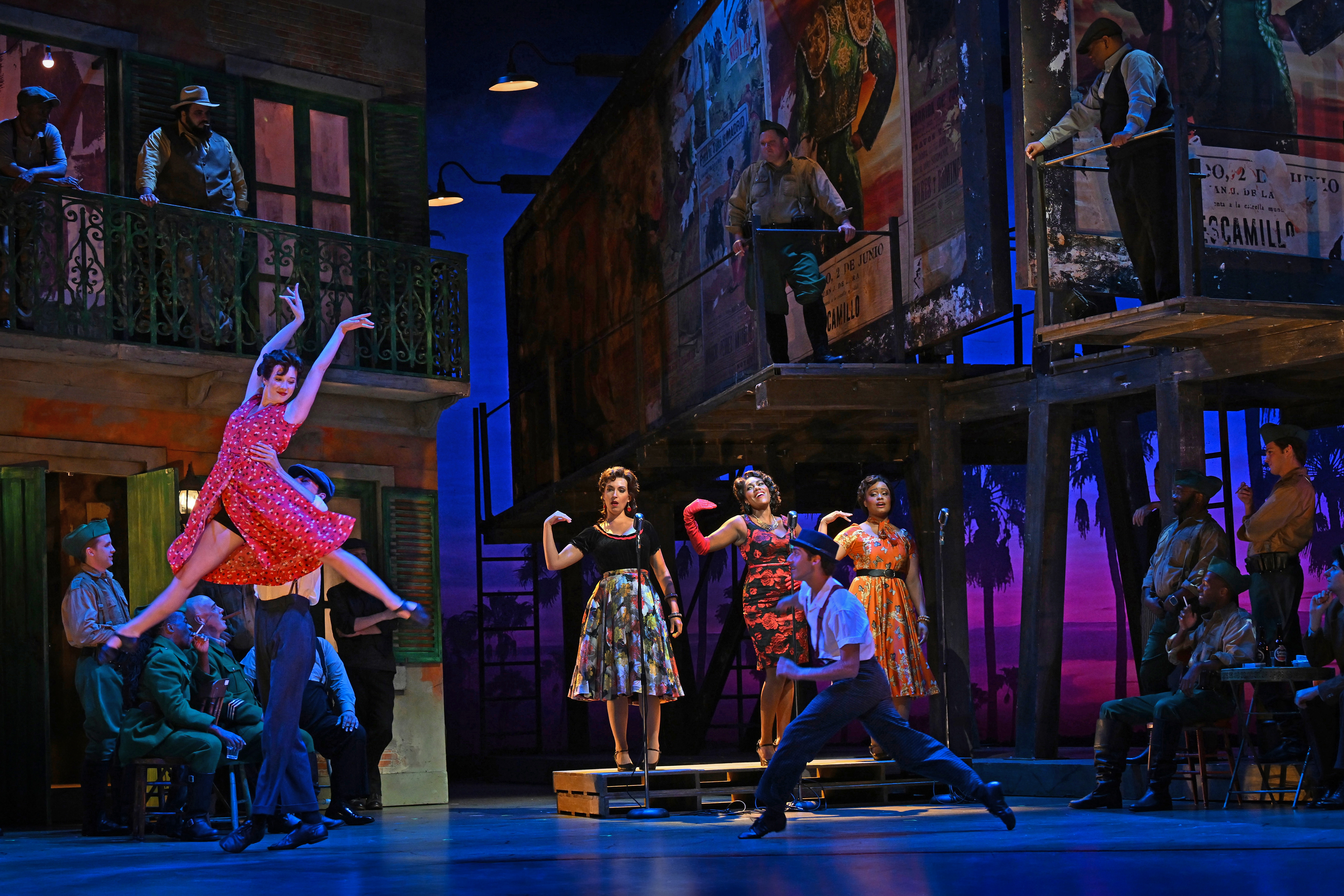
In the final two acts, momentum picked up considerably. Four dancers attired as toreadors (Piper Panek, Lionnis Del Toro, Zander Magolnick and Nicholas Motley) added bravado to the festive scene of the matador’s parade. The chorus, prepared by Henri Venanzi, sang with a robust sound and added vibrance throughout the opera, from supporting the “Toreador Song” to the chorus of smugglers. The youth chorus — Cincinnati Boychoir members under the direction of Jason Alexander Holmes and Andrew Miller — sang earnestly and won hearts as they taunted the soldiers in Act I, and later, as choirboys in a religious procession that began the parade to the arena.
The orchestra performed superbly and Tebar meticulously supported the singers while illuminating colors and details in the score. The prelude before Act 3, with its rapturous flute solo performed by Randolph Bowman, was magical. At the conclusion, the audience in the nearly full house rose with lengthy ovations.
“Carmen” continues on Wednesday, July 29 and Friday, July 31 and Sunday Aug. 2 in Music Hall. For times and tickets: 513-241-2742, cincinnatiopera.org.
Discover more from janellesnotes
Subscribe to get the latest posts sent to your email.
