
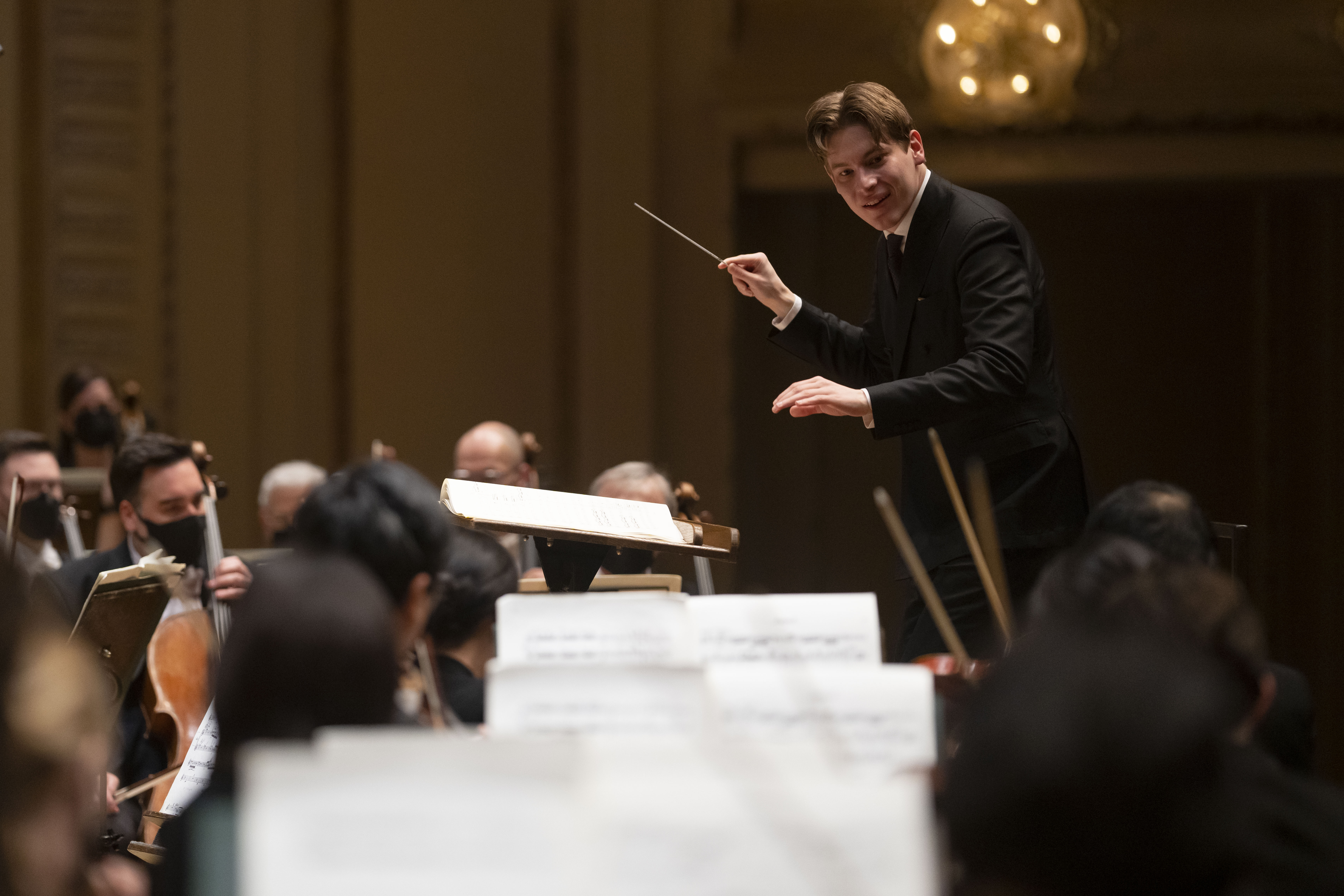
CSO — the other one — names Klaus Mäkelä as its next Music Director

Klaus Mäkelä is newly named Music Director Designate of the Chicago Symphony Orchestra 
© Todd Rosenberg Photography 2022

It’s the talk of the music world today. The Chicago Symphony Orchestra announced on April 2 that Finnish conductor Klaus Mäkelä, 28, will be the next Music Director of the CSO, the 11th in its 133-year history. The Chicago Symphony Orchestra Association (CSOA) Board of Trustees voted unanimously to approve the recommendation of the CSOA Music Director Search Committee.

(Our own CSO has said that an announcement will occur this spring…)

Following a term as Zell Music Director Designate effective immediately, Mäkelä will begin an initial five-year tenure in September 2027. In this role, he will conduct the orchestra a minimum of 14 weeks per season: 10 weeks of subscription and other concerts in and around Chicago, plus four weeks of domestic and international tours.
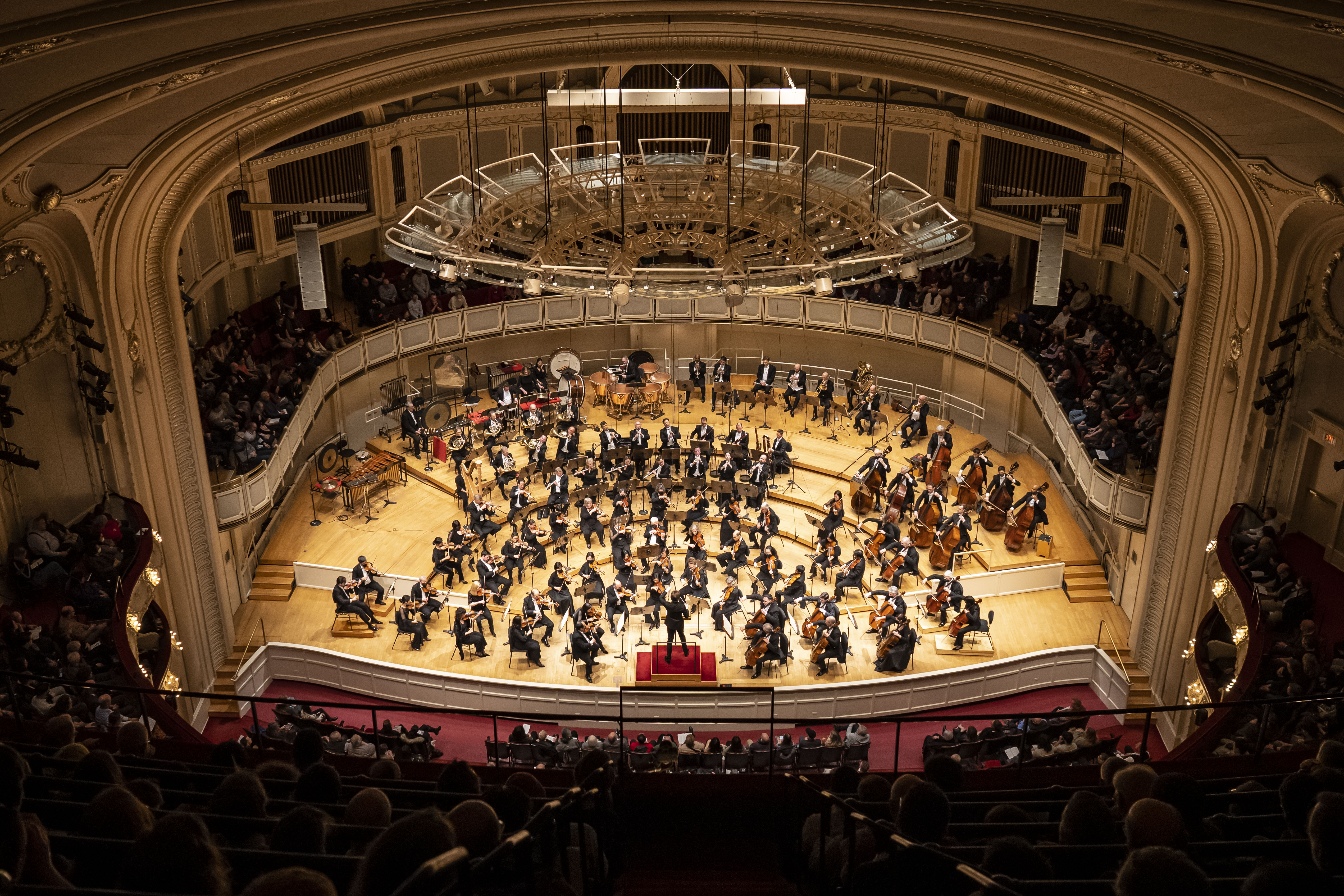

Klaus Mäkelä leading the Chicago Symphony in 2023 in Mahler’s Symphony No. 5 and other works.
© Todd Rosenberg Photography 2023

Currently music director of the Orchestre de Paris and chief conductor of the Oslo Philharmonic, Mäkelä is already one of the busiest conductors on the planet. His rise in the classical music industry has been meteoric. Mäkelä will be 31 when he begins his tenure at the start of the 2027-28 season. That will coincide with his inauguration as Chief Conductor of the Royal Concertgebouw Orchestra.  He explained in a statement released today:

“From 2027-28 my main responsibilities will be my partnerships with the Chicago Symphony Orchestra and Royal Concertgebouw Orchestra. Until then I remain committed to my ongoing collaborations with the Orchestre de Paris and Oslo Philharmonic. I look forward to all the music-making we have planned for the next three seasons and to returning to both institutions on a regular basis after my official tenures are completed.”

He is leading subscription concerts this week in Chicago, and will return for two concerts next season.

Mäkelä made his debut with the CSO in April 2022, to both critical and audience acclaim. When he returned to the CSO podium in February 2023, Classical Voice North America marveled at “the potent chemistry evident
between Mäkelä and the musicians, not to mention between Mäkelä and the audience, on both occasions.”

The orchestra’s president, Jeff Alexander, who worked in management for the Cincinnati Symphony before going to Chicago, noted Mäkelä’s “exceptional connection” with the musicians and his “ability to deliver extremely moving performances of a wide range of repertoire.”

In a statement, Alexander said, “As we got to know him off the podium and witnessed – in addition to his extraordinary musical talent – his passion for the artform, keen interest in music education and the legacy of the CSO, and innate ability to connect warmly and sincerely with our trustees, volunteers, concert attendees, donors, and administrative staff, it quickly became clear that he was the ideal choice to lead the orchestra into the future. I am delighted with this outcome.”

Throughout its distinguished history, the CSO has counted 10 of the most notable and respected conductors as music director. Theodore Thomas, of course, was founding music director of the Cincinnati May Festival, and Fritz Reiner was music director of the Cincinnati Symphony before going to Chicago:

Theodore Thomas (1891 to 1905)
Frederick Stock (1905 to 1942)
Désiré Defauw (1943 to 1947)
Artur Rodzinski (1947 to 1948)
Rafael Kubelík (1950 to 1953)
Fritz Reiner (1953 to 1962)
Jean Martinon (1963 to 1968)
Sir Georg Solti (1969 to 1991)
Daniel Barenboim (1991 to 2006)
Riccardo Muti (2010 to 2023)
 

Weekend in Chicago

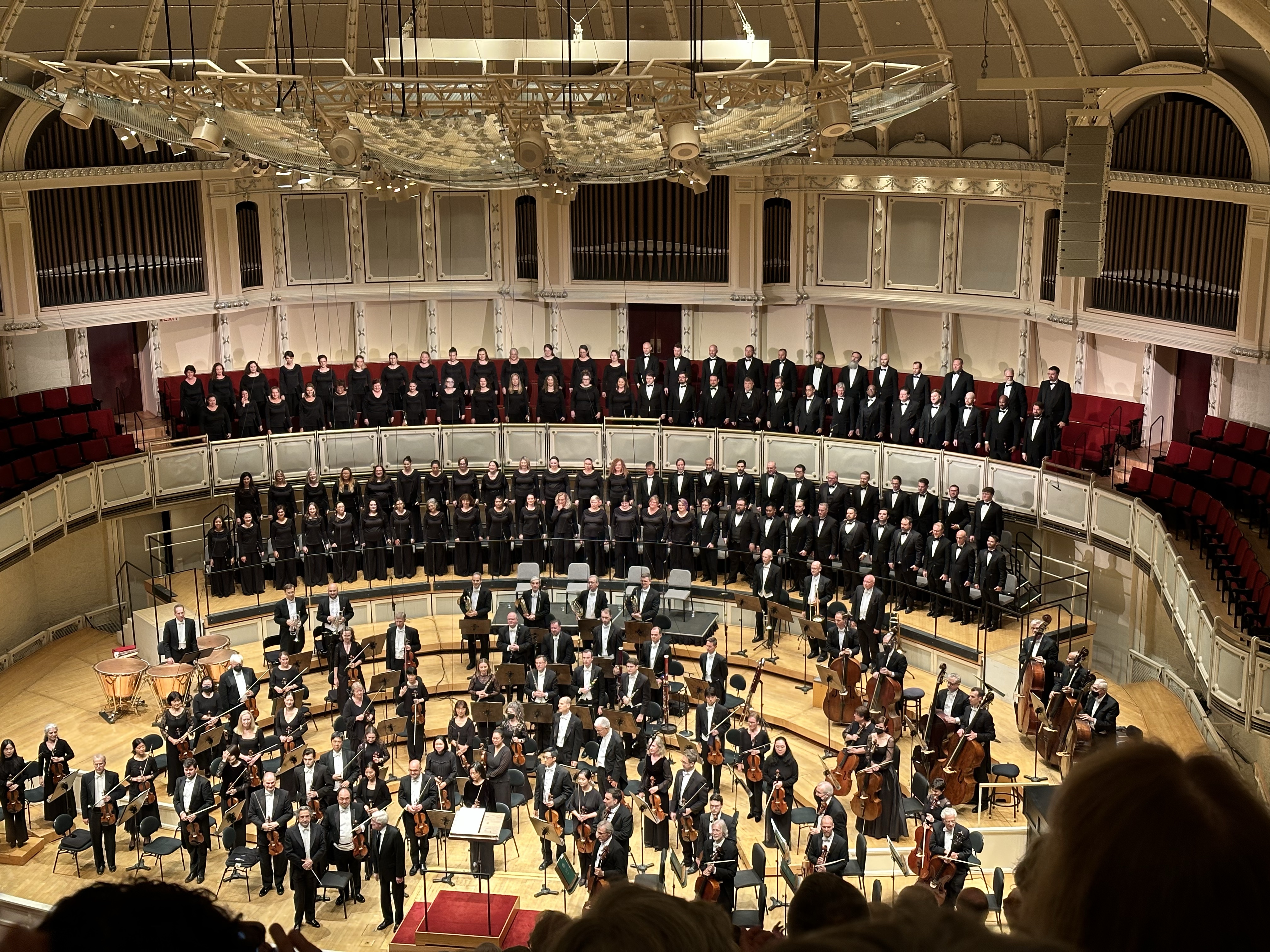
Muti and Palumbo taking bows following a superb performance of Beethoven’s Missa Solemnis.

A couple of weeks ago, I was able to visit Chicago for the annual meeting of the Music Critics Association of North America. It’s always eye-opening to revisit a city with exceptional arts. On this occasion, we visited Orchestra Hall for the final — and deeply moving — program led by Chicago Symphony Orchestra music director Riccardo Muti, Beethoven’s Missa Solemnis. We also went to Haymarket Opera Company at DePaul University for a rare mounting of Johann Hesse’s Marc’Antonio e Cleopatra. And on the lighter side, there was Leonard Bernstein’s West Side Story at Lyric Opera of Chicago. All of that in two days, as well as our own panel discussions … Below are some of my random impressions.

Muti and Missa Solemnis –It’s interesting that with his distinguished career, Muti, 81, had not felt “ready” to conduct the Missa Solemnis until recently. (His only other performance was with the Vienna Philharmonic in Salzburg in 2021.) “I felt not worthy even to touch the score,” he said in an interview with program annotator Phillip Huscher. He quoted Carlos Kleiber, who said, “There is some music that is better if it stays on the paper.”

Whether because of Muti’s solemn view of this work, or because it was his final set of concerts, Muti’s reading was deeply reverent, even meditative at times. I was instantly struck by the warmth and stunning ensemble of the strings in the opening Kyrie. The sound of the Chicago Symphony Chorus, prepared by the Met’s Donald Palumbo, was hushed but full. The four excellent soloists (Erin Morley, Alisa Kolosova, Giovanni Sala and Kyle Ketelsen) phrased seamlessly in a flowing legato. The Gloria was an exuberant contrast, with short attack in orchestra and chorus and an electrifying fugue. The clarity in the acoustical space of Orchestra Hall was stunning — I could hear every word. Powerful outbursts had a kind of controlled brilliance. Muti moved little as he conducted, and the music breathed from beginning to end. (I invite you to read the full review by my MCANA colleague Arthur Kaptainis on Classical Voice North America.)

I was thinking during the performance of the many connections between Cincinnati and Chicago. There was, of course, Theodore Thomas, who founded the Cincinnati May Festival in 1873 and was founding director of the College of Music (later CCM) before becoming the founding music director of the Chicago Symphony Orchestra in 1891. Fritz Reiner was CSO music director before going to Chicago. The current principal cellist, John Sharp, was formerly principal cellist of the Cincinnati Symphony. (I’m sure that some of you will think of other connections.)

And the Chicago Symphony’s current president Jeff Alexander was formerly with the Cincinnati Symphony. Alexander praised Muti’s 13-year tenure and he and the board chair announced that he will be “Music Director Emeritus for Life.” To the audience’s delight, Muti spoke engagingly about his time in Chicago, displaying quite a sense of humor.

It will be interesting to follow Chicago’s music director search, even as the Cincinnati Symphony Orchestra is also searching.

Thoughts on the operatic productions I saw in Chicago to follow…


Michael Gielen championed modern music, led CSO through the ’80s

Michael Gielen was the CSO’s 10th music director. Photo courtesy of the Cincinnati Symphony Orchestra

The distinguished German-born conductor Michael Gielen, who led the Cincinnati Symphony Orchestra in the 1980s, died of pneumonia on March 8 at his home in Mondsee, Austria. He was 91.

Gielen was appointed the 10th music director of the Cincinnati Symphony Orchestra, serving from 1980 to 1986. He succeeded music adviser Walter Susskind, who stepped in for two seasons following the untimely death of Thomas Schippers in 1977.

An ardent champion of contemporary music, Gielen was one of the most important conductors of his generation.

As a music director, Gielen’s preference for programming the music of the Second Viennese School didn’t always endear him to Cincinnati audiences. But during his tenure, his discipline and exceptional ear became legendary, and the orchestra achieved new heights as a polished performing ensemble.

“Many felt that, through no fault of its own, the orchestra had lost some of its technical edge. Though his tenure was a brief six years, Michael’s strong, consistent artistic leadership restored the CSO’s luster and musical discipline,” said David Loebel, associate conductor of orchestras at the New England Conservatory, who was Gielen’s assistant conductor during his tenure.

“Many bristled at his demanding programs, which were meant to challenge and enlighten rather than merely entertain,” Loebel said. “Those who attended one of his CSO concerts expecting to relax and have pretty sounds wash over them were bound to be disappointed. Those willing to be exposed to worthwhile music they had never heard and to discover new things about the music they already knew, usually left exhilarated.”Read More »