
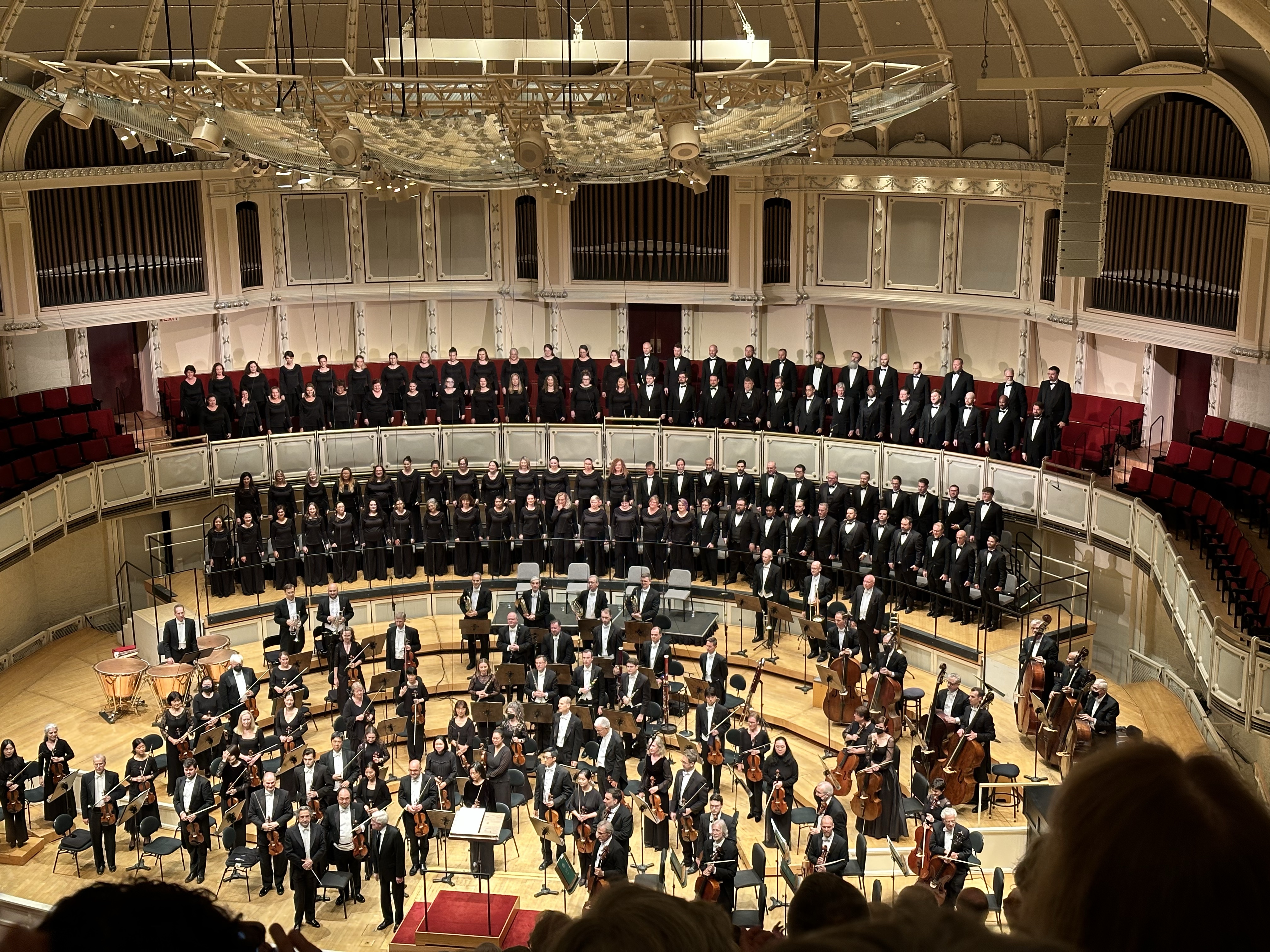
A couple of weeks ago, I was able to visit Chicago for the annual meeting of the Music Critics Association of North America. It’s always eye-opening to revisit a city with exceptional arts. On this occasion, we visited Orchestra Hall for the final — and deeply moving — program led by Chicago Symphony Orchestra music director Riccardo Muti, Beethoven’s Missa Solemnis. We also went to Haymarket Opera Company at DePaul University for a rare mounting of Johann Hesse’s Marc’Antonio e Cleopatra. And on the lighter side, there was Leonard Bernstein’s West Side Story at Lyric Opera of Chicago. All of that in two days, as well as our own panel discussions … Below are some of my random impressions.
Muti and Missa Solemnis –It’s interesting that with his distinguished career, Muti, 81, had not felt “ready” to conduct the Missa Solemnis until recently. (His only other performance was with the Vienna Philharmonic in Salzburg in 2021.) “I felt not worthy even to touch the score,” he said in an interview with program annotator Phillip Huscher. He quoted Carlos Kleiber, who said, “There is some music that is better if it stays on the paper.”
Whether because of Muti’s solemn view of this work, or because it was his final set of concerts, Muti’s reading was deeply reverent, even meditative at times. I was instantly struck by the warmth and stunning ensemble of the strings in the opening Kyrie. The sound of the Chicago Symphony Chorus, prepared by the Met’s Donald Palumbo, was hushed but full. The four excellent soloists (Erin Morley, Alisa Kolosova, Giovanni Sala and Kyle Ketelsen) phrased seamlessly in a flowing legato. The Gloria was an exuberant contrast, with short attack in orchestra and chorus and an electrifying fugue. The clarity in the acoustical space of Orchestra Hall was stunning — I could hear every word. Powerful outbursts had a kind of controlled brilliance. Muti moved little as he conducted, and the music breathed from beginning to end. (I invite you to read the full review by my MCANA colleague Arthur Kaptainis on Classical Voice North America.)
I was thinking during the performance of the many connections between Cincinnati and Chicago. There was, of course, Theodore Thomas, who founded the Cincinnati May Festival in 1873 and was founding director of the College of Music (later CCM) before becoming the founding music director of the Chicago Symphony Orchestra in 1891. Fritz Reiner was CSO music director before going to Chicago. The current principal cellist, John Sharp, was formerly principal cellist of the Cincinnati Symphony. (I’m sure that some of you will think of other connections.)
And the Chicago Symphony’s current president Jeff Alexander was formerly with the Cincinnati Symphony. Alexander praised Muti’s 13-year tenure and he and the board chair announced that he will be “Music Director Emeritus for Life.” To the audience’s delight, Muti spoke engagingly about his time in Chicago, displaying quite a sense of humor.
It will be interesting to follow Chicago’s music director search, even as the Cincinnati Symphony Orchestra is also searching.
Thoughts on the operatic productions I saw in Chicago to follow…
Discover more from janellesnotes
Subscribe to get the latest posts sent to your email.
