
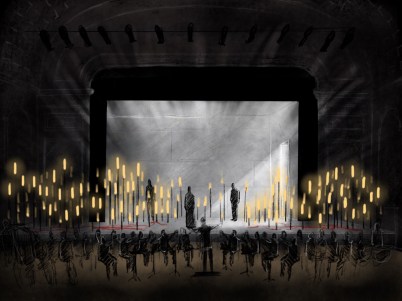
James Darrah likes to point out that he has curated the Cincinnati Symphony Orchestra’s “Pelleas Trilogy” in three different phases of Music Hall’s renovation.
CSO music director Louis Langrée’s three year project exploring Maurice Maeterlinck’s 1893 play, “Pelléas et Mélisande” began with Arnold Schoenberg’s tone poem in Music Hall – pre-renovation. It continued last year with Gabriel Fauré’s incidental music to the play when the orchestra was displaced at the Taft Theater.
This weekend, the project culminates in Debussy’s “Pelléas et Mélisande” in the newly renovated Music Hall. The performance is in collaboration with Cincinnati Opera.
“It’s been really fun to bring an opera to life in this space,” says the Los Angeles-based director and designer. “We’re all still learning what we can and can’t do (in the theater). Some things are familiar and some different.”
It will be a concert presentation, meaning that the orchestra will be onstage with the singers, and not in a pit. What’s different, Darrah says, is having the orchestra on a thrust stage – 12 feet farther into the hall than previously. Because of that, the opera will take place “360 degrees” around the orchestra.
“We’ve created an intentionally simple design that wraps around it, so it’s a way to bring the performers very close to the performers,” he says.
Langrée calls it his “desert island” piece. And Debussy’s opera is not like traditional opera, but more abstract, Darrah points out. It is full of mystery and rich with symbolism. His challenge was finding a way to tell a story that is atmospheric and ambiguous but also very human.
In Maeterlinck’s tale (which the composer adapted for his libretto), Golaud happens upon Mélisande, lost and weeping by a stream. He takes her home to his castle and marries her. But gradually, there is a mutual, and ultimately fatal, attraction between Mélisande and Golaud’s half-brother, Pelléas.
“The opera is so not about Rapunzel throwing down her hair,” Darrah said, describing a scene in which Mélisande’s hair cascades down from her window. “These things described in the text are metaphors and intangibles. It’s all about being enigmatic, almost an abstraction. It requires everyone to buy into that.”
In some ways, Debussy’s opera is more suited to a concert version than a traditional staging. To Darrah, it feels a bit like Greek theater.
“They’re all real people in real situations. But you’re creating a ritualization of the piece and finding a way visually to bring it into the space, without overwhelming it or creating a detailed, more operatic context,” he says.
Projections designer Adam Larsen, also a collaborator in the three-year project, will help to create some of that surreal, dream-like feeling.
“At times he’s projecting texture or a certain color or a general feeling, that might have a slight movement to it,” Darrah says. “And he’s creating those to provide shifts of emotional tone.”
It will be the first time an audience hears singers in the newly-renovated hall. Sometimes they are elevated on platforms behind the stage. Langrée and the orchestra will have lighting and be a prominent part of the production.
All of that will create atmosphere around one of Debussy’s most voluptuous scores.
“It’s all about shadow and illumination and seeing some things or hearing somebody’s voice before you see them,” he says. “I think that’s going to be a different experience for the audience.”
The Cincinnati Symphony Orchestra perfoms Debussy’s “Pelléas et Mélisande” in collaboration with Cincinnati Opera, 8 p.m. Friday and Saturday in Music Hall. 513-381-3300, cincinnatisymphony.org.
Watch for my review to post on Monday.
Discover more from janellesnotes
Subscribe to get the latest posts sent to your email.
