
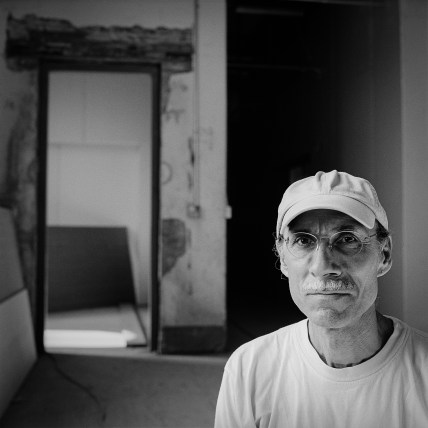
You’ve seen double bassist Matthew Zory performing in a tux with the bass section at the back of the Cincinnati Symphony Orchestra each week since he joined the orchestra in 1993.
But maybe you don’t know that for 16 months, Zory was inside Music Hall’s construction zone, wearing a hard hat with his camera slung over a shoulder, documenting the $143 million renovation project from the basement to the Rose Window.
“I could go anywhere, wherever I wanted,” said Zory, “When there were guys working overhead, they would put up danger tape. I know it’s a standard construction site — there were holes in the floor and no rails up yet. But the (construction crew) would help me out.”
What began as curiosity and a hunt for “cool pictures” by Zory, who “dabbles in photography,” evolved into a substantial photography book documenting the process and the people behind Music Hall’s renovation.
“Through the Lens: The Remaking of Cincinnati’s Music Hall,” a limited edition by Cincinnati Book Publishing, will be available Dec. 1.
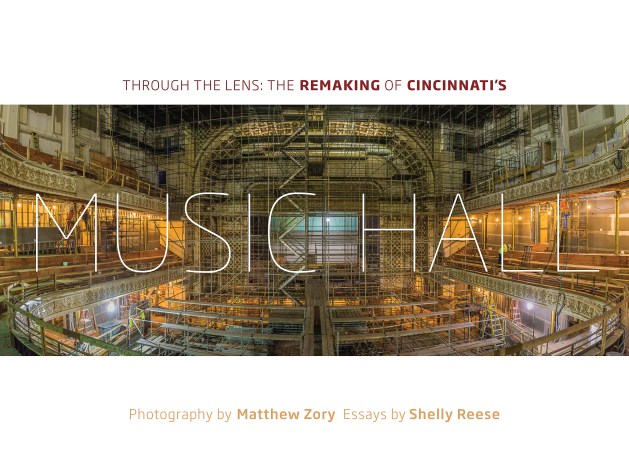
Zory was feeling “kind of wistful,” as the project wrapped up. He had been in parts of the hall that were never seen by the public but which, he felt, were “beautiful in their deconstructed state.” Depending upon his schedule with the CSO and Pops, he was in the building two to four times per month with his camera.
On Music Hall’s opening night, Oct. 6, Zory was stationed with his tripod aimed at Music Hall’s front door as concertgoers streamed in for a first look.
“It would have been nice to have (the book) ready opening week, but then the final chapter would not have been written,” he said.
He had not planned a book, but rather, “backed into” the project. It started during the final concerts of the May Festival in 2016, just before the hall closed. Zory began thinking that when the construction crew began tearing the place apart, he might be able to capture some “cool pictures.” He received permission to hang around as workers began, literally the next day, removing chairs and light fixtures and starting demolition.
“It wasn’t until I got into the basement, where they were doing serious demolition. using torches and taking out stuff such as boilers that hadn’t been used for generations, that I thought this is cool. I’m in,” he said.
Initially, Zory had been interested in only shooting artistic scenes of light, color and perhaps abstract shapes. His photos were so good that the Cincinnati Symphony and the project manager Cincinnati Center City Development Corp. (3CDC) began using some of them for publicity.
At first, the Long Island, N.Y. native had not realized how important Music Hall was to the people of the city.
“I don’t have that coming-of-age experience with the city or the hall. But local folks were saying, ‘This is important to us. You should continue documenting it,’” he said.
When the idea of a book surfaced, Zory approached Jack Rouse, the businessman and arts patron who initially headed the Music Hall Revitalization group. Rouse suggested they find a way to fund the project. Patrons jumped on the idea, including Trish Bryan, who, with her husband Rick, endowed Zory’s chair in the orchestra.
Most surprising to Zory, the project’s contractors also wanted to be involved as a testament to “the hard work of the workers and their commitment to the community,” he said.
“Once the majority of the funding came from the contractors who were actually doing the work, I felt an obligation that I needed to tell the story somewhat sequentially of the work that went on here,” he said.
He was felt compelled to follow some of the men and women, deciding to do portraits of them at work.
“I’ve been so impressed with how dedicated and focused they are. There’ve been many lighthearted moments, but these guys are working hard for long hours,” he said.

Creating a book would involve much more than just shooting photos. Zory soon realized that he had to get organized. Zory’s wife, Shelly Reese, wrote essays for each chapter and served as project manager. Reese, who owns her own communications company, previously was a business writer for the Cincinnati Enquirer and USA Today.
“On Monday morning, she’d have a to-do list on my desk for the week,” he said. “All the organization I don’t have, she does.”
Zory compares his effort to another, three-year project, “The Other Side of Music Hall,” for which he photographed the people who live and work in the neighborhood around Music Hall. That project was both a book and an exhibition.
“The irony is, I come to work, where very wealthy people pay my salary, we play in tails and that in no way reflects the community,” he said. “In some ways, the worker portraits are sort of a bookend to that. A lot of these people have never been in Music Hall. It’s a different world from what we’re used to.”
For 16 months, he’s made connections and heard the stories of the workers’ lives, their careers and their kids. Those personal stories will go untold, unfortunately.
But he’s happy to have been able to record them as they worked, and to document the process that has transformed a Cincinnati landmark.
“A guy said to me, ‘Man, I’m really glad to have been part of this,’” Zory said. “It’s been cool, and I’ve been lucky and I’m grateful about that.”
To purchase or reserve your copy ($49.95 plus shipping), visit matthewzory.com or visit Music Hall’s new Bravo Shop (as well as local bookstores) in December.
Zory will be speaking at Joseph Beth Booksellers on Dec, 11 and at the Mercantile Library on Dec. 5. Check venues for times.
Discover more from janellesnotes
Subscribe to get the latest posts sent to your email.
