
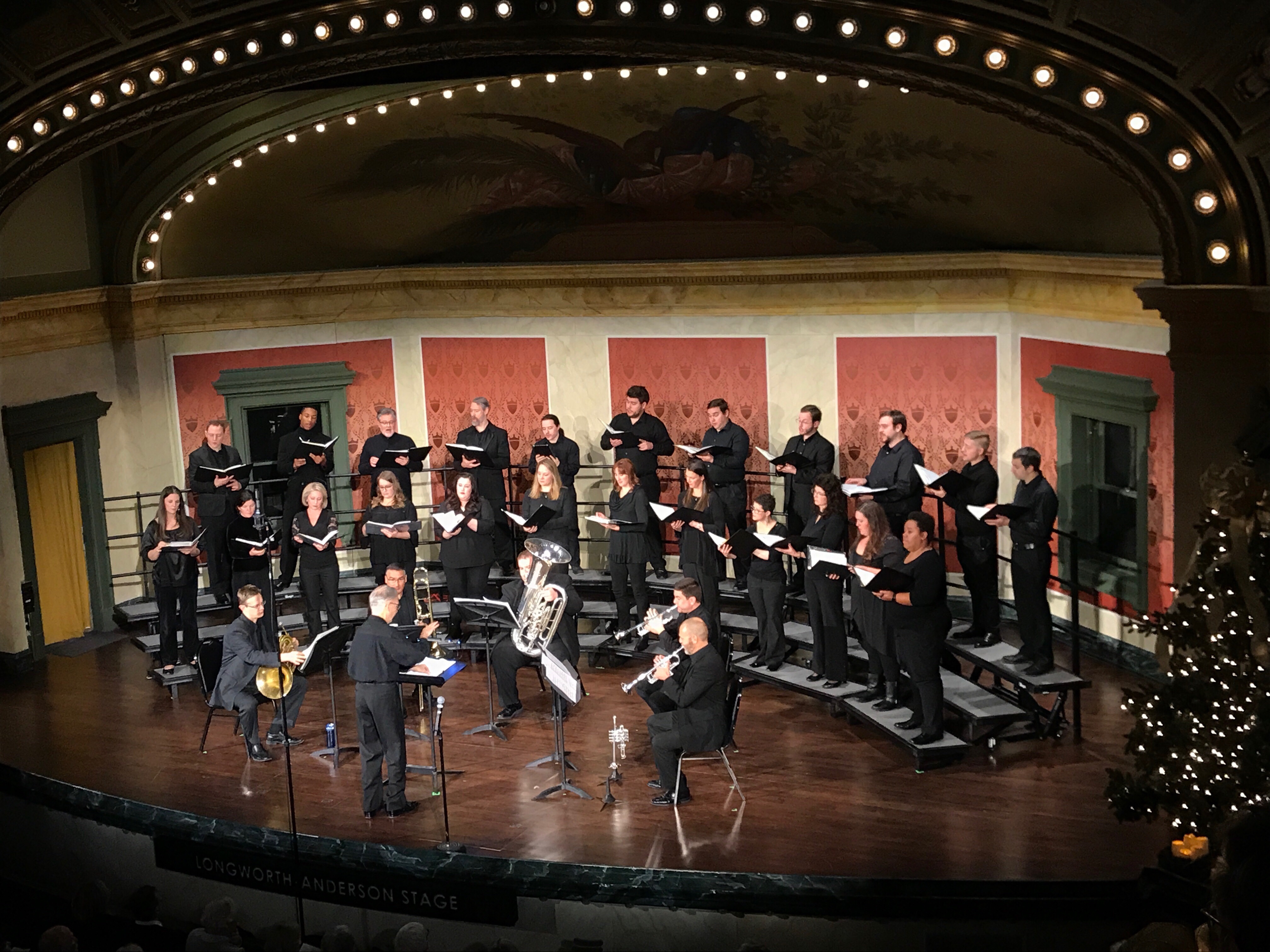
The Vocal Arts Ensemble’s annual Candlelit Christmas concert offered transformative choral treats spanning centuries and continents.
Sunday’s concert in Over-the-Rhine’s Memorial Hall was packed – the third sellout of the season. And small wonder. The all-professional vocal ensemble has developed a following for its inventive programs and peerless execution.
With the collaboration of the Canterbury Brass, this program captured the holiday spirit with a few entertaining and humorous selections, too. Who could ever forget the brass quintet’s “Twelve Days of Christmas”? The clever arrangement by Howard Cable altered the lyrics to include “some brass music on a CD,” with a dozen snippets from the classical hit parade played by the brass musicians between verses. The audience cheered.
Emeritus music director Earl Rivers, who led VAE from 1998 to 2008, was the conductor and host. (The VAE is currently led by Craig Hella Johnson.) Also the well-known director of choral studies at the University of Cincinnati College-Conservatory of Music and director of music at Knox Church, Rivers gave informative insights to the audience between numbers, and wrote excellent program notes and translations.
It was a jewel-like setting to hear this radiant music. The elegantly renovated hall was decorated with two sparkling Christmas trees flanking the stage and garlands of sparkle lights on the balcony front. There were no candles for the candlelit concert (likely due to fire marshal laws), but when the lights dimmed, the sparkle lights achieved the desired effect.
The 24-member ensemble opened on a spiritual note, with Estonian composer Arvo Pärt’s “Sieben Magnificat-Antiphonen.” They performed five of Pärt’s seven pieces, inspired by the “O” Antiphons sung before or after the Magnificat at Evensong in the days leading up to Christmas.
Sung a cappella in German, the music transported the listener to a different place. The opening “O Weisheit” (O Wisdom) was mystical and quiet, with a melody that repeated like tolling chimes. The singers caught its atmospheric beauty, soaring easily through the sometimes dissonant harmonies.
A modern arrangement (Joshua Shank) of a Basque carol, “Gabriel’s Message,” was an example of the stunning blend and expressive artistry of these singers. The first half included English Renaissance composers Thomas Tallis and William Byrd. The seamless polyphony of Tallis’ six-part “Videte miraculum” (Behold the miracle), sung quietly in a semi-circle, glowed in this space.
Byrd’s “This Day Christ Was Born” contrasted as a joyous anthem, colored by pure-toned sopranos.
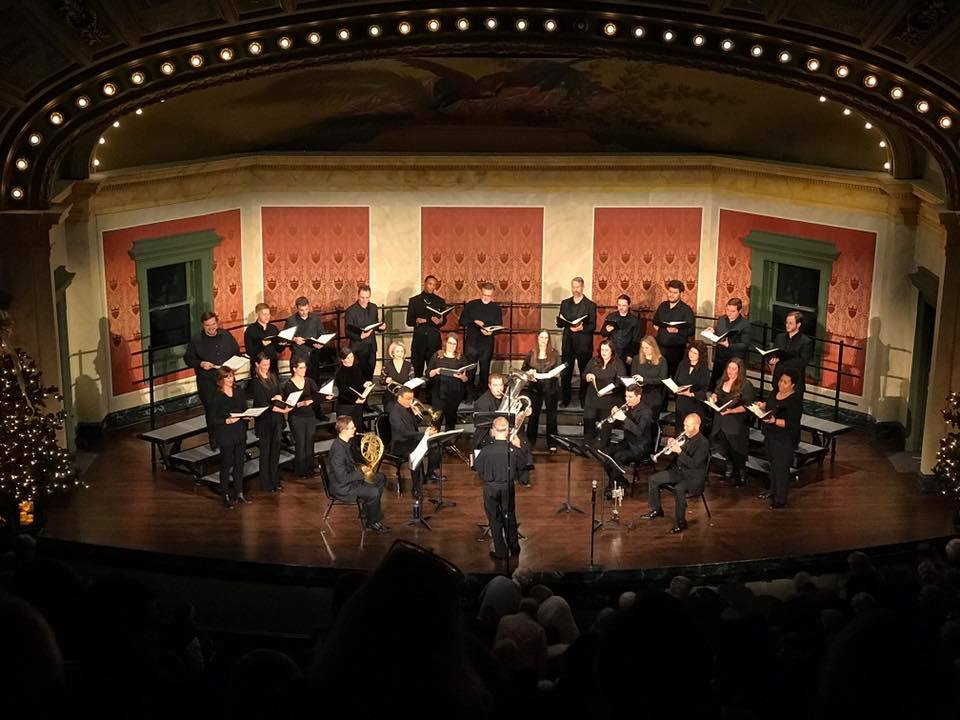
Announcing that “we’re living in a golden age of a cappella choral music,” Rivers introduced a set by emerging Norwegian composers Kim André Arnesen and Ola Gjeilo. Arnesen’s “The Lamb,” a setting of texts by William Blake, was a simple yet well-crafted hymn, and Rivers’ spacious tempo added a sense of reverence. An inspiring a cappella arrangement by Gjeilo of “In the Bleak Midwinter” was restorative and lovely.
Lighthearted numbers included Swingle Singers founder Ward Swingle’s “A Visit from St. Nicholas,” accompanied by the brass quintet. (It’s too bad that the brass overpowered the singers, the risk of a small theater.)
Another audience hit occurred after intermission in the medieval Spanish carol, “Ríu ríu, chíu.” The singers were embedded within the audience, providing a “surround sound” experience as they sang, accompanied only by a tambourine. It was a theatrical stroke that surprised and delighted listeners.
VAE soloists shone in several numbers, including a set of French carols. Krista Cornish Scott’s lyrical tone was an asset to the reflective “Noël c’est l’amour” (Christmas is love), sung a cappella. The lively and familiar carol “Il est né” (He is born), given a modern twist by Canadian arranger Derek Holman, was charming.
The Canterbury Brass – Brian Buerkle and Dan Grantham, trumpet; Aaron Brant, French horn; José Mangual, trombone; and Preston Light, tuba – impressed in their own arrangements of “Carol of the Bells” and the March from “The Nutcracker,” which they performed with flair and considerable virtuosity.
For the finale, “Deck the Halls,” Rivers coached the audience to sing the “fa-la-la-la-la” refrain, for their broadcast debut when WGUC (90.9 FM) airs the entire concert at 7 p.m. on Thursday.
Discover more from janellesnotes
Subscribe to get the latest posts sent to your email.
