
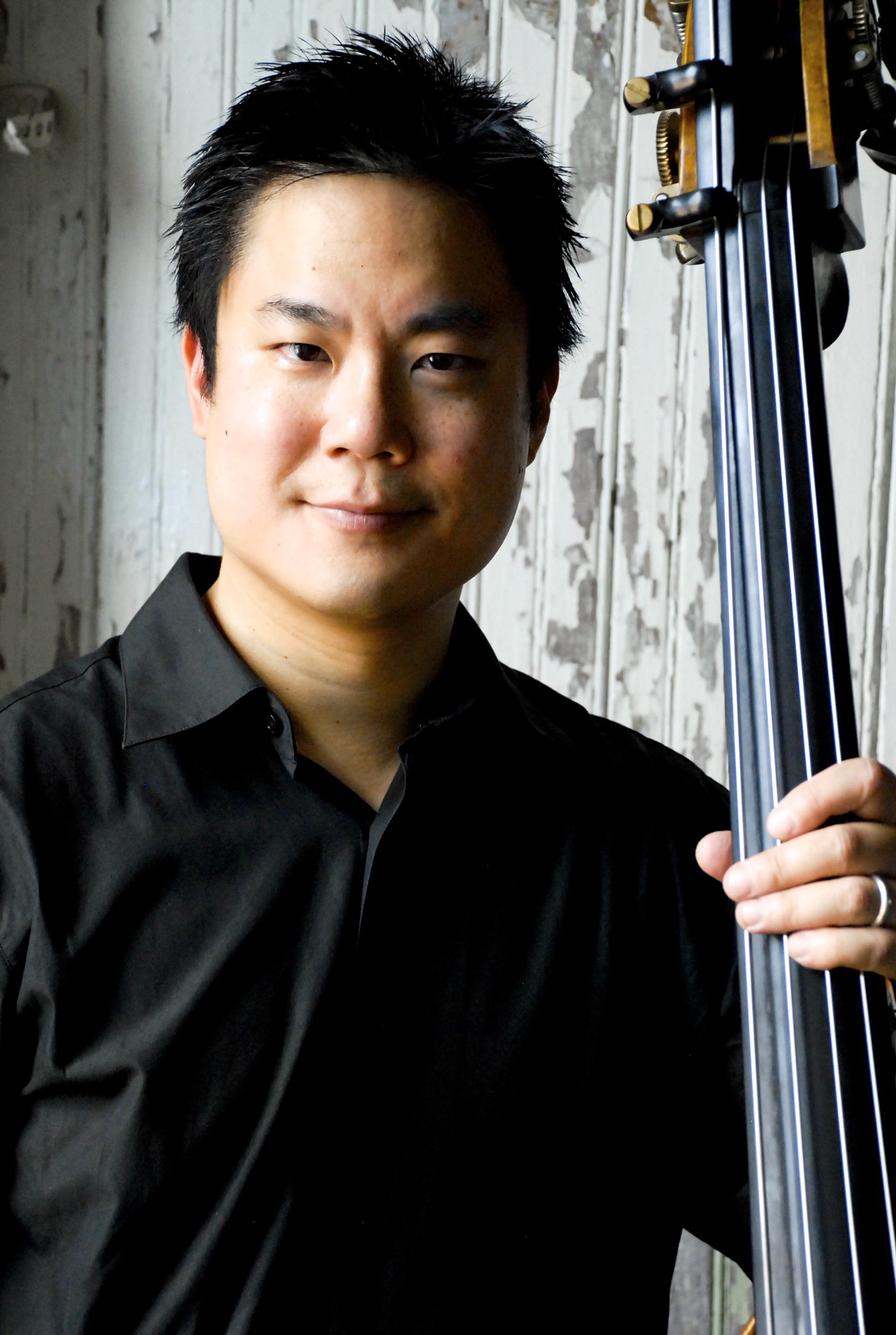
Owen Lee came to Cincinnati 22 years ago to take the post of principal bass of the Cincinnati Symphony Orchestra. This weekend, Lee will come out from the bass section that he leads to perform the CSO’s premiere performance of Serge Koussevitzky’s Concerto for Double Bass.
This will be his fourth concerto appearance with the orchestra. He was soloist in Giovanni Bottesini’s Concerto No. 1 in 1998; played Estonian composer Eduard Tubin’s Concerto under then-music director Paavo Järvi, and about 11 years ago, performed a concerto by John Harbison that was co-commissioned by the CSO.
You’ve probably also seen him around town in chamber music performances, or perhaps at the University of Cincinnati College-Conservatory of Music, where he serves on the faculty. Or maybe you’ve caught him playing keyboard in the Cincinnati rock band Electric Citizen.
The Berkeley, CA native grew up in Southern California and now lives in Montgomery. He spoke about Koussevitzky, the bass concerto and the cadenza that he wrote for the piece, over lunch at Half-Day Café in Wyoming.
Question: What is your experience with Koussevitzky’s concerto?
Answer: It’s one of the first concertos I ever learned. Every bass player learns it. Koussevitzky is only remembered as a fantastic conductor of the Boston Symphony. As an instrumentalist, he’s a hero among bass players. He’s one of the greatest bass players who ever lived.
Q: Can you give us a thumbnail history of great bass players?
A: Not many bass players have made it as a virtuoso soloist. In Beethoven’s time, there was Domenico Dragonetti. The difficult bass parts in Beethoven symphonies were written with Dragonetti in mind, because he was the principal bass player in Vienna.
Then there was Giovanni Bottesini, who was also a great conductor and Verdi’s close friend. He conducted the world premiere of Verdi’s opera, “Aida.” And then there was Koussevitzky.
In our time, there are Gary Karr and Edgar Meyer. It’s a fascinating world.
Q: Koussevitzky was also a major supporter of new music while he was music director in Boston, wasn’t he?
A: Yes, he personally commissioned Bartok’s Concerto for Orchestra (also being performed on this CSO program). Bartok was sick and Koussevitzky came to his hospital room and put a check on his bedside table, and that was a shot in the arm for Bartok. Koussevitzky conducted its world premiere.
He doesn’t’ get enough credit, first as a bass player, second as a composer, third as a teacher. He founded Tanglewood Music Center, and one of his students was Leonard Bernstein. He was really a renaissance man.
Q: But he never wrote a cadenza (a flashy solo played alone) for this concerto. How hard was it to write your own?
A: It came about pretty naturally. I think my first idea was (to use) the second theme in the first movement, and to turn it upside down, kind of like Schoenberg inversions. I’m really not much of a composer. When you’re composing a cadenza, it’s sort of like being a jazz musician. You’re jamming on something that’s already there.
Q: What can people expect in this piece?
A: Of all the standard bass concertos, it’s the most lyrical and songful. Everything that people love in Rachmaninoff and Tchaikovsky, it’s very much in that idiom. It has really memorable melodies, and that sort of soulful, Russian aesthetic.
Lee performs Koussevitzky’s Double Bass Concerto with the CSO at 8 p.m. Saturday and 2 p.m. Sunday in Music Hall. Tickets: 513-381-3300, cincinnatisymphony.org
Discover more from janellesnotes
Subscribe to get the latest posts sent to your email.

good performance
LikeLike