
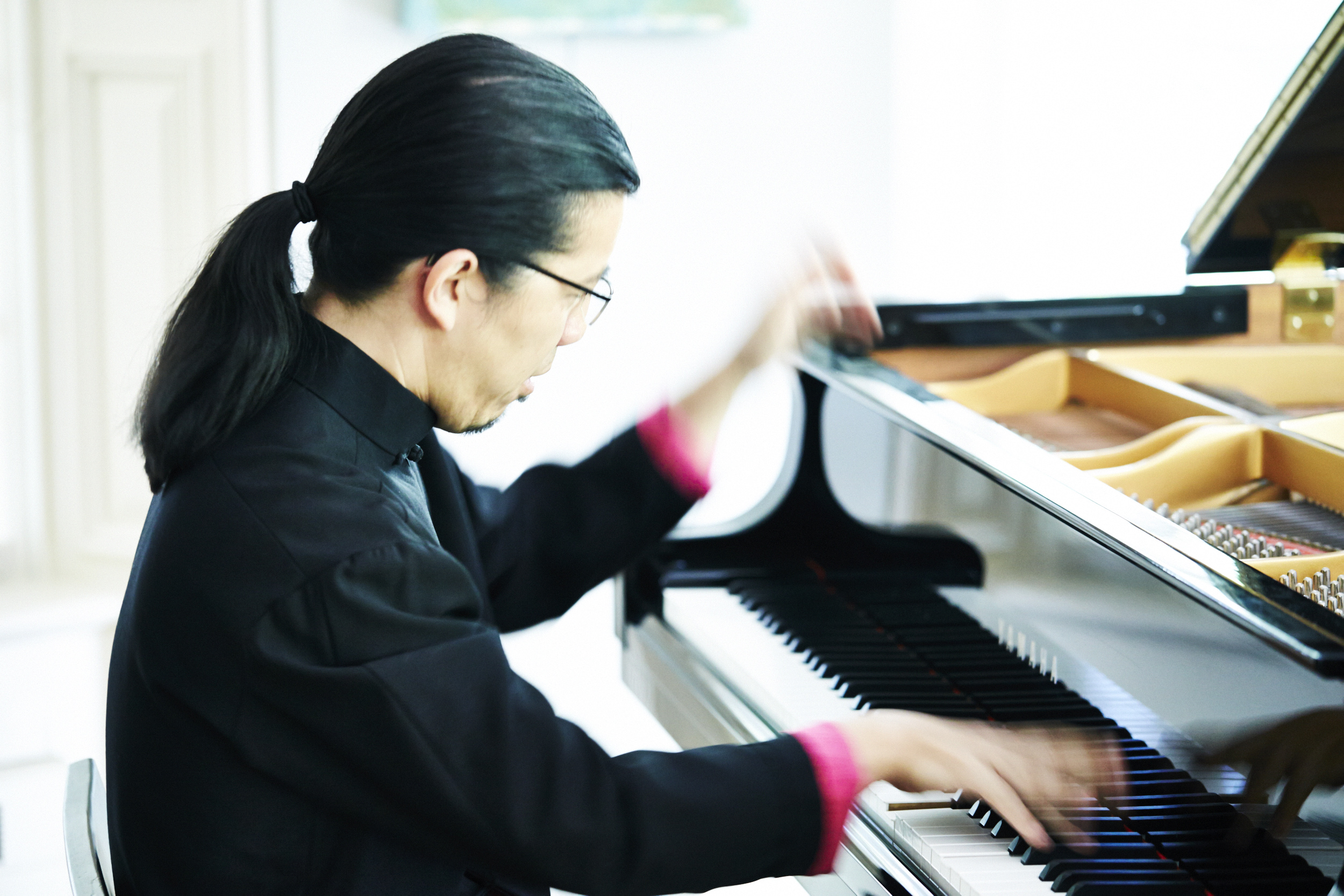
I’m always inspired when I hear a recital by a remarkable pianist. Frederic Chiu returns to Cincinnati this Sunday, 2:30 p.m. April 28, in Xavier University’s Gallagher Center Theater for an all-Prokofiev program for the Xavier Piano Series.
Chiu’s early career followed a traditional path — such as winning an Avery Fisher Career Grant, and becoming perhaps more famous as a “non-winner” of the 1993 Van Cliburn Competition than the actual winner because of the uproar caused by his elimination.
Since then, his career has been anything but traditional. For starters, he’s a savvy marketer on the Internet. His Chopin Etudes have gone viral on YouTube, with more than 200,000 views.
Then, there’s Prokofiev’s music, to which he’s devoted a lifetime to performing and recording. Here is his Q&A with me, where he explains how he developed his affinity for the Russian composer — and much more.
Q: When it comes to Prokofiev, have you made more recordings than anyone of his complete piano literature?
When you say complete piano recordings, it can be many different things. I think my complete Prokofiev is perhaps the most extensive collection, because I’ve included a number of transcriptions and added my own, so I feel like I’ve covered a lot more ground that most.
Q: Why are you so attracted to Prokofiev?
I’ve asked that question of myself many times (laughs) because I’ve tried to figure it out! I grew up listening to “Peter and Wolf” just like everyone else does. My parents are big fans of piano and particularly Russian pianists. In the 60s and 70s, when I was growing up, there was this trend of Soviet artists coming out to play, so I heard a lot of (Sviatoslav) Richter, a lot of (Emil) Gilels, a lot of Lazar Berman, and many of them played a lot of Prokofiev.
There were iconic albums that I can picture in my mind that would be on the turntable a lot– the Fifth Concerto, which is unusual to hear. I have a Richter recording, and I can see that album; the Second and Fourth Concerto on another album, and “Alexander Nevsky.” All of this repertoire for some reason was vivid in my household. I grew up with it and had a lot of exposure.
“Lieutenant Kijé” was one of my go-to pieces. I listened to a reel-to-reel recording of it that my dad had recorded off the radio over and over again, until the tape wore out. My dad didn’t know which version it was. So at some point in my late 20s, I wanted to hear that version again. I looked at all of the CDs coming out at that time and couldn’t find that particular version that I was playing on the reel-to-reel.
So that’s what pushed me to start playing it on the piano myself, to try to capture some of the tempos and the voicings that I heard in my head. That led to writing the whole suite out in a transcription, which I was very proud of.
Maybe 10 or 15 years after I wrote the transcription, I was scheduled to do a radio interview, and the host wanted to talk about transcriptions and wanted to compare the originals to the transcriptions. One of the things he had researched was “Lieutenant Kijé” and he wanted to compare my recording to an orchestra version. He started playing the orchestra version that he had picked out, without telling me that he’d chosen this version. I was listening, and I said “Wait a minute, that’s the version I grew up with!”
It turned out to be Chicago and Fritz Reiner from 1960. That would have been exactly the kind of thing that was playing on the radio at the time. My dad must have recorded that, and I was growing up listening to it, and here it was, 30 years later. And it was on the air live. It was quite a feeling.
Q: What is your program for Xavier?
My program includes Sonatas Nos. 3 and 4, which are the early sonatas that he composed using material from his childhood notebooks. And Sonata No. 7 to close the program. In between, I have various transcriptions from the “Romeo and Juliet” ballet, some of Prokofiev, some of my own, and my “Lieutenant Kijé” transcription.
It should be a really easy to listen to, engaging, and there will be a lot of passages that are recognizable from “Romeo and Juliet” and “Lieutenant Kijé.” The sonatas are all super active and interesting, and very characteristic of his music.
Q: Is it fair to say you’ve had an unconventional career as concert pianists go? You’ve carved out groundbreaking programs, engaging the audiences everybody wants.
Yes. Deep down, I think that the solo piano recital is something really vital. When it’s presented in the right way, people gravitate towards it. Proof for me has been tours organized by Allied Concerts. They are like the old community concerts, a bunch of small-town associations who group together and engage acts in a way where it may be feasible for everybody to participate.
It’s a chance for me to get to the part of the country where I wouldn’t get to. I just did an 11-concert, 12- day, 2,000-mile driving tour across the Midwest to the Rockies and played for close to 4,000 people. There was one concert with 800 junior high students in a basketball arena. The program that I played was a Classical Smackdown program, where two composers do a face-off, kind of in the style of “The Voice.” People love it, because I tell them that they don’t need to know anything about either composer to be able to have an emotional response to the music, and they pick which emotional response they prefer.
It starts a whole process of sensitization to music, to their own feelings to piano and sounds of the piano, and the energy of the piano, and people love it. Everybody votes, and everybody is involved because it’s something that’s engaging. And it’s great music.
For someone like you and for somebody like me, who spends their whole life immersed in this world, it’s not surprising to say, it’s so rich, you can spend your whole life. But a lot of people don’t realize that. Part of what I’ve tried to do is to share that sense of richness and sense of exploration and just being open to it in all the programs I do.
Q: Has anything surprised you as you meet people across the country who haven’t been exposed very much to classical music?
One thing that really surprised me on this last tour, one of the questions that I asked on the ballot for the Smackdown was, “Do you take piano, have you taken piano lessons, do you continue to play today?” Exactly half of all the people who came to the concert checked the “yes” box. I was quite stunned by that. I had no idea that so many people had gone through that, and therefore have more of an appreciation for piano, whether they continue to play or not.
This is across all age groups. I break it down by age, gender and by whether you play piano or not.
Q: That is reassuring. In the orchestra world, as well, orchestras also struggle with the perception that audiences won’t understand the music.
Yes, I think it would be interesting to know of the people who go to an orchestra concert how many of them play or have played an instrument. It would not only be an interesting response for the orchestra – the musicians and the administration — to know, but also for the audience to know, “Hey, I’m sitting in audience where half the people have played an instrument before.” Just the idea of oneself playing an instrument is a very powerful idea.
Q: What’s your next project?
Q: I have a recording being produced right now coming out at the end of the year, of Beethoven’s Symphony No. 5 and No. 7, the Liszt transcription, to be out on Centaur records. Judy Sherman, a Grammy Award-winner and producer of the year, is the producer.
I’m gearing up for Beethoven’s 250th in 2020 with lots of programs, exploring Beethoven and what he still means to people and culture and society today. I have a couple of Beethoven programs — one is a monument to Beethoven, which pulls out two pieces from repertoire that were both inspired by a monument that was going to be built to Beethoven on the 100th anniversary.
The Schumann Fantasy and Liszt transcription of the Fifth Symphony were both written to raise money for the Beethoven monument (in Bonn). They’re so iconic and yet they’re so different, and to have both inspired by Beethoven is quite interesting. In the end, the fundraising effort was so poorly done, that Liszt just gave all the money, the equivalent of $100,000. They eventually built the monument, and Schumann removed the dedication to the Beethoven monument from the Fantasy and dedicated the piece to Clara Schumann.
FOR TICKET INFORMATION VISIT: xavier.edu/musicseries
Or call Box office: 513-745-3162, etc. 393
Discover more from janellesnotes
Subscribe to get the latest posts sent to your email.
