
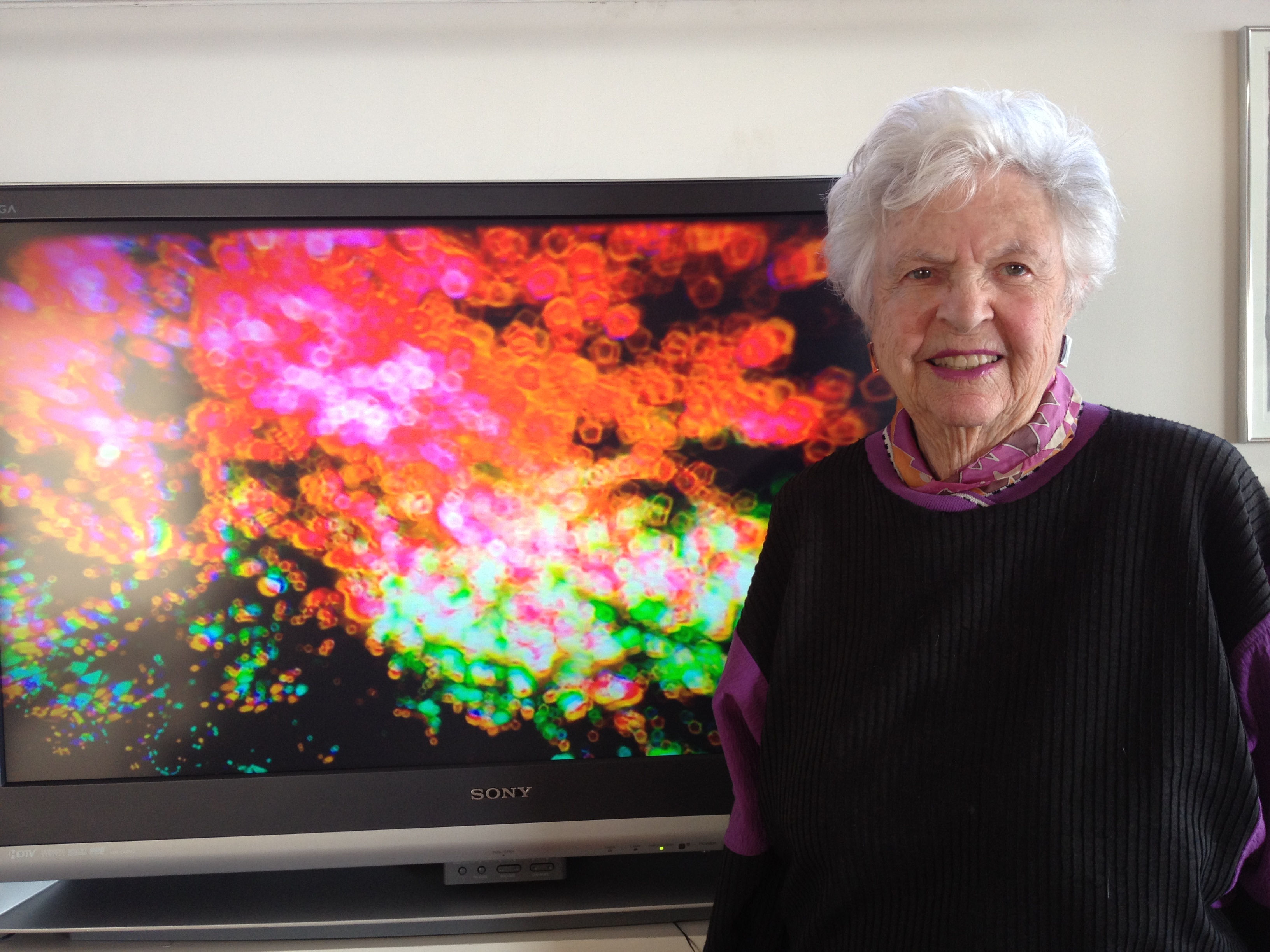
Cincinnati lost a giant in the arts this week when Alice Weston, philanthropist and artist, passed away at age 93. Over the years, I interviewed Alice a number of times on a variety of topics, from her own extraordinary work in photography, shown above, to works she commissioned for the Cincinnati Symphony Orchestra. One of my favorite interviews, though, was conducted with her cousin, Jane Ellis, about their experiences as children in the Philippines.
Alice was born in the Philippines, where her family — the five Frieder brothers of Cincinnati — owned a cigar factory. A documentary, “Rescue in the Philippines,” produced by Weston’s daughter, Barbara Sasser, describes how the Frieder family saved more than 1,300 Austrian and German Jews during World War II by hiring them to work in the factory.
Weston recalled how she, as a child, watched the rescue plot being hatched with high-powered officials over poker games on their porch in Manila. The players included Paul McNutt, U.S. High Commissioner of the Philippines, then-U.S. Army Col Dwight D. Eisenhower and the president of the Philippines, Manuel Quezon.
“Very few countries would allow (the refugees) to come in, so my father and his brothers wondered whether arrangements could be made for them to come into the Philippines,” she said. She recalled numerous details of their discussions, down to the poker chips that were supplied by McNutt.
“My father was just an ordinary person. He wasn’t anything special. But this documentary makes us realize that just ordinary people can be very important, and that good can come out of evil. I’m very proud of my daughter for bringing this to the world’s attention, and I’m of my father for having been able to enlist Paul McNutt, the High Commission to the Philippines and the president of the Philippines,” she said at the time. “They did it all over poker games on our back porch which I could see from my bedroom window. “
Weston’s interests in the arts were wide-ranging and her own photography was breathtaking. She was a good friend of the composer Gunther Schuller. She and her husband, the late Harris Weston, underwrote several of his compositions for the Cincinnati Symphony Orchestra. They started in 1962 with a Piano Concerto Jeanne Kirstein, faculty member at the University of Cincinnati College-Conservatory of Music (and later, my own teacher), and ended with his “Symphonic Triptych,” premiered in 2016, shortly after his death.
In 1996, the American Symphony Orchestra League (now the League of American Orchestras) commissioned Schuller to compose a piece on an American theme. It ended up becoming a unique collaboration between Weston and the composer.
It was while he was staying with Weston that he found his inspiration for the piece. He noticed her photograph of the Winter Solstice as seen in native American earthworks known as Fort Ancient. She had photographed these earthworks over 15 years in Ohio, Kentucky, Indiana and West Virginia. They deal with the cosmic cycles – cycles of the sun and the moon.
That inspired a unique artistic collaboration entitled “An Arc Ascending,” based on Weston’s photographs. The CSO performed Schuller’s piece at Music Hall, which was completely darkened. “My annual seasonal calendar, starting with my single Winter Solstice photo was phased, very slowly, in and out, in proportion to the hall’s 80-foot screen,” she recalled. While praising Schuller’s music, I think, secretly, she was proud of her own achievement in the collaboration.
Discover more from janellesnotes
Subscribe to get the latest posts sent to your email.
