
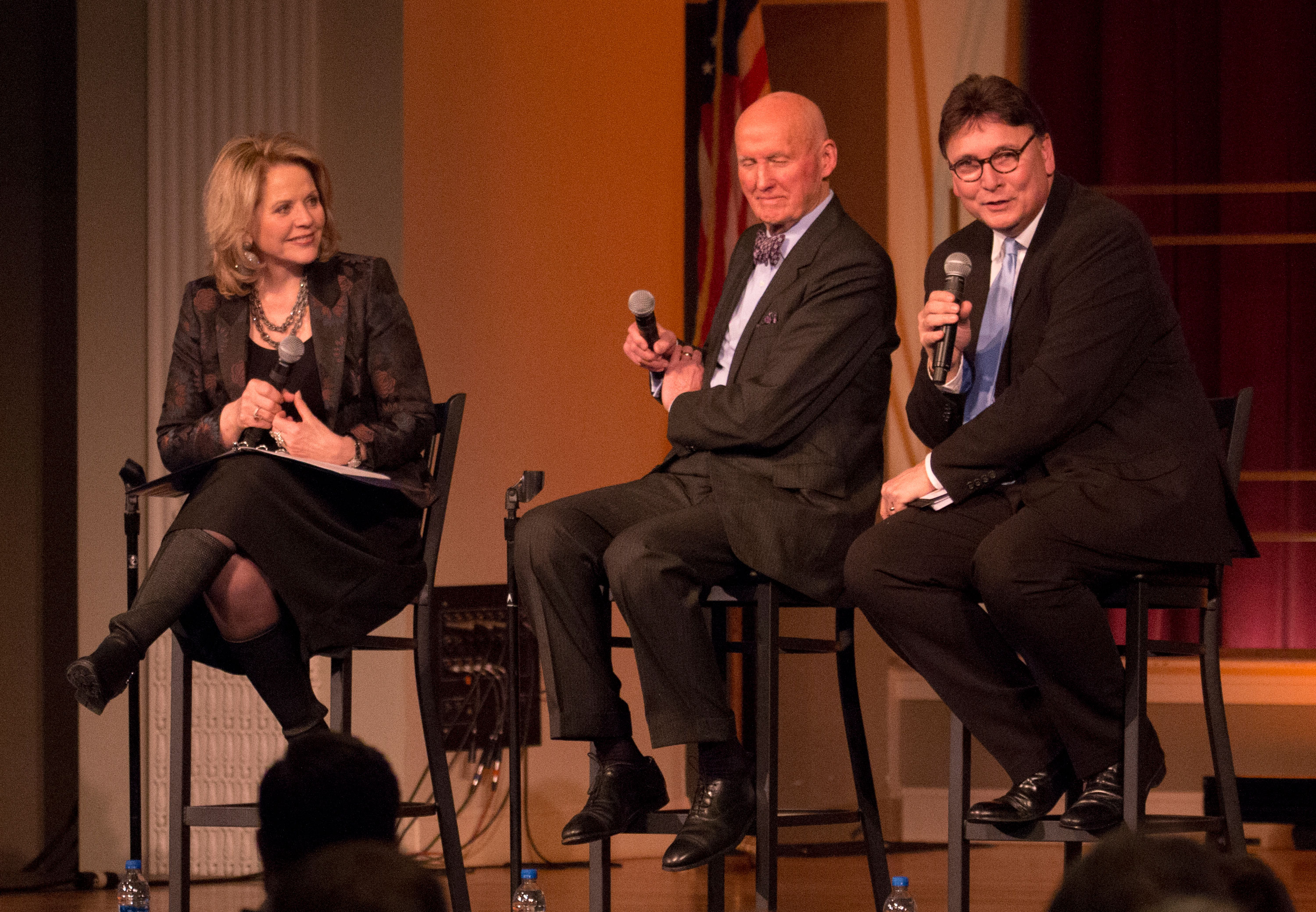
Two days before performing Richard Strauss’ Four Last Songs and other works with the Cincinnati Symphony Orchestra, opera superstar Renée Fleming spoke on a panel about something close to her heart. America’s diva has become an advocate for the power of music, and how it affects our health, our brain, our healing — virtually everything about our being.
The conversation in Music Hall’s Ballroom on Wednesday was jointly presented by the CSO and the Lindner Center of Hope. Its participants included Dr. Chris Tuell, clinical director of addition services at the Lindner Center of Hope, and neurosurgeon Dr. John Tew, Jr., who was clinical director of the UC Neuroscience Institute for 15 years.
Fleming spearheads the Sound Health initiative as part of her role as artistic advisor to the Kennedy Center for the Performing Arts. She delivered an excellent lecture, saying her curiosity regarding the intersection of music and health was piqued when she noticed that researchers were studying music.
Her Sound Health project began at a dinner party that included Supreme Court justices Ginsburg and Scalia (who were famously good friends) as well as NIH director Francis Collins — who brought along his guitar, and they all began singing together. Besides showing that music has the power to bridge political differences, the evening prompted Fleming to propose that the Kennedy Center and NIH collaborate on researching music and health.
Because of the opera singer’s efforts, NIH has committed $20 million to this collaborative study. The National Endowment for the Arts has also become involved, and will announce a new research center this spring, she said.
It’s wonderful to see this effort receive national attention. In cities around the country, researchers are already studying the affects of music on the brain, as we learned in concerts presented by Cincinnati’s concert:nova and neuroradiologists from UC Health and Children’s Hospital. Here’s my column, showing an MRI image of CSO cellist Ted Nelson’s brain, showing activation in the primary auditory cortex while listening to and imagining playing J.S. Bach’s cello suite.
Fleming also gamely volunteered to have a functional MRI of her brain — while singing, speaking and imagining singing. We saw a video of her singing inside the scanner, to which she remarked with a laugh that it “wouldn’t win a Grammy.”
But, she said, “it allows us to understand what’s going on in the brain while listening to or playing music.” She was surprised to find that “singing engaged more of my brain than speaking, but imagining singing was the most powerful.”
An interesting discussion followed about the benefits of studying music. For instance, children who study for two years show a noticeable change in their brain, and many become high achievers in life.
Dr. Tew’s remarks included a thumbnail history of music being used therapeutically, virtually from the beginning of recorded time. Important research continues today in everything from helping patients with Parkinson’s Disease to helping young students in schools. Cincinnati-based Mindful Music Moments enables students to start their day with a quiet meditation while listening to music.
It’s used to alleviate depression, anxiety and trauma. And it helps to cope with grief. Who could ever forget Fleming’s emotional, deeply moving performance of “Danny Boy” at the memorial service of Sen. John McCain?
Music can also help people cope with the stresses of life without resorting to drugs, Dr. Tuell remarked. His comments included one that stuck with me: “Music is also mathematical. It’s like fireworks going off in the brain.”
That is exactly how it feels, to me, when I perform, sing or listen intently to music.
That music has the power to heal is far from a new concept, but thanks to the work of Renée Fleming and others, the idea seems to be gaining more respect in the health world. Today, music therapy is being used in areas such as pain reduction, dementia and brain injury. Personally, I followed a music therapist around Cincinnati Children’s Hospital for a day, and I’ll never forget the important work that is being done there, both for the patients as well as their families.
Fleming sees “incredible potential” for collaborative research between arts and science as the world moves ahead in areas such as AI (artificial intelligence).
Ultimately, she said, “Remembering that we are still emotional, social and creative human beings is healing.”
Discover more from janellesnotes
Subscribe to get the latest posts sent to your email.

Excellent. Perhaps when we can measure the benefits objectively, greater respect and funding will follow in our educational institutions.
LikeLike
Music can be such a powerful therapeutic tool. When we experience music, it is so strongly connected to our social experience. Whether it be a symphony, a choir, a rock band, or a barber shop quartet, music connects us. Unfortunately, we are seeing a trend in which we are more disconnected with one another. This is obvious by what we have been seeing in the realm of digital devices and the Internet. We think we are connected, with social media, followers, and “Likes,” but it is a “pseudo connection.” This social isolation, I believe, feeds into fear, anxiety and hatred towards others who we are more disconnected with. Music allows us to reconnect with one another. We need it now more than ever.
LikeLiked by 1 person