
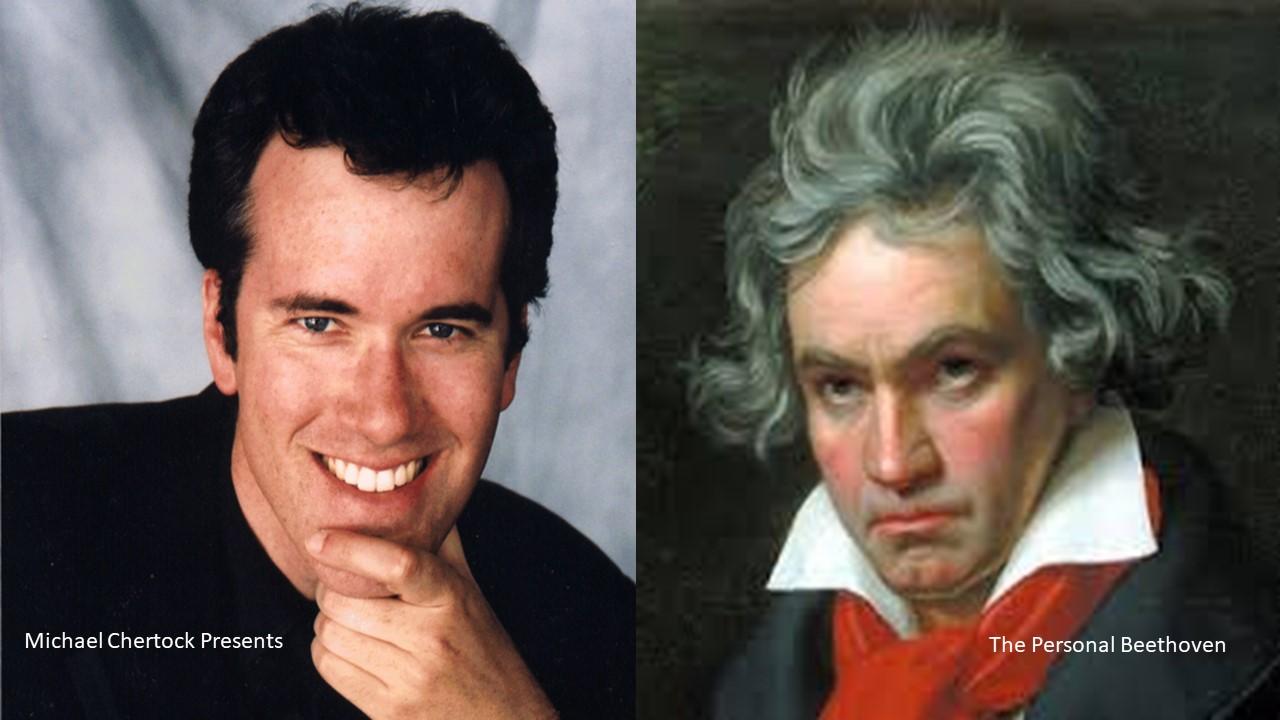
 In honor of Beethoven’s 250th birthday year (2020), local pianist Michael Chertock and Tom Hughes have produced a series of audio podcasts entitled “Beethoven: A Personal Look at the Man Behind the Masterpieces”.
 Written, narrated, and with musical excerpts performed by Michael, five podcasts take the listener through Beethoven’s life from his childhood through his final works.
They might be enlightening for those who will be attending the Beethoven Akademie 1808 concerts at the CSO later this month.
These are available on both Youtube and Apple Podcasts under “Michael Chertock Presents”, and the playlist for all five can be found at https://www.youtube.com/playlist?list=PL7_5BKU6-z2ifFYxbDrnBDq64Bh-rcpV8
The individual episodes are:
The Personal Beethoven: Episode 1, Beethoven’s Childhood. 13:42
What affect did Beethoven’s overbearing father have on his early musical development? Did Beethoven really play for Mozart? What was his relationship with his mother and brothers? Michael addresses these issues surrounding Beethoven’s childhood and eventual arrival in Vienna.
The Personal Beethoven: Episode 2, The Young Conqueror in Vienna. 8:18
Mozart dies. Haydn reigns supreme and becomes Beethoven’s teacher. Or does he? Complicated relationship between teacher and pupil set the stage for Beethoven’s success in Vienna. Listen in as Michael discusses the influence of Haydn on Beethoven, whose star is rising.
The Personal Beethoven: Episode 3, Crisis and Conflict 8:47
Beethoven faces a personal crisis. Michael explores a new theory on how Beethoven lost his hearing, and how he handled the resulting social isolation. Even with the support of his friends, Beethoven becomes increasingly frustrated and his musical output is affected.
The Personal Beethoven: Episode 4, Beethoven, Napoleon & Romanticism. 11:02
Beethoven’s world is changing. Napoleon’s rise to power creates in Beethoven an initial fascination that evolves into deep disillusionment. His relationship with orchestras and with the aristocracy continues to be challenged, but as a composer, he begins to transition from the Classical traditions of Haydn to being a leader of the new Romantic movement. Yet can Beethoven truly be considered a Romantic or Classical composer? Michael answers this question along with discussing the influence of Beethoven on Wagner and Brahms.
The Personal Beethoven: Episode 5, Music for Another Time. 9:54
Triumphs and sufferings define Beethoven’s personal and professional life. His brother Carl dies, Beethoven becomes foster parent to his nephew, all while his profound deafness challenges his ability to communicate with others. His final works, while baffling and confusing to some of his contemporaries, are, in Beethovens words, “for another time”. In this episode, Michael also points out features of the five late piano sonatas, and Beethoven’s almost experimental approach to composition.
Discover more from janellesnotes
Subscribe to get the latest posts sent to your email.
