
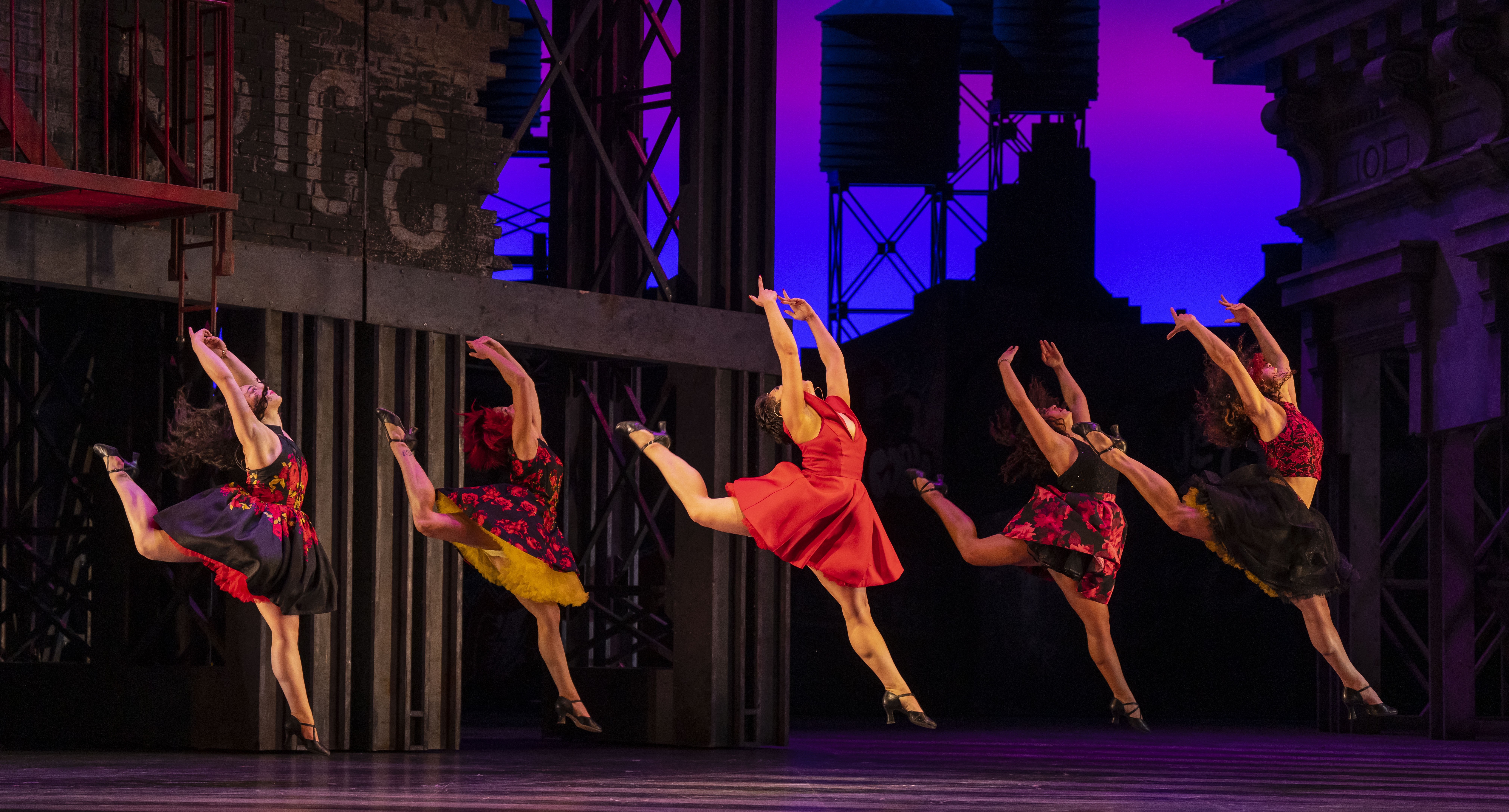
On one day in Chicago recently, I saw two “opera” productions that were at opposite ends of the spectrum. The first was really musical theater — “West Side Story” — mounted by Lyric Opera of Chicago. A couple of hours later, I was in the intimate Jarvis Opera Hall to see a historically informed, ravishing production of Johann Adolph Hasse’s “Marc’Antonio e Cleopatra” (really a serenade mounted as opera) at Haymarket Opera Company. Here are a few thoughts about each:
West Side Story — Cincinnati Opera has experimented with presenting musicals in the past, but after a few tries, let it go. In Chicago, Lyric Opera has made a full commitment to Broadway in the opera world. That was a topic of discussion for a panel moderated by Chicago critic Wynne Delacoma at the annual meeting of MCANA (see below). The participants were Lyric Opera’s director of artistic programs Cory Lippiello and James Lowe, the conductor for West Side Story. The company also presented the U.S. premiere of director Barrie Kosky’s production of Fiddler on the Roof in September.
Part of the appeal for opera companies is that musical theater brings in a whole new audience. For Fiddler, 50% of the audience was new to Lyric Opera, said Lippiello, who was unclear about how many returned to see an opera. The other appeal is that the last time Lyric Opera presented West Side Story, it took in $10 million at the box office. Although officials don’t think they’ll meet that number this year, as everyone is still emerging from Covid, that kind of money can be likened to the annual Nutcracker at the ballet. It helps pay for the rest of the season.
The idea of mounting a musical in an opera house, they said, is that they believe they can present consistently high caliber singers and a full orchestra in the pit, for a different experience. If you notice the pit orchestra in most touring Broadway shows, it is often very small. Said Lowe: “Audiences love to hear a great score played well.”
There’s also the issue of amplification, “a dirty word in opera,” he noted. But technology has improved and more companies are using “sound design.” There are other issues to consider, as well, such as obtaining the rights.
It was all food for thought. I wonder how many American opera companies will be dipping into musical theater?
That said, with 45 musicians in the pit orchestra of West Side Story, the orchestral sound was indeed glorious. The production directed by Francesca Zambello was highly entertaining. The original Jerome Robbins choreography, restaged by Joshua Bergasse, was simply wonderful. It took me a few minutes to get used to the amplification. Unfortunately, the two main stars couldn’t sing that day, and were replaced by understudies.
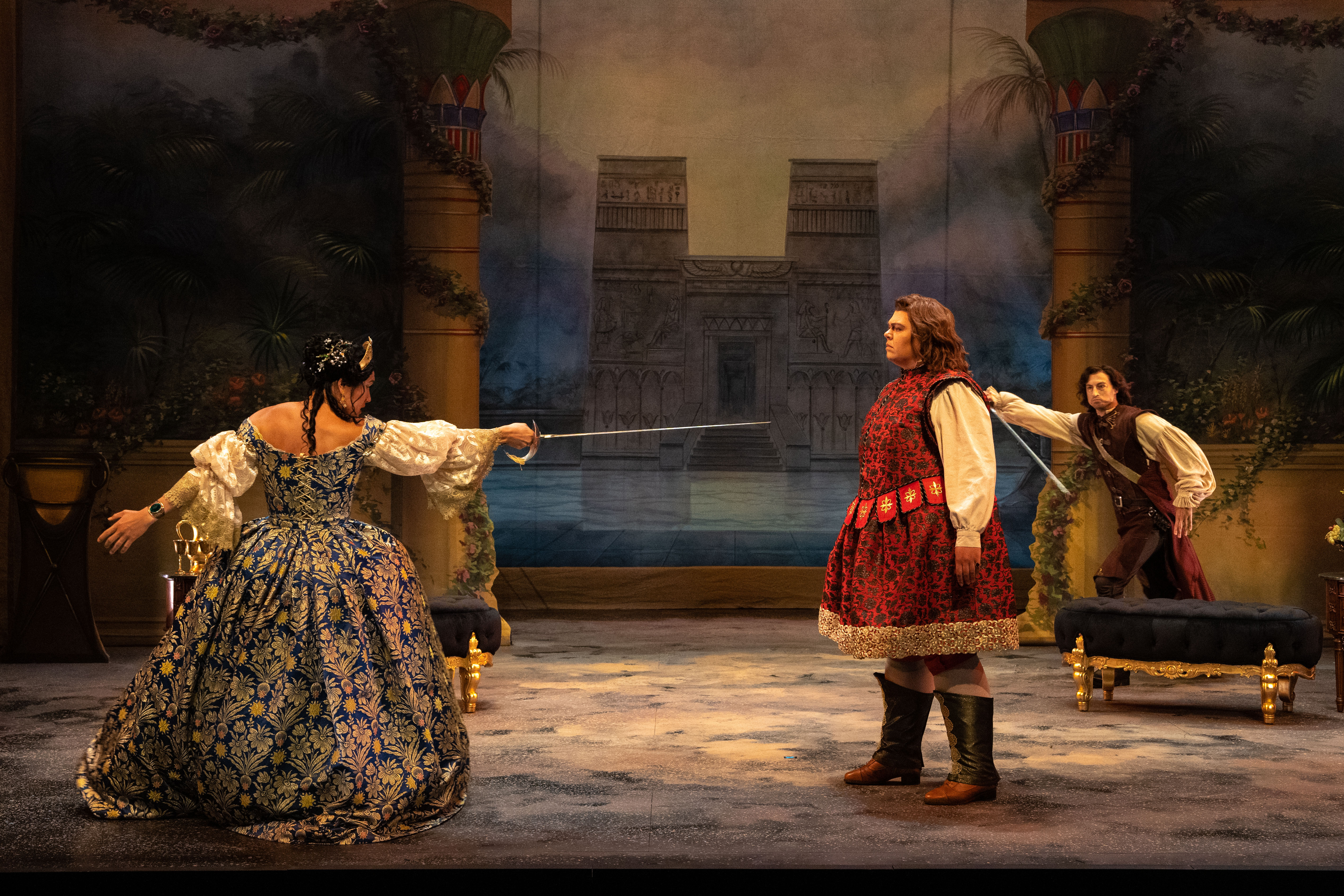
Haymarket Opera Company — Later, at DePaul University, the 12-year-old Haymarket Opera Co. mounted the Chicago premiere of Johann Adolph Hasse’s 1725 serenade, Marc’Antonio e Cleopatra, as a staged opera. Making his directorial debut was Chase Hopkins, the company’s general director, who described the endeavor as “a fusion of ancient Egypt and baroque spectacle.” The wonderful pit orchestra of period instruments, which included archlute and harpsichord, was conducted by Craig Trompeter, who is also the artistic director. (Also a performer of viola da gamba, Trompeter appeared in Cincinnati several times with Catacoustic Consort, he told me.)
As was custom in early opera, a castrato originally sang the role of Cleopatra (Carlo Broschi, known as Farinelli). The role of Marc-Antonio was sung by a female contralto, Vittoria Tesi Tramontini. So for this performance, the genders were also reversed. Countertenor Kangmin Justin Kim sang the highly ornamented and emotional role of Cleopatra. The stunning contralto Lauren Decker was Marc’Antonio. Their performance throughout the score, consisting of florid arias and recitatives, could only be described as a vocal tour-de-force. I loved the vibrant and stylishly led orchestral music, which was reminiscent of Handel. It was all performed with impeccable style and attention to performance practice. There was even a baroque dance, spiced with swords.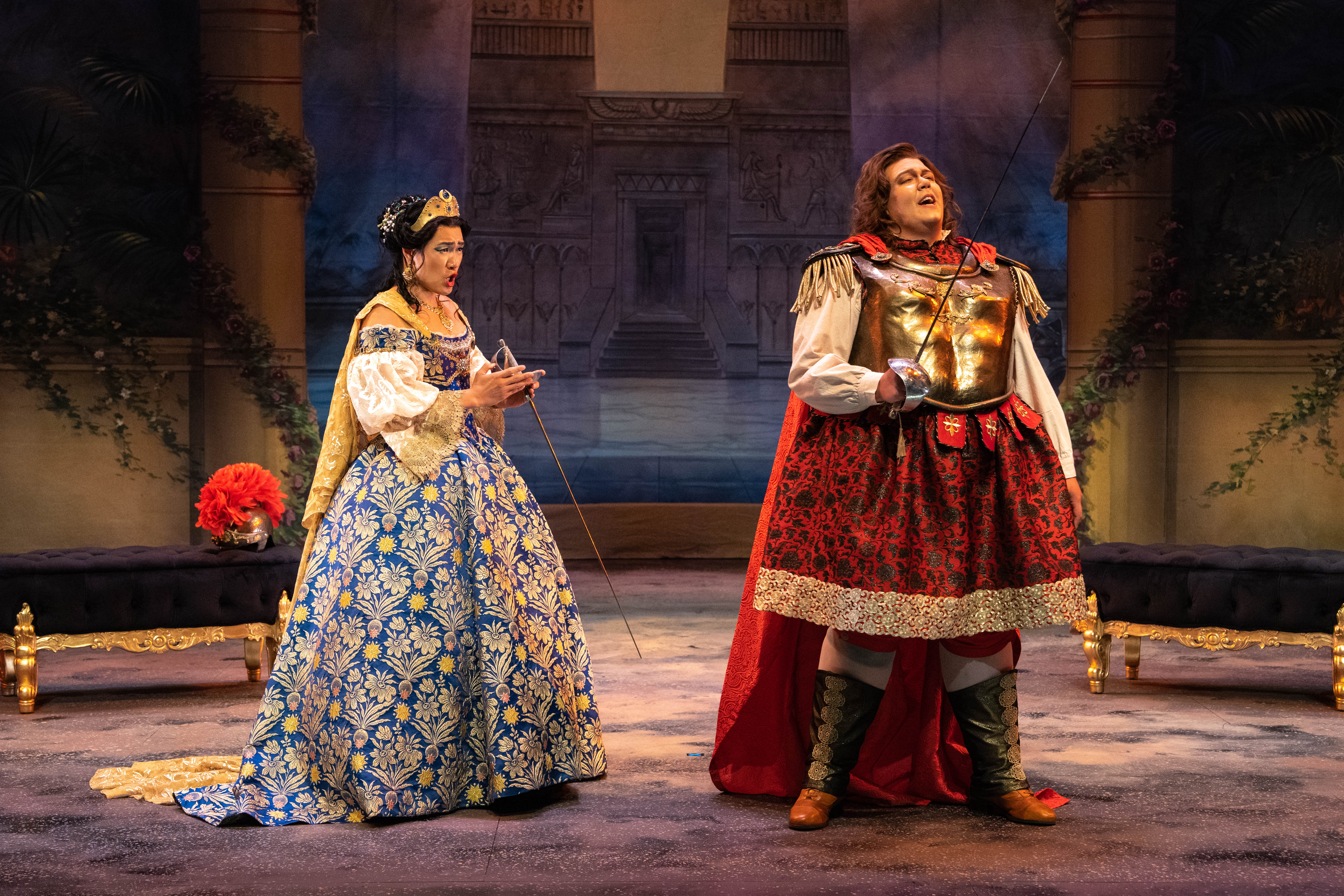
The baroque period costumes were lavish, and the main characters were joined by non-singing ladies in waiting and a Roman soldier. There was also particular attention to authenticity of the set. Set designer Wendy Waszut-Barrett spoke to our group about how the scenery was painted with layers of “distemper” paint, allowing underlying colors to shine through. The scenery and subtle lighting, including onstage braziers, effectively created a soft glow.
Coming next, Haymarket will present the oldest surviving opera by a woman composer, Francesca Caccini. The company is also making some groundbreaking recordings with Cedille Records. One of the newest albums is the only surviving opera by Joseph Bologne, the Chevalier de Saint-Georges, “L’Amant Anonyme.” It stars the soprano Nicole Cabell. The recording is the first project supported by the Ruth Bader Ginsburg Fund for Vocal Recordings. Information: haymarketopera.org and cedillerecords.org.
Discover more from janellesnotes
Subscribe to get the latest posts sent to your email.
