
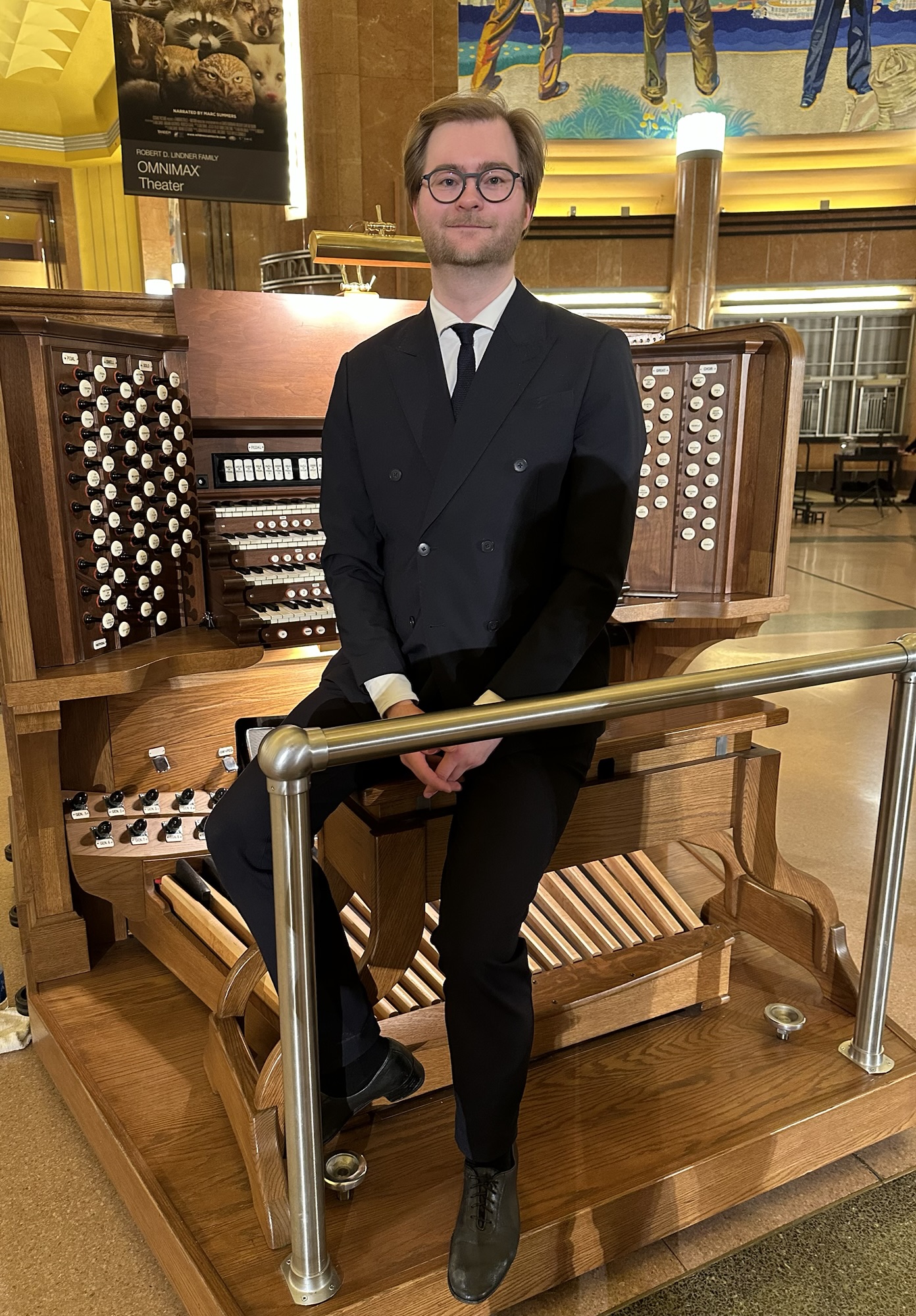
 Johannes Skoog, Royal Court Organist of Stockholm/ photo Janelle Gelfand
It took Swedish organist Johannes Skoog 24 hours to get to Cincinnati. Despite a canceled flight — originally out of Helsinki– and almost no sleep or time to rehearse, he performed his program magnificently on the historic 1929 E.M. Skinner Concert Organ in Cincinnati Museum Center on Feb. 25.
Under the circumstances, it was an Olympian feat for him even to play at all. Best of all, Skoog seemed to be enjoying the performance, playing his mostly French repertoire with flair and offering big smiles to the audience. Most of us don’t consider the trials a touring artist must endure, especially in these days of “bomb cyclone” snowstorms and frequent “mechanical” issues. The sold-out audience assembled in the Rotunda of Union Terminal was riveted throughout his two-hour program, thronging him at intermission and awarding a standing ovation at the conclusion.
Skoog is a rising star, who won First Prize and the Bach Prize at the prestigious Canadian International Organ Competition in 2024. Now the Stockholm native is the newly appointed Royal Court Organist and is becoming accustomed to his official duties, mostly at the Royal Palace in Stockholm, he told me, but also at the royals’ charming summer home, Drottningholm.
Skoog’s program included four anthems performed with the combined choirs of Christ Church Cathedral, Stephan Casurella, director, and St. Thomas Episcopal Church, Carlton Monroe, director.
Cincinnati’s E.M. Skinner organ is one of the treasures of the United States. It has nearly 5,000 pipes, all divided into divisions installed behind the panels surrounding the Rotunda. Hence, there is an amazing “surround-sound” experience to these concerts, curated by the organ’s restorer, Harley Piltingsrud. It is designed in the American Symphonic Organ tradition, able to produce every tone of a symphonic orchestra, and then some.
It was a treat to witness Skoog’s virtuosity, both in his technical wizardry at the keyboard and his pedal technique. I’ve never seen such fleetness — his feet literally flew across the pedals. And in such a vibrant acoustical space as the massive Rotunda, Skoog’s balance and control of sound were truly impressive. Equally impressive was his artistry at registration, a complex task involving selecting and combining stops for specific tone colors, such as strings, mixtures of reeds, and so on, with little time to accomplish this beforehand.
The organist opened with Prokofiev’s Toccata, Op. 11 (trans. Jean Guillou), featuring staccato repeating notes, which grew to a massive peak of technical virtuosity.
Anchoring his first half were two movements from Ravel’s “Gaspard de la nuit,” a fiendishly difficult work written originally for piano, transcribed by Ryan Kennedy. “Ondine” was simply ravishing. The organ’s colors shimmered and sparkled. Skoog has a fluid, musical style of playing, and was effortlessly in command. The way he was able to illuminate the theme while playing soft, fleeting accompaniment figures with great delicacy — which is difficult even on the piano — was striking.
“Scarbo” was full of technical wizardry, but even more impressive were the extraordinary atmospheres he conjured, from mystery to thundering climaxes of astonishing power. It was a masterful performance.
Between these movements, the artist inserted Debussy’s “Clair de lune” (trans. Jean-Baptiste Robin). It was mesmerizing to watch his hands in this work that everyone knows, so elegantly played.
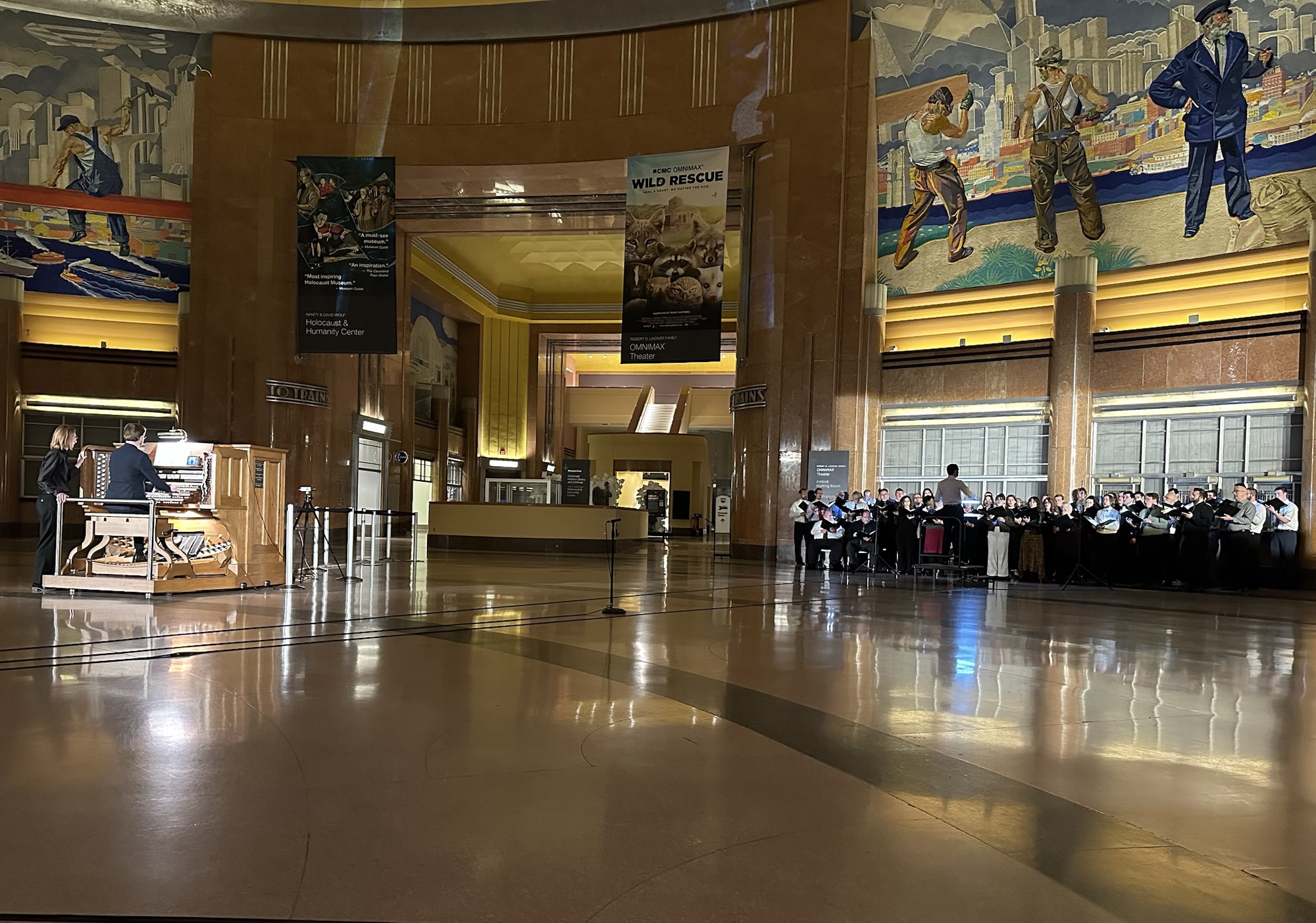
Skoog’s second half focused on four choral anthems with two local choirs, Christ Church Cathedral Choir and the St. Thomas Parish Choir. Their respective directors, Stephan Casurella and Carlton Monroe, each conducted two works. Because of the extremely lively acoustics, the choir stood against the back wall of the Rotunda. (You can see in the photo I took that there was considerable distance between the organ and choir.)
The accomplished singers performed selections by John Ireland, Edgar Bainton, the Scottish composer James MacMillan and Gerald Finzi. These inspiring anthems suited the soaring nature of the space. I was taken by MacMillan’s “A New Song,” an atmospheric piece of ethereal beauty. Skoog performed with care, never overpowering the choir, which was not an easy task. (Fortunately, the texts were provided.)
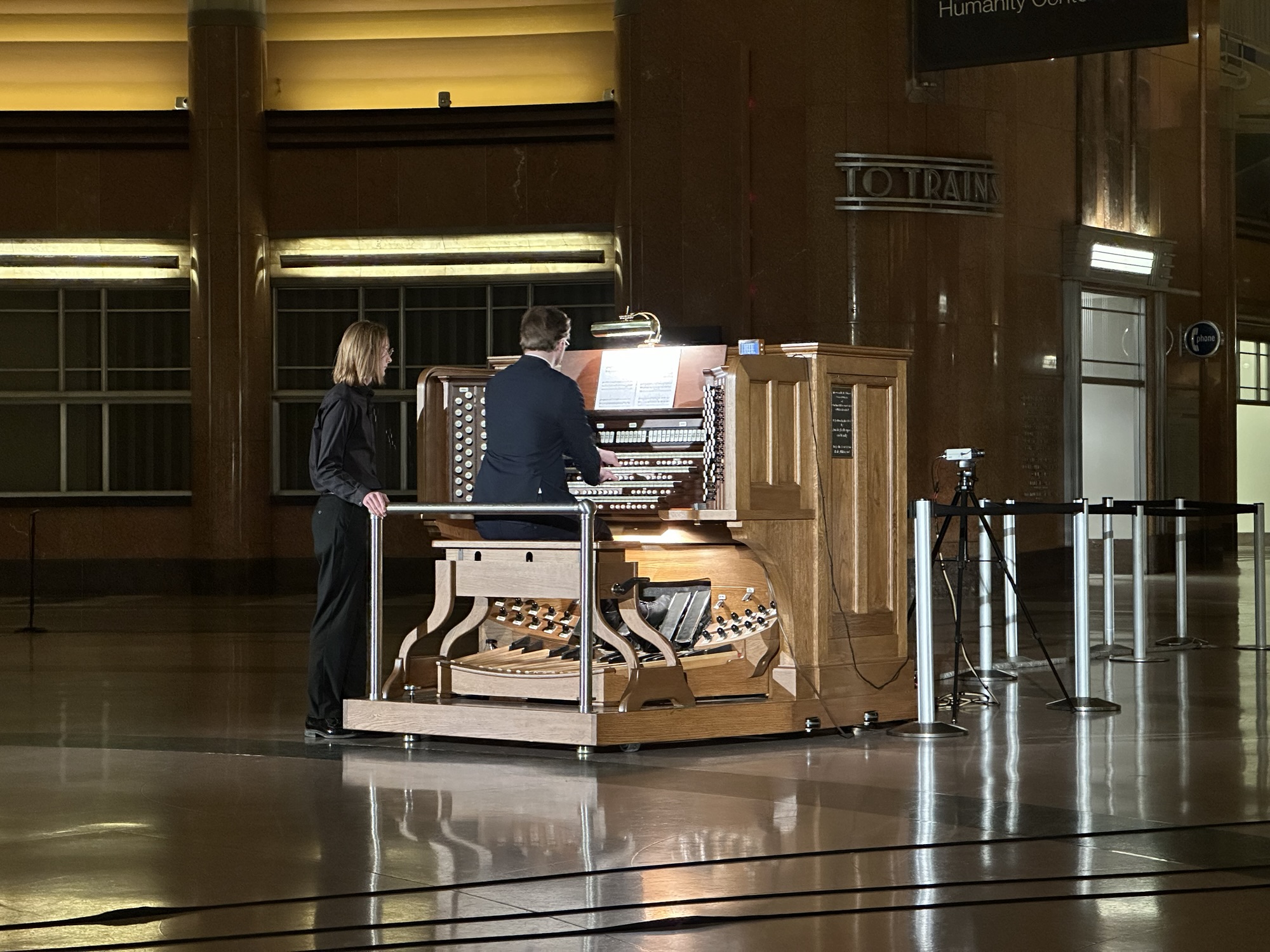 He concluded his concert with three more works. The French Romantic composer César Franck was represented by his “Fantaisie, Op. 16. The organist displayed superb control of color and dynamic, and the warmth of the organ’s sound was memorable.
Sweden was represented by “Inventio Processionis,” by Carl Unander-Scharin, a Swedish opera singer, composer and professor. The program notes stated that this work was inspired by dream about ants on a hill, and to accomplish that image, the composer invented a new serial technique he called “Ergonomic serialism.” The result was a toccata-like piece, with the organist playing close repeating notes on two manuals and cascades of brilliant figures. It was another tour-de-force among many for Skoog.
The grand finale was Liszt’s symphonic poem, “Les Préludes,” in a transcription by Nathan Laube. The romantic symphony in this setting was indeed majestic, with Skoog’s technical prowess on full display. The power and virtuosity of the concluding bars was thrilling, and the Rotunda was left ringing at its end.
This concert was the start of an American tour that will take Skoog to Minnesota and Texas, told me afterward. As far as the organ and its setting in the great acoustical space of Union Terminal, he noted that there is nothing like the E.M. Skinner in Europe, calling it one of the great instruments in the world. He said the combination of the instrument and its space was “truly unique.”
Discover more from janellesnotes
Subscribe to get the latest posts sent to your email.
