
Last weekend, the Music Critics Association of North America held its annual meeting in Atlanta, GA, with host partners the Atlanta Symphony Orchestra, Atlanta Opera and the Alliance Theatre. The stars aligned so that we were able to see performances by each organization. (Stay tuned for further impressions about each.) In addition, there were some wonderful exhibitions at the High Museum of Art. You may not think of Atlanta as being especially arts-centric. But I was impressed by the high-caliber performances, the strong donor support and the diverse audiences, all illustrating how important the arts have become in this Southern city.
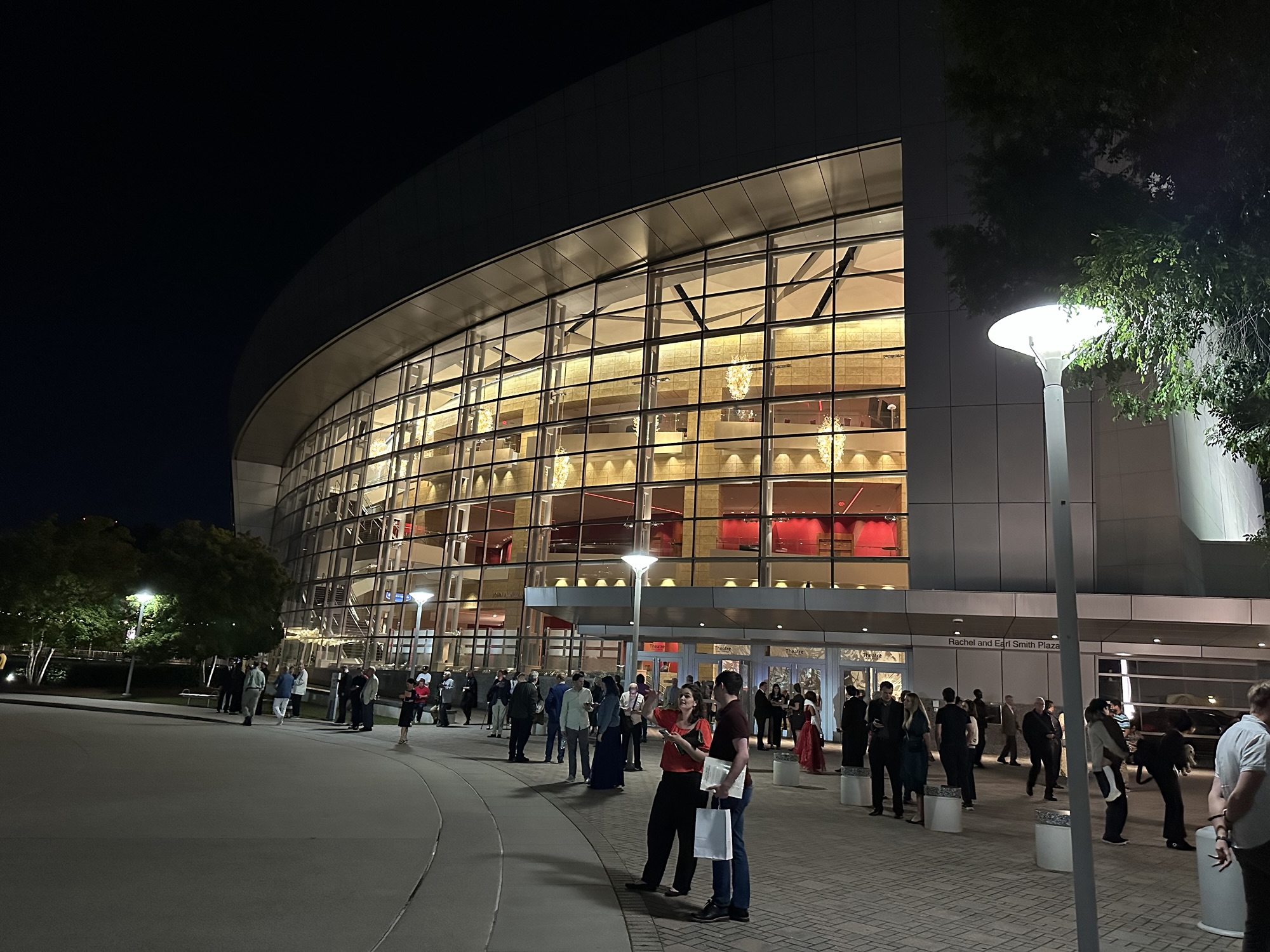
One of the most striking examples of this is the Atlanta Opera, under the leadership of Israeli-born General and Artistic Director Tomer Zvulun for the past 13 years. (Cincinnati Opera audiences have seen two operas with Zvulun’s staging in recent years: last year’s “Rigoletto” and Wagner’s “The Flying Dutchman” in 2018.) He spoke to our group before we trekked to the Cobb Energy Performing Arts Centre, the company’s home about 10 miles from Midtown Atlanta.
The current “Ring” Cycle — Wagner’s epic masterpiece of four operas, “Das Rheingold,” “Die Walküre,” “Siegfried” and “Götterdämmerung” — was staged, one by one, starting in 2023. The completion of “Götterdämmerung” — “Twilight of the Gods” — marked the American Southeast’s first fully staged production of the “Ring.”
Zvulun dedicated the work to his mentor, the late Speight Jenkins, who, as general director of Seattle Opera, mounted three “Ring” cycles. Zvulun has used technology to keep down costs. His productions have benefited from an 80 foot by 40 foot LED wall. The overall concept as well as the projections for “Götterdämmerung” were simply breathtaking.
The scenic and projection design by Erhard Rom featured Brutalist architecture for the court of the Gibichungs, befitting a Fascist-like regime. Its walls stretched into infinity so seamlessly, that it was impossible to tell where the projections began beyond the pillars of the set.
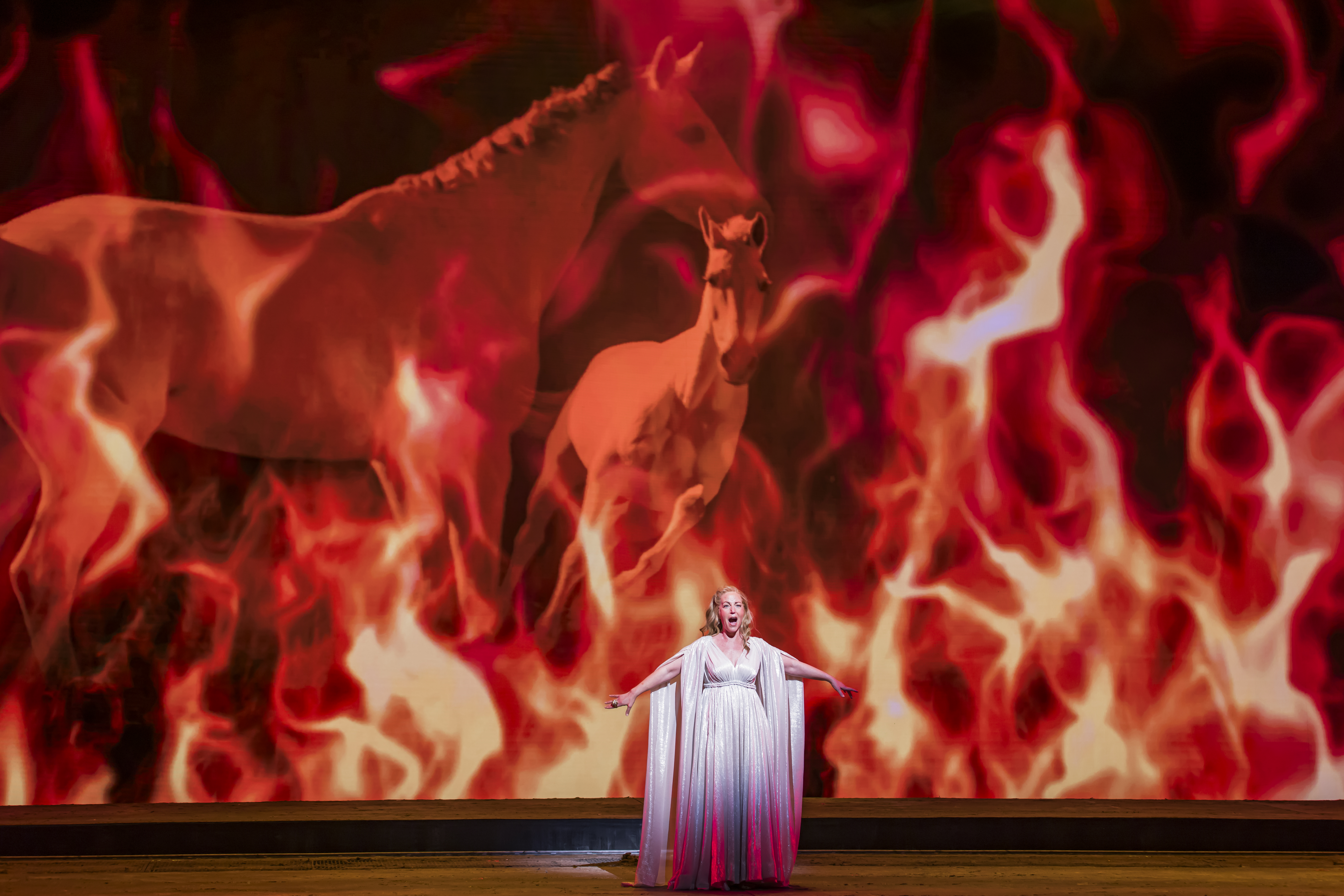
Indeed, the visual elements left the viewer with indelible impressions. Act III opened on a magical setting in an emerald green forest by the Rhine as the Rhinemaidens cavorted (Gretchen Krupp, Flosshilde; Cadie J. Bryan, Woglinde; and Alexandra Razskazoff, Wellgunde). The ship sailed up the Rhine, images of Wotan gazed from the clouds and Siegfried’s funeral pyre grew to a full-blown catastrophe. Brünnhilde’s horse, Grane, could be seen in the flames before the ex-Valkyrie joined, along with the Ring on her finger, and Valhalla came crashing down.
Zvulun’s staging was natural, effective and allowed the drama to unfold clearly. I was struck by how he’d leave a character – Brünnhilde, Gutrune and especially Hagen – onstage with backs turned, frozen, staring out into the Rhine, waiting, watching, or in Hagen’s case perhaps, conniving, as a scene progressed. In this way, it became very much a psychological drama, even a thriller. The forces were always there.
Vocally, the men particularly excelled in this production. David Leigh’s Hagen was both charming and evil, and he sang superbly all evening. The Chinese bass-baritone Le Bu made a strong and deeply memorable impression as Gunther, the King. As Alberich, the Nibelung who began this story in “Das Rheingold,” Aleksey Bogdanov climbed out of a hole and proceeded to command the stage with a powerful baritone.
Soprano Sylvia D’Eramo brought sympathetic character to Gutrune, who unwittingly was part of the web of betrayal woven by Hagen. Although Siegfried and Brünnhilde made realistic lovers, neither seemed vocally convincing, albeit in highly taxing roles, until their final scenes. Our hero Siegfried, Stefan Vinke riveted in Act III as he told his story, was speared by Hagen and stayed alive long enough to utter Brünnhilde’s name. The distinguished soprano Lise Lindström, too, sang brilliantly. As Brünnhilde’s final realization set in, she heroically conveyed what she had to do.
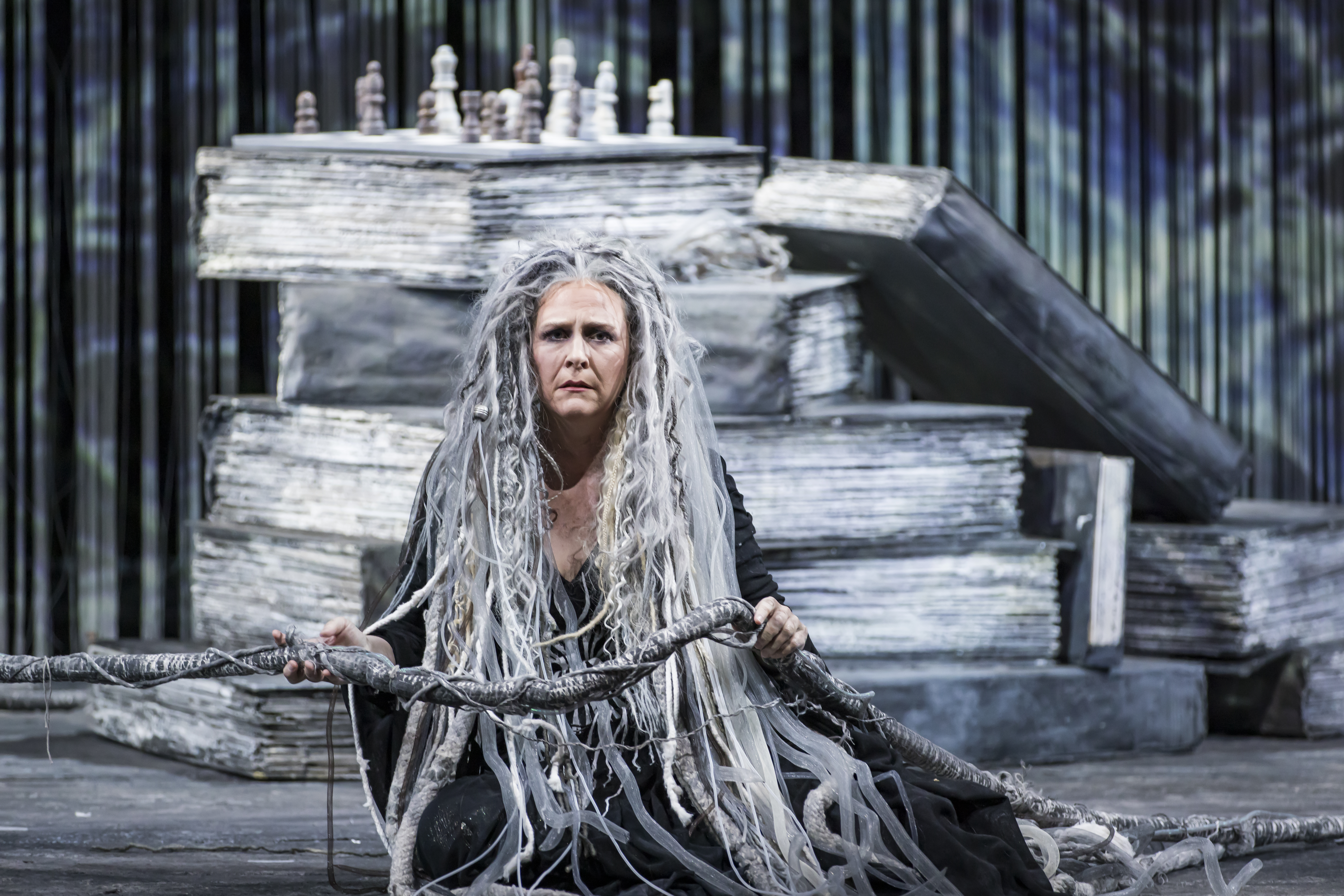
It’s always fun to pick out a CCM graduate when I’m away from Cincinnati. In this case, Caitlin Lynch was the Third Norn (with First Norn Tamara Mumford and Second Norn Olivia Vote). They sang while weaving the rope of destiny in an overstuffed, ancient library amidst a forest of cobwebs.
The chorus, prepared by Walter Huff, was excellent. For me, the 60-piece orchestra, led by Roberto Kalb, was one of the stars of this show.
In a world where many opera companies are struggling, Atlanta Opera seems to be bucking the trend. Since Tvulun’s arrival, Atlanta Opera’s season has grown from three productions with a $5 million budget and a $1.5 million deficit, to seven productions and a $17 million budget, and no deficit. Annual attendance has grown — helped by initiatives such as mounting “immersive” opera in a circus tent during Covid — from about 8,400 to 48,000. Fundraising has tripled. Operas are livestreamed to about 88 different countries.
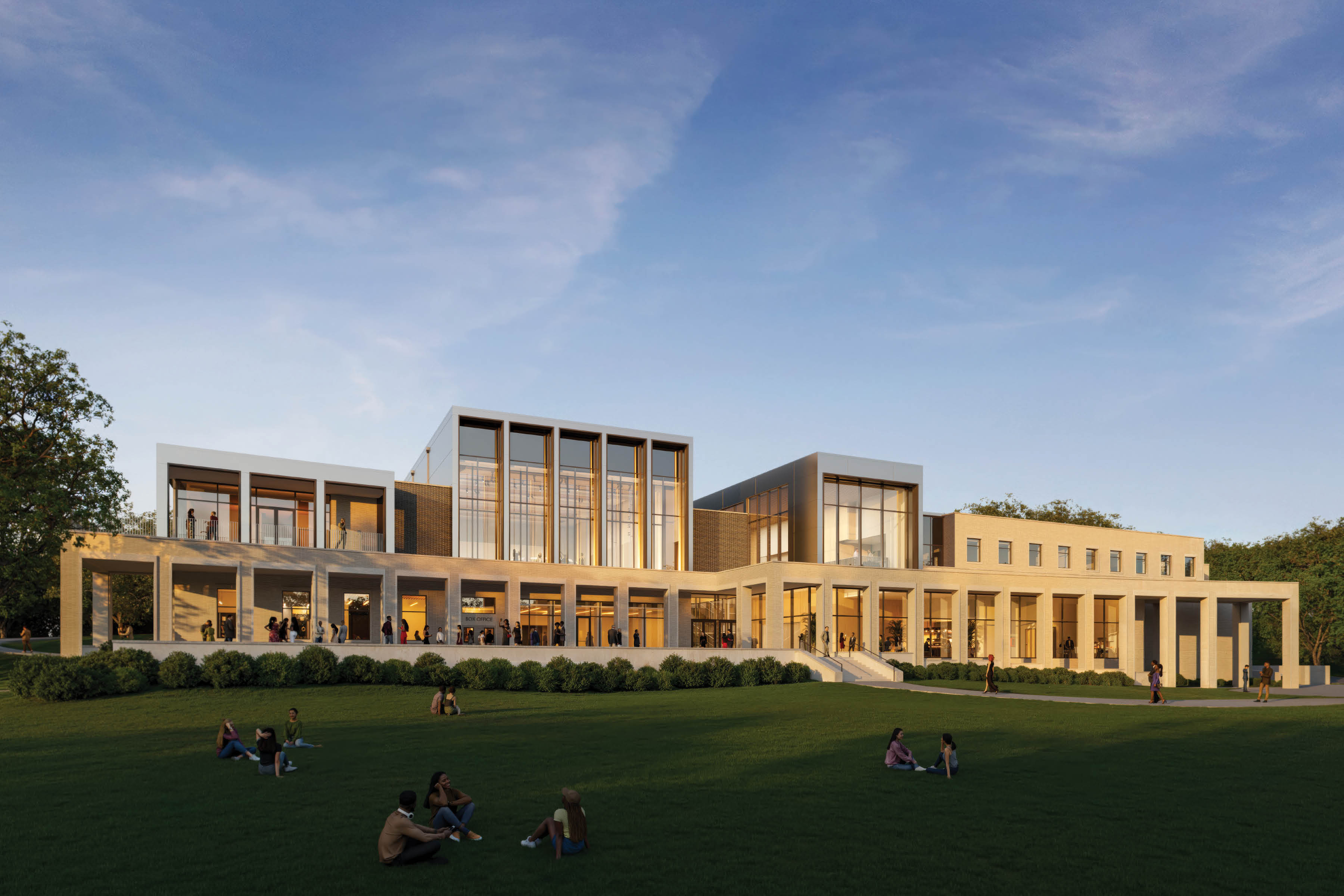
Atlanta Opera has just broken ground on a new home, the Molly Blank Center for Opera and the Arts, slated to open in Fall 2027. The company will begin modest programming there, which will include a series of recitals and smaller events in a planned Rosemary Hall recital space and Coca-Cola Immersive Theater, each seating about 200. It is being built on along the Atlanta Beltline on the edge of a historic golf course. The project is preserving the locally revered Bobby Jones Clubhouse as part of the design.
The capital campaign for the project is $72 million, which includes a $5 million endowment for maintenance.
And in June of 2029, Atlanta Opera plans to mount two consecutive “Ring” Cycle Festivals, timed for its 50th anniversary. The “Ring” will be mounted in the Cobb Energy Centre. The company’s principal conductor, Iván López Reynoso, will conduct. (Tickets and info here.)
Those are just some of the reasons why the opera industry agency Opera America named it one of the “Top 10” opera companies in America in 2024. Zvulun admitted to being “wet behind the ears” when he arrived. The board sent him to the Harvard Business School for an MBA, which resulted in a Harvard case study and a TED Talk on innovation in the arts.
Why do a “Ring”? “When you put on a high goal, it jolts an organization into a different metabolism,” he told us. “All departments, from the marketing staff to the orchestra, are transformed.”
Discover more from janellesnotes
Subscribe to get the latest posts sent to your email.
