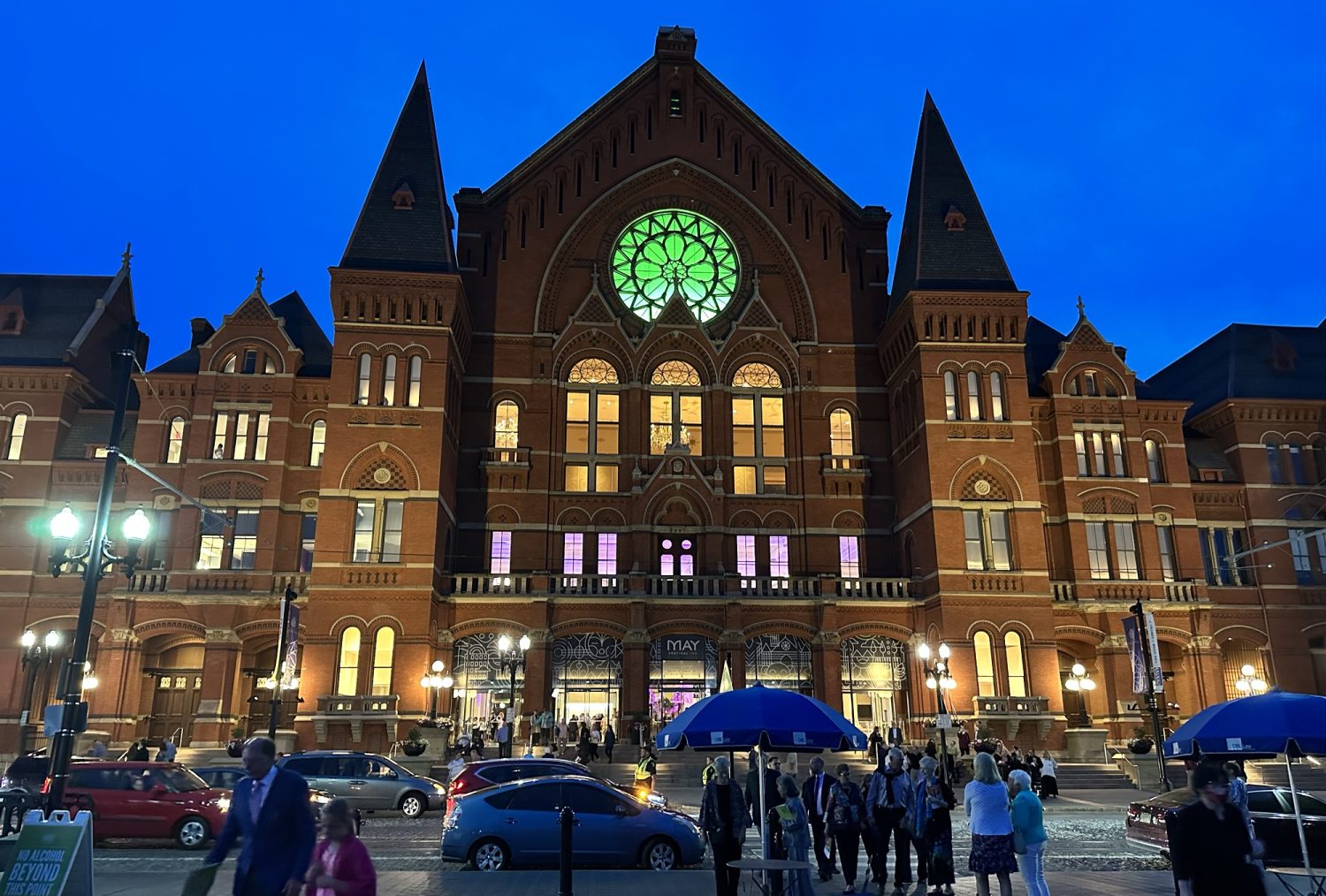
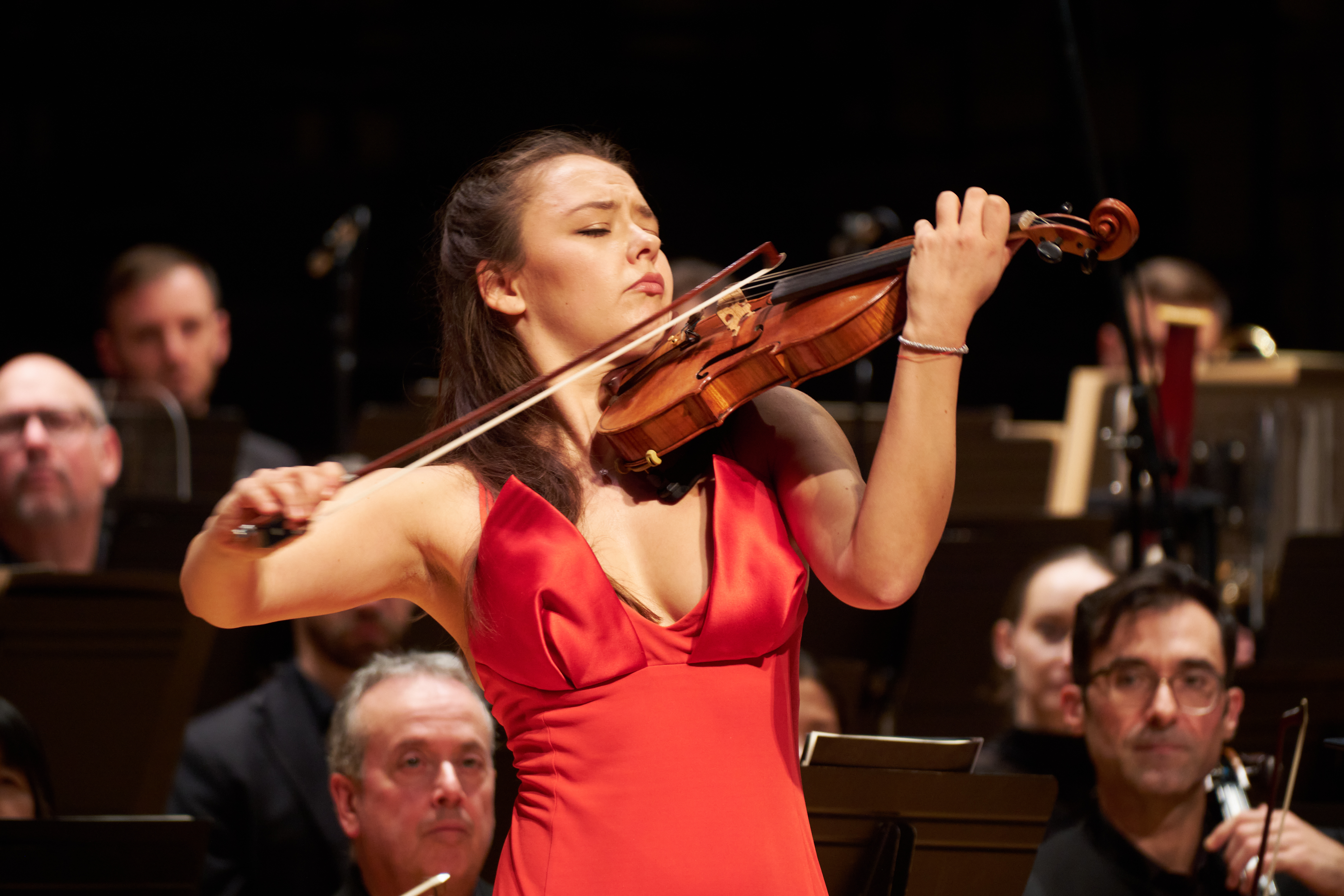
I doubt that anyone in Music Hall expected the firestorm of virtuosity that poured forth from Alexandra Conunova’s violin in the Khachaturian Violin Concerto. In her debut with the Cincinnati Symphony Orchestra on Oct. 17, Conunova flew through its difficulties in a breathtaking display.
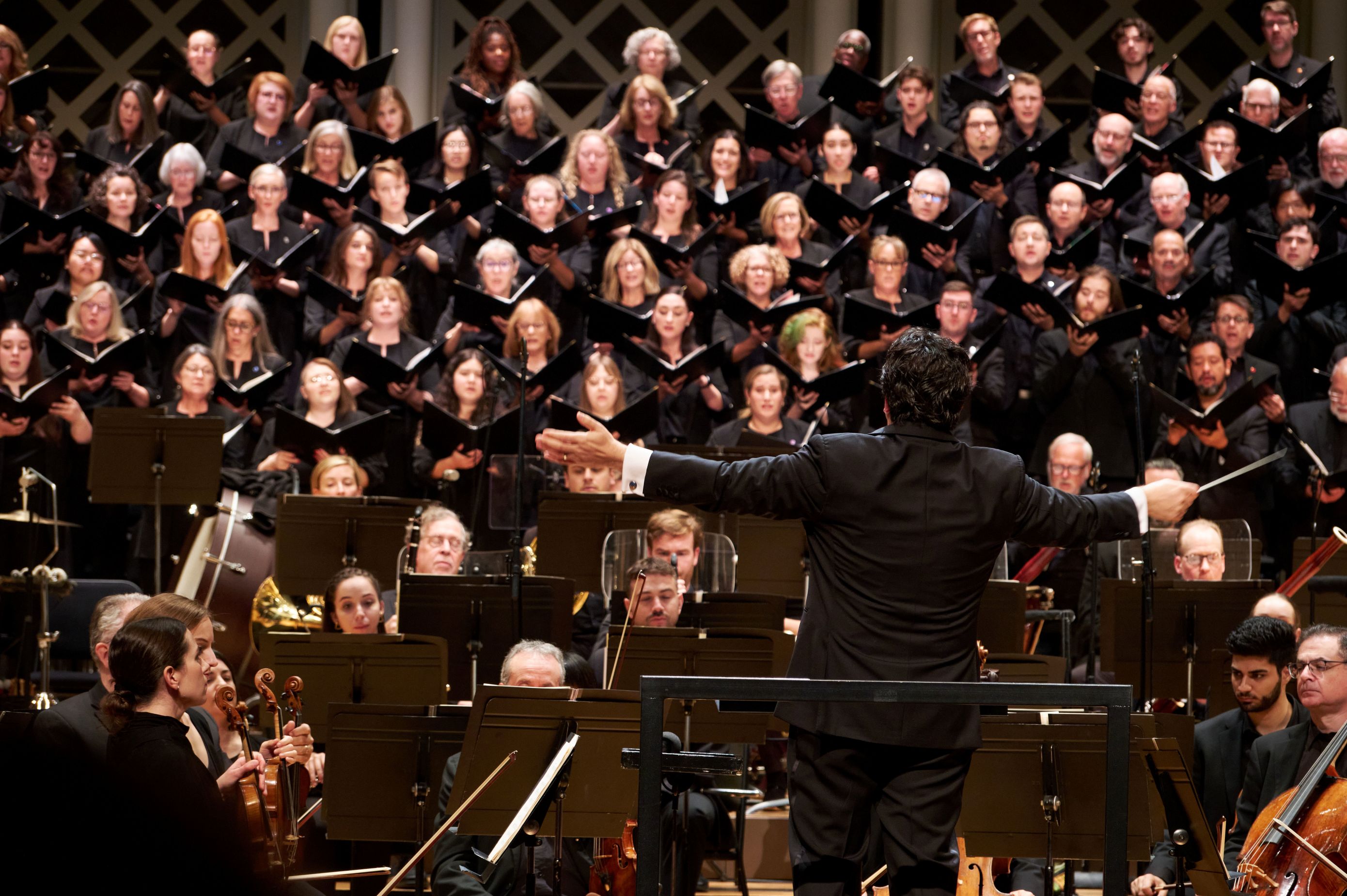
This weekend, CSO music director Cristian Măcelaru was on the podium leading a program of vastly different moods. Măcelaru, who is also an accomplished violinist who has played the daunting Khachaturian Concerto, told the audience that it was a challenge to find the right music to fill out the program “after a passionate and fiery first half.”
He found his solution – along with a great deal of inspiration — in Brahms’ “Nänie” and “Schicksalslied” (The Song of Destiny), performed after intermission with the May Festival Chorus. And, continuing the thread of themes evoking Greek mythology, he opened the program with the orchestra’s first performance of “Lamia,” a tone poem by British composer Dorothy Howell.
So, between the serene, there was Khachaturian’s showpiece. American violinist Rachel Barton Pine once compared its opening bars to heavy metal. The Armenian composer wrote it in 1940 for one of the greatest violinists of the 20th century, David Oistrakh. The central movement opens with a bassoon solo that is said to imitate the improvisations of the Armenian bards, or “ashugs.” Despite the popular appeal of its folk tunes and endless fireworks, hearing it performed live is a somewhat rare occasion. The most recent CSO performance was 15 years ago by Mikhail Simonyan under Paavo Järvi.
Conunova won first prize at the Joseph Joachim International Violin Competition in in Hanover, Germany in 2012, and has also won prizes at the International Tchaikovsky Competition in Moscow and the Singapore International Violin Competition. A native of Moldova, she performs on a rare Giovanni Battista Guadagnini violin made in Turin in 1785, ex-“Ida Levin,” on loan from a patron. With her Cincinnati Symphony debut, Conunova, now in her 30s, is making “a major expansion of her international presence,” her bio says.
The violinist dug into the opening phrases with intensity, her violin projecting a throaty sound. She tackled technical feats with flair, crouching as she reached for a low passage, turning to play with the orchestra, and swaying with the music. Her first-movement cadenza was an extraordinary technical display.
Yet her playing wasn’t all about speed and bravura. The first movement’s lyrical second theme had an attractive lightness. At the work’s center, the Andante sostenuto was the emotional summit, almost projecting notes of tragedy. She brought out its folk mood with sweetness of tone — perhaps partly a characteristic of her Guadagnini violin. After that bittersweet moment, the finale was exuberant. Her playing sparkled and she smiled through its difficulties with stunning control.
Măcelaru was the ideal partner, anticipating every note. The orchestra punctuated the soloist’s lines emphatically but never overpowered her sound. There were many excellent orchestral solos, among them the memorable solo for bassoon (Martin Garcia).
Following numerous ovations, Conunova returned for an encore that she commissioned in honor of Cincinnati’s musical heritage. Martin Hebel’s “For Common Purpose” used themes from Aaron Copland’s “Fanfare for the Common Man,” written for the CSO in 1942 as part of a wartime commissioning project by Eugene Goossens. She played its flourishes and familiar phrases with beauty of tone and depth of feeling, and the audience was clearly touched by the gesture.
After intermission, the May Festival Chorus was arrayed on risers behind the orchestra for Brahms’ two choral masterpieces, “Nänie,” Op. 82, and “Schickalslied” (the Song of Destiny), Op. 54. Măcelaru introduced the pieces with, “The next few minutes are about to change your life.”
Indeed, they were profound and, despite the solemn tone, uplifting. The chorus, prepared by Director of Choruses Matthew Swanson, sounded refined and luminous throughout both works, and the communication between chorus and orchestra was seamless. The orchestra shone in these works, with a memorable flute solo (Henrik Heide) in “Schickalslied.” The works were sung in German, with surtitles.
“Nänie,” a setting of Friedrich Schiller’s poem, touches on the Greek tragedies of Eurydice, Adonis and Achilles, with the overall message that “the beautiful, too, must die.” The choral sound in this reflective gem was hushed, even radiant, and the orchestra richly underscored the choral textures.
The poem for “Schickalslied” is from Friedrich Holderlin’s novel, “Hyperion: or, the Hermit in Greece.” Brahms’ music unfolded serenely as the poem evoked gods living peacefully. The rise to the fate (Schicksal) of suffering mortals was evoked by agitated strings and the chorus’ clipped enunciation.
Măcelaru’s reading provided many moments of reflective beauty. In the opening bars, he summoned extraordinary color in the violins as they played against a heartbeat in the timpani (Patrick Schleker). Upon the return of this music in the work’s final moments, the effect was transcendent.
The evening opened with the tone poem, “Lamia,” by Dorothy Howell (1898-1982). Howell’s music follows the tale of Lamia from ancient Greek mythology, as told by English poet John Keats. This was a wonderful find, an evocative work featuring bold writing for the brass, climaxes for full orchestra, exotic touches, and lots of romantic sweep. The composer wrote an engaging solo melody for the concertmaster, and Stefani Matsuo’s sound was radiant.
Discover more from janellesnotes
Subscribe to get the latest posts sent to your email.
