
It’s amazing that Carl Maria von Weber’s 1821 opera, “Der Freischütz,” is rarely performed in the United States. The early German romantic opera – which Queen City Opera loosely translated as “The Magic Bullets,” has a rich orchestral score, wonderful choruses and arias and a supernatural story. It’s easy to see how it paved the way to the German opera that was to come, especially that of Richard Wagner.
Isaac Selya, founder and artistic director of Queen City Opera and conductor for the production, told me in an interview for the Cincinnati Business Courier that the opera has only been performed once before in Ohio, by Cincinnati Opera in 1933. According to Operavore, the Met last performed this early romantic gem in 1972.
On Sunday, I joined many other opera lovers who were curious to see and hear Weber’s under-appreciated work, which was staged by Rebecca Herman.
Leading a good-sized orchestra of local professional musicians, Selya conducted the world premiere of a just-released critical edition by Schott.
Queen City Opera performed in the Finneytown Performing Arts Center, which provided the seven-year-old company with an orchestra pit for the first time.
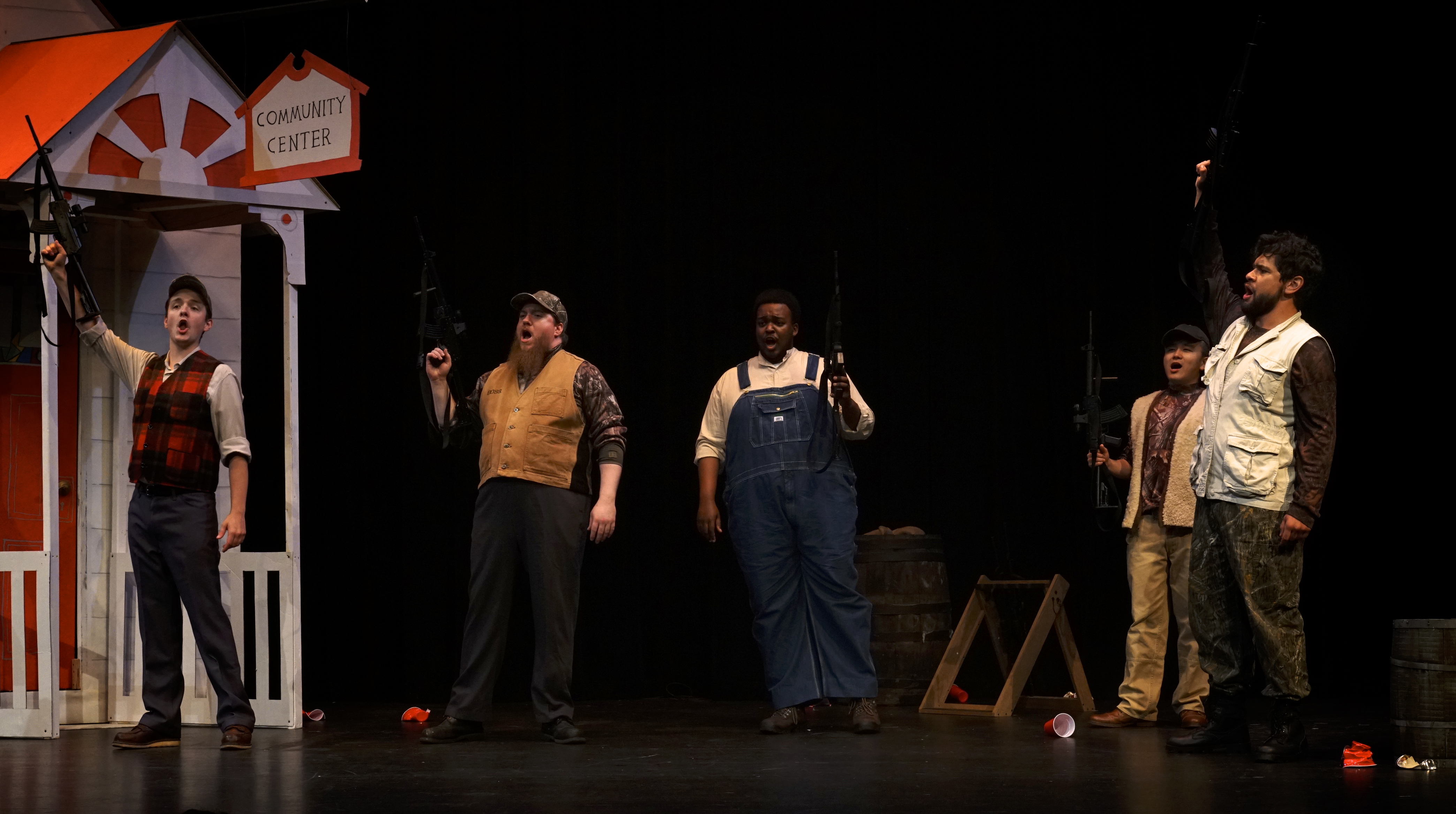
Because “Der Freischütz” is a tale about a shooting contest, Selya – who typically tries to highlight contemporary issues – decided to focus on the issue of gun violence prevention. The story was set in 1980s America, a period “when laws regarding assault rifles were in flux,” he said. “One thing we’re exploring in the opera is, is it about machismo? Do you feel like a man when you have a military grade rifle?”
On the stage, the cast wore clothing that could have been from an Orvis catalog and carried assault weapons rather than hunting rifles. When they fired, the sound effect of the gunshots was startling. Off the stage, a panel discussion preceded the performance with Ohio Ceasefire, Moms Demand Action and Cincinnati Works.
It was sung in German, while the spoken dialogue of the libretto by Johann Friedrich Kind was updated to modern English jargon. The production’s set design on a shoestring budget (by Lizzy DuQuette) centered on a single “community center” that became a spooky cabin for the Wolf’s Glen scene.
It all worked. But nothing impressed so much as Weber’s magnificent music, beautifully performed by Selya’s orchestra, and the cast of fine young singers that he assembled. What audience, after all, wouldn’t be charmed by the sheer joy of the famous “Hunters’ Chorus,” with its jolly hunting themes performed by four French horns? The score has many marvels. There were wonderful solos for the orchestra, including one for viola (I-Chen Su) and a lovely cello obbligato during Agathe’s Act III aria (Laura Jekel).
The Overture, with its horn calls, string tremolos and clarinet solo, was full of drama. Selya’s view throughout the work was flowing and spacious, and he propelled the drama seamlessly from the pit. One of the production’s interesting touches featured a pantomime during the overture – evidently restoring a scene between Agathe and the Hermit (or holy man) that Weber had deleted against his librettist’s wishes.
In the tale, which has roots in German fairy tale, Caspar has sold his soul to the devil (Samiel) in exchange for magic bullets. He’s in love with Agathe, who rejects him for Max. But before Max can win his bride, he must win a shooting contest, and Caspar arranges for Max to get magic bullets from Samiel, in exchange, of course, for his soul.
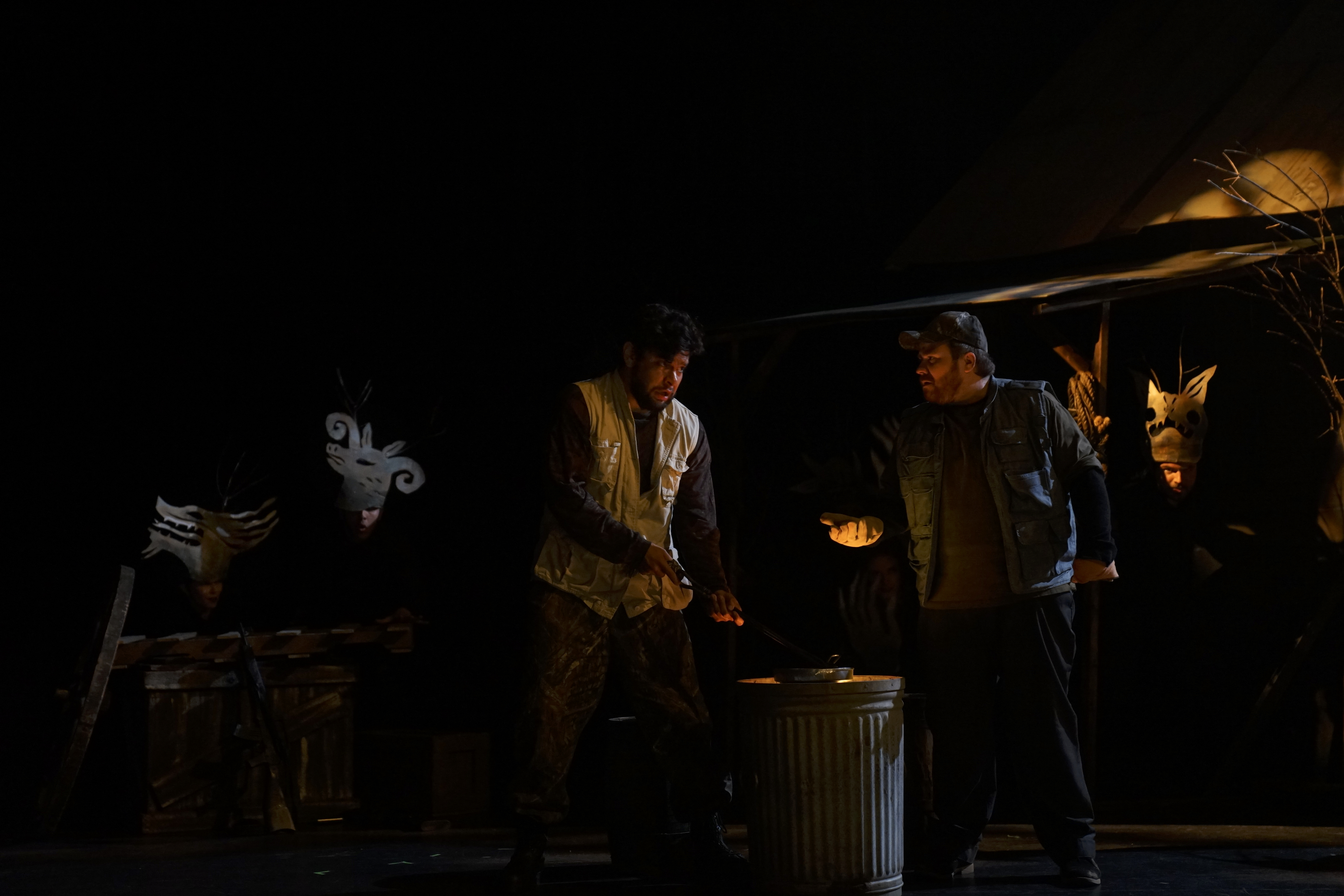
The Wolf’s Glen scene, which includes shrieks in the winds and in the chorus, was spinetingling – a scene that must have terrified 19th-century Germans. I loved the nocturnal fiends and monsters – chorus members in black with creepy head pieces, who writhed in the dark of the forest. The voice of Samiel (Matt Tschimperle) boomed through a speaker while Samiel’s shadow played on a wall. Caspar and Max both contributed their own blood, a kind of blood oath, into the brew that cast seven magic bullets. Max was unaware that one of them was destined to kill his bride.
As Max, M. Andrew Jones summoned a powerful tenor, with exciting high notes. His Max was a sympathetic fellow, who dramatically dropped to his knees and cried “I’m doomed” as he weighed his fate. Bass-baritone Brandon Morales was formidable as bad guy Caspar. He prowled the stage, seething with malevolence, and sang consistently with ominous, dark color.
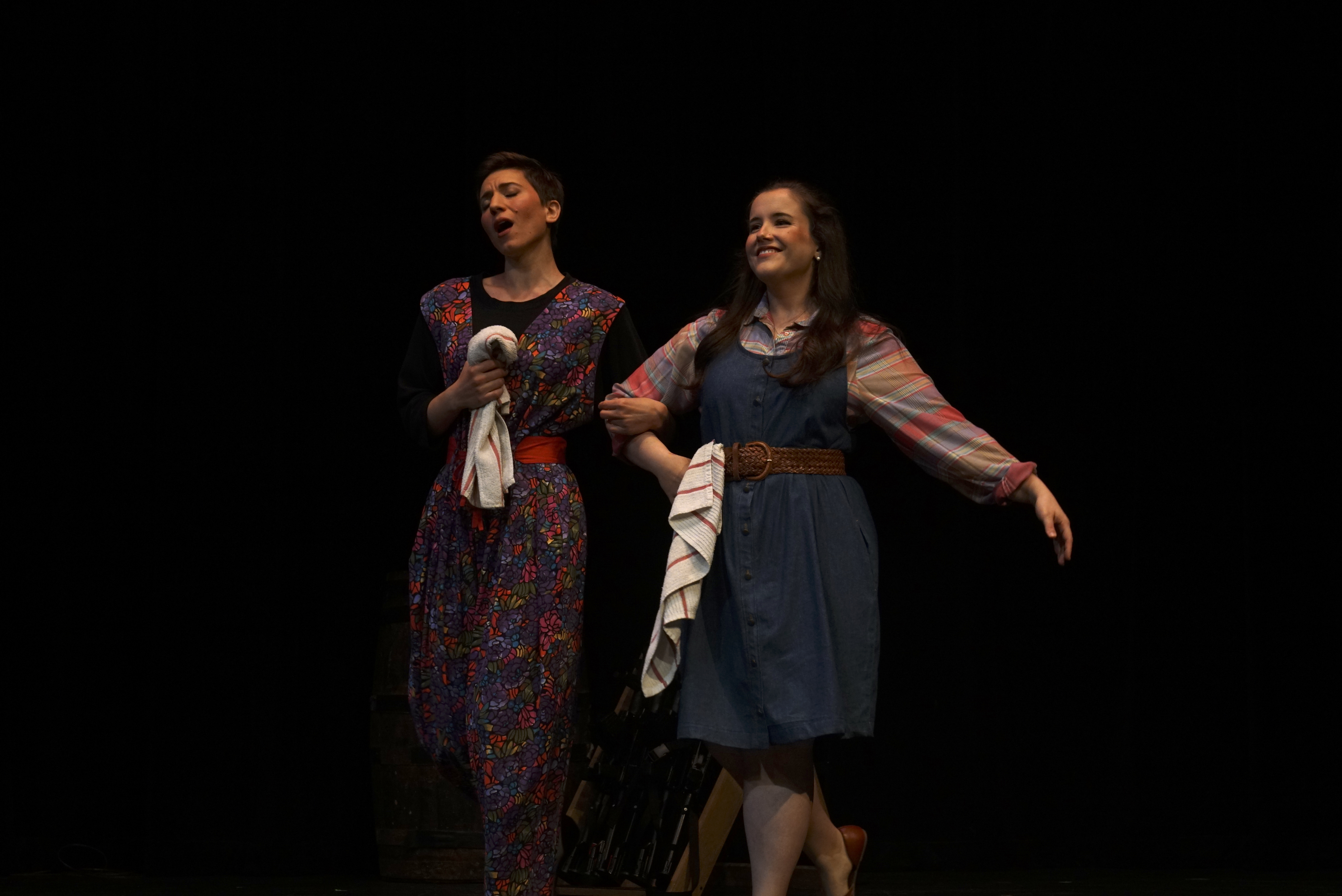
Erin Keesy made an engaging Agathe, and sang the lovely “Leise, leise” with wonderful intimacy and beautiful line. In the role of Ännchen, Alexandra Kassouf oozed personality and sang brightly through her role as Agathe’s cousin.
Simon Barrad was excellent in his minimal role of Ottokar. Smaller roles included a well-sung Cuno (Stephen Michael Hanna) and the noble holy man, Darrell Jones. The chorus shone as hunters, forest creatures and bridesmaids. In another inventive touch, Agathe opened the bridesmaids’ gift of a wreath, only to find a dead white dove instead.
Although the original fairy-tale ended darkly, the opera’s creators provided a happy ending. The bullet misses Agathe, but kills Caspar. The joyous chorus that ended the opera provided a moral to the tale: “Let us place our trust, not in might, but in integrity. Let the power of peace guide us to trust one another.”
It was another triumph for Selya’s Queen City Opera. We can only hope that he will bring us yet another discovery.
Discover more from janellesnotes
Subscribe to get the latest posts sent to your email.
