
This is always a busy time of year for Cincinnati’s classical music organizations. I’ve heard some extraordinary concerts between covering the concerts of the Cincinnati Symphony Orchestra (you can find CSO, May Festival, Cincinnati Opera and other reviews here).
Here are a few of my impressions of some other shows, including the debut of a new piano quartet, a stunning piano duo recital and a world premiere at concert:nova:
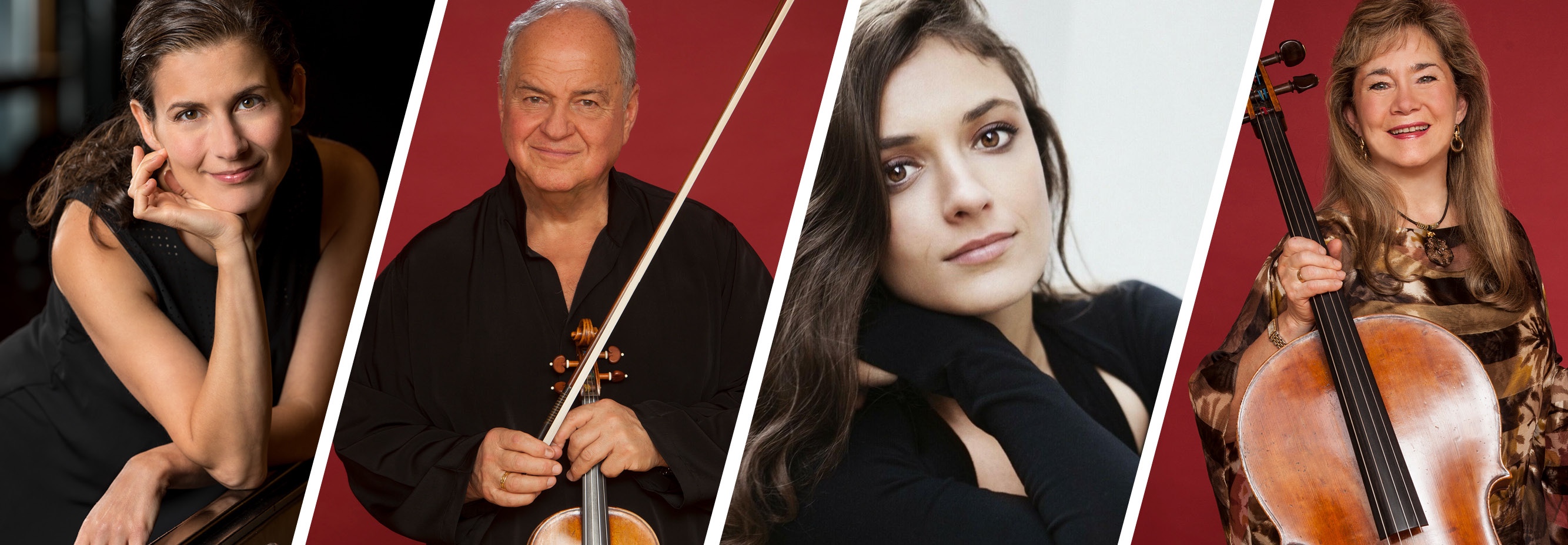 Linton Chamber Music series, April 24: Besides the piano trio literature, piano quartets are among my favorite genres. So I couldn’t wait to hear the debut of a new ensemble at the Linton Music Series, the Espressivo! Piano Quartet.
Its anchors are the indefatigable Jaime Laredo (violin) and Sharon Robinson (cello), who also serve as co-artistic directors. Rounding out the quartet are pianist Anna Polonsky and violist Milena Pajaro-van de Stadt, both superb artists.
In the wake the death of the esteemed pianist Joseph Kalichstein, who died in March 2022 at age 76, Laredo and Robinson did not want to revisit the piano trio literature that they shared for decades with their extraordinary pianist, “Yossi.” I’m so glad that they have decided to explore the quartets. The “Encore” concert I heard at Congregation Beth Adam was deeply rewarding.
The program opened with “Morpheus” for viola and piano by Rebecca Clarke. It was a gorgeous, Impressionistic work by the British composer (1886-1979). Apparently when it premiered in New York, Clarke used a male pseudonym so the critics might review it favorably (they did). Polonsky’s piano sparkled, and Pajaro-van de Stadt played with expressive beauty.
It was a rare treat to hear Fauré’s Piano Quartet No. 1 in C Minor. This was a ravishing performance by the ensemble. The piano was lush and supportive and the srings glowed. To finish, Brahms’ Piano Quartet No. 2 in A Major had both breadth and power, and the well-matched ensemble breathed together. The piece was somewhat moody until the red-blooded finale. They played the coda exuberantly and listeners were on their feet. More piano quartets from this group soon, please!
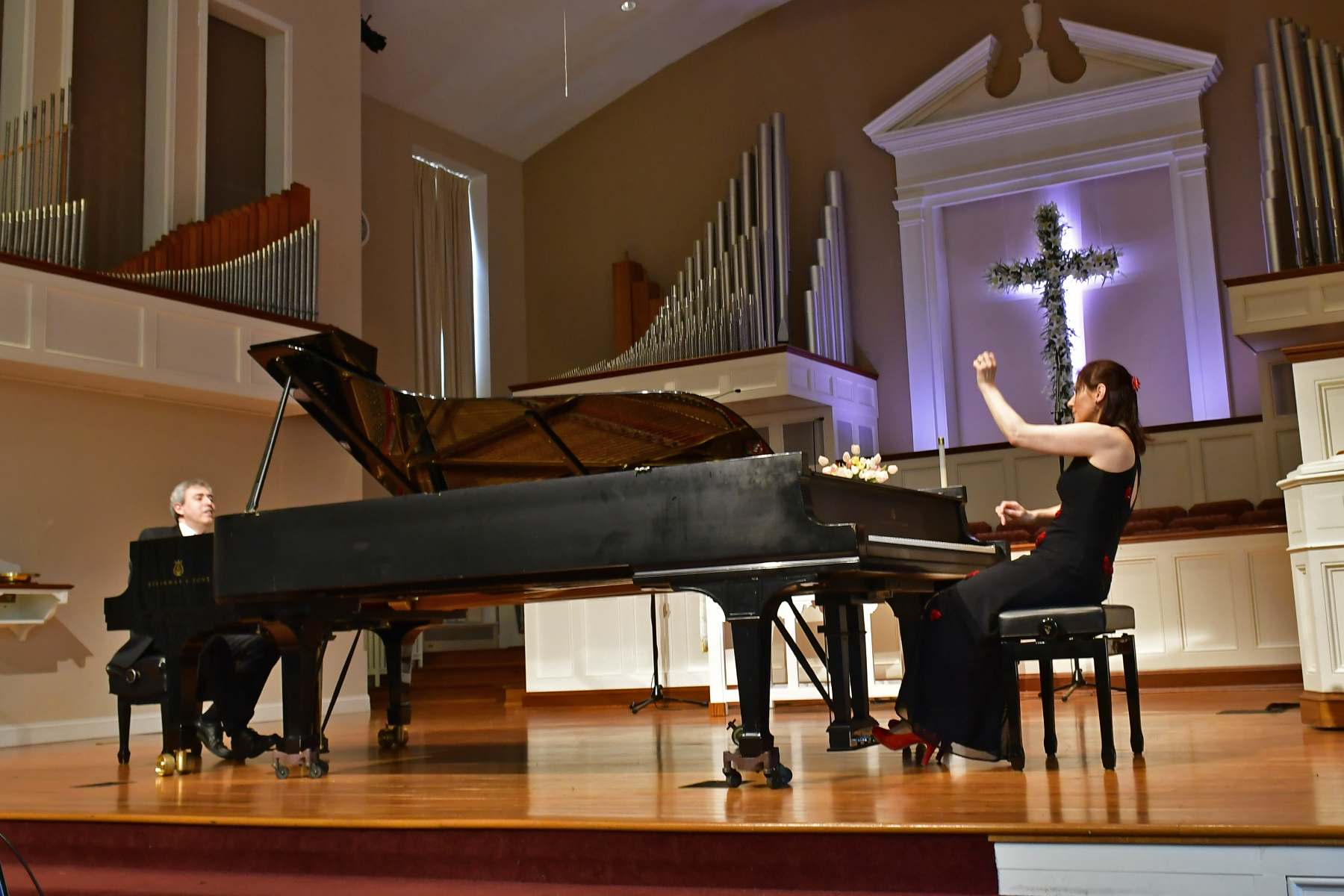
Photo by Gayna Bassin
Duo pianists: On Sunday, May 7, Matinee Musicale presented the superb Silver-Garburg Piano Duo for a large crowd at Anderson Hills Church. Born in Israel, Sivan Silver and Gil Garburg are also a married couple. Perhaps that explained their “sixth sense” in their perfect communication at two 9-foot concert grand Steinways. Based in Berlin, the couple tours internationally as champions of the duo piano repertoire. They occupy one of the few professorships devoted to the piano duo at the Graz University for the Arts in Austria.
The pianists performed their entire program from memory. They opened with Mendelssohn’s Overture to “A Midsummer Night’s Dream,” a transcription by the composer for one-piano, four-hands. Silver took the first part, and her articulation of the fairy music flew like the wind. Their two personalities were instantly evident — she passionate, he more elegant.
Franz Liszt’s Sonata in B Minor was arranged for two pianos by Camille Saint-Saëns. The precision of their unison opening theme was astounding. They summoned orchestral sonorities in one of the great romantic works in the piano repertoire. Lyrical themes were beautifully shaped, and they played glittery runs with panache. Besides the technical prowess, there was lots to admire in the color and singing tone of this performance. The final fugue, which pitted piano against piano, was mesmerizing.
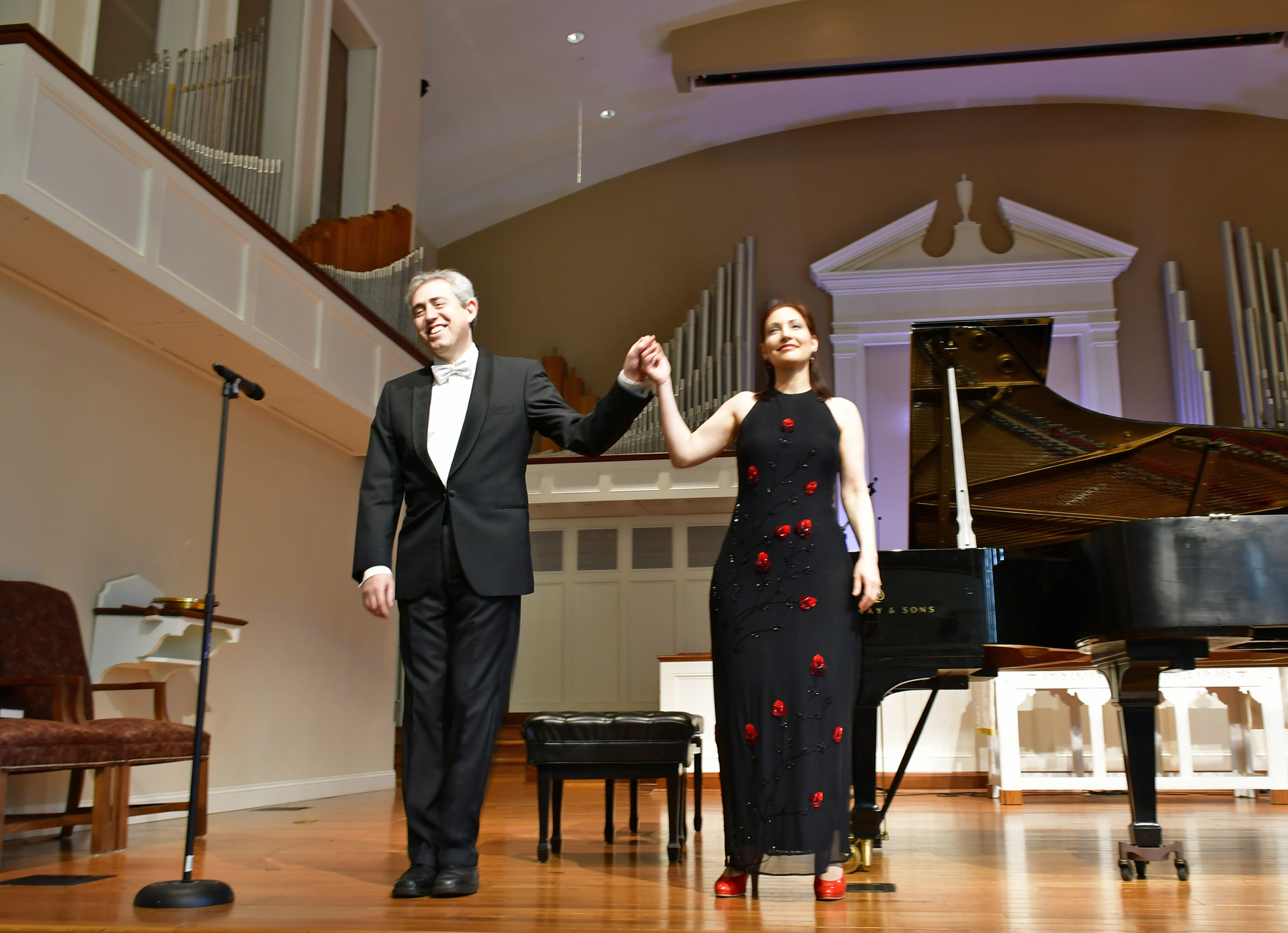 The second half opened with a nuanced performance of Schubert’s Fantasy in F Minor for one piano, four-hands. Saint-Saëns again made an appearance, this time in the “Introduction and Rondo Capriccioso” — originally a violin solo — in a transcription for two pianos by Debussy. It was a true rediscovery of a work you’ve heard many times in concert halls. This was a showpiece full of trills, runs and Spanish flair. The pianists’ playing was absolutely pristine. They breathed together and communicated its joy together.
For encores, they treated with a splashy “Malagueña” and finally, Brahms’ Lullaby.
Remembering the LaSalle Quartet — On Monday, May 8, concert:nova performed a tribute to the LaSalle Quartet, which was quartet-in-residence from 1953 for more than 30 years. The quartet became world-renowned for championing the quartet literature of 20th century composers, were leading proponents of the Second Viennese School, and resurrected the music of Alexander Zemlinsky.
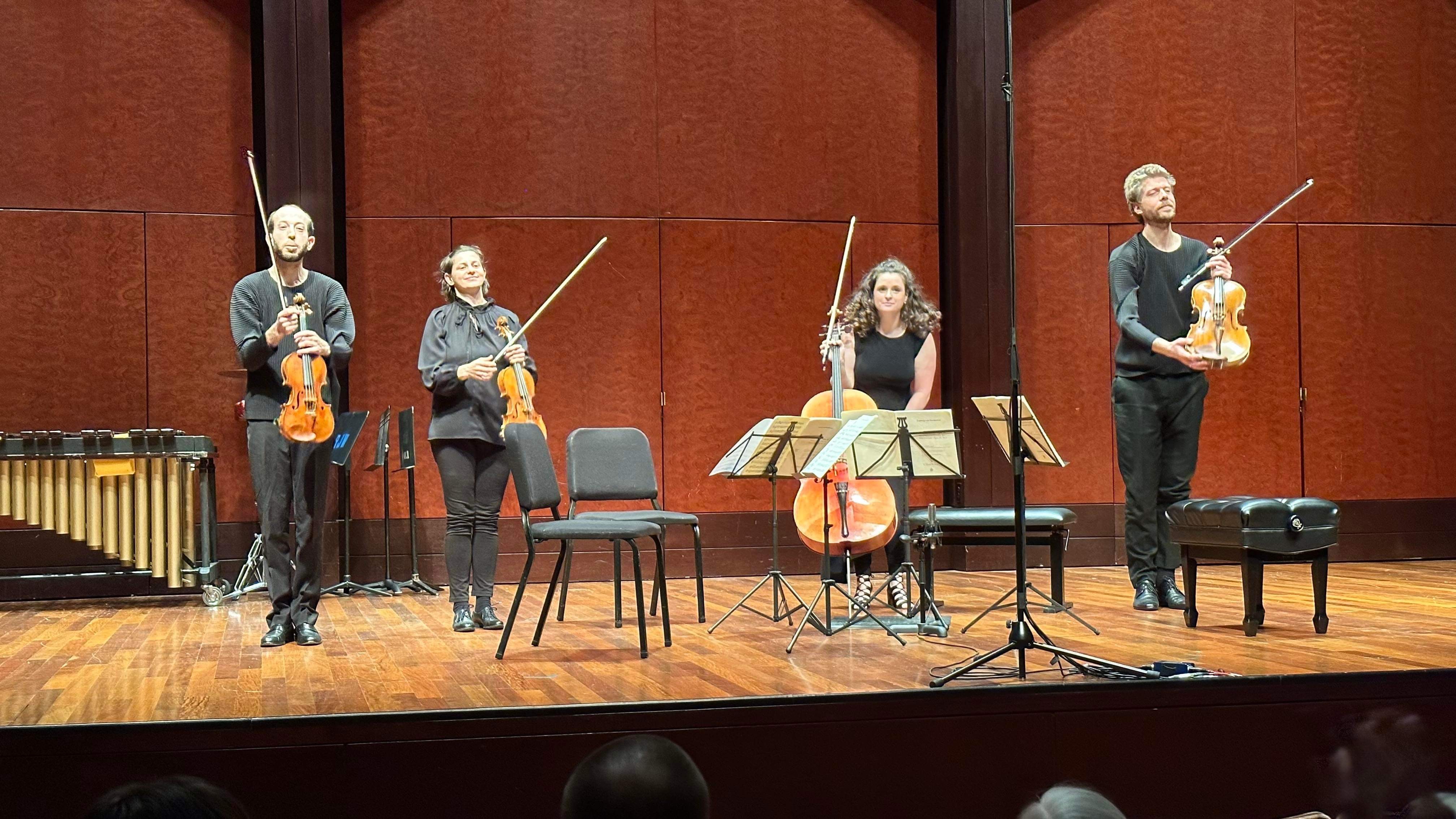
The links on this concert included the Ariel Quartet, who studied with members of the LaSalle, as well as the composer John Cage, whose String Quartet was recorded by the LaSalle and who did a residency at the school in the 1967-68 academic year.
And following in the footsteps of the LaSalle is concert:nova, founded by CSO clarinetist Ixi Chen. Since its founding in 2007, it has commissioned an astounding 50 new works. Not surprisingly, most of the music on the program was music of today — something the members of LaSalle would have appreciated.
It was an ambitious and diverse program that ranged from Beethoven’s Quartet No. 6, Op. 18 to a world premiere by Julia Adolphe. So I will start with those.
Any chance to hear the Ariel Quartet is a treat. The CCM faculty quartet-in-residence — Alexandra Kazovsky, Amit Even-Tov, Gershon Gerchikov and Jan Grüning — travels the globe with a busy concert schedule. Recently, I wrote about Even-Tov’s very special cello, here.
The hallmarks of the Ariel Quartet include their split-second precision, freshness of spirit and stunning artistry. All of those were on hand in their performance of Beethoven’s Quartet No. 6 in B-flat major, Op. 18, in the second half of this concert.
Gerchikov was playing in the first chair this time. He’s always an animated player, and this was an envigorating dialogue between colleagues, energized from their first notes. In the Adagio, there was stuning unity of sound between players. The scherzo had exciting precision and clarity. The finale was sublime, especially the Adagio introduction, in which the sound of Even-Tov’s cello was almost vocal.
A birthday gift: American composer Julia Adolphe was in town to talk a bit about her new work, “Silver Shadows on Sweeping Snow,” commissioned by longtime supporters Ann and Harry Santen in honor of Ann’s birthday. It was inspired, Adolphe said, by the Artic landscape she experienced on her honeymoon in Norway. She said she tried to capture the majesty of the land despite the harsh elements. The work is in three parts, beginning with the “delicate fragility of ice and the looming shadow of mountains.” There was also a love duet for her husband, and for the other couples involved, including both the performers and the commissioning couple.
Violinist Stefani Matsuo and cellist Hiro Matsuo performed its world premiere. It was a ravishing piece. The work opened with bleak harmonics in both instruments, and soon became an animated dialogue with full-bodied sound. The work grew into an impassioned theme in the violin against long tones in the cello, just one example of Adolphe’s gift for melody. Stefani Matsuo communicated with a rapt sound as she concluded the work in the stratosphere of her instrument.
There were many other wonderful works on this program. I really enjoyed Julien Monick’s “Architects of a Whimsical Nature” for Ted Nelson, who played cello and bass drum, and Joe Bricker, one of the newest members of the CSO percussion section, who played marimba. It was a bright, syncopated work that bubbled along with inventive colors in a perpetual motion.
The program opened with Chen and Nelson (another married couple) performing Pierre Jalbert‘s “Shimmer and Flow,” and indeed, it did. There was also a haunting work by Jasmine Moni Guo, currently a CCM faculty member, who has scored music for 40 short films. This was performed by Philip Marten on violin, Nelson on cello and Ben Freimuth on bass clarinet.
Finally, there was Cage’s String Quartet in Four Parts, with violinists Marten and Mari Lunde, violist Caterina Longhi and Nelson on cello. The first three movements were muted and veiled… which made the folk-like fourth movement all the more startling.
Discover more from janellesnotes
Subscribe to get the latest posts sent to your email.
