Linton Series opens season with a world premiere

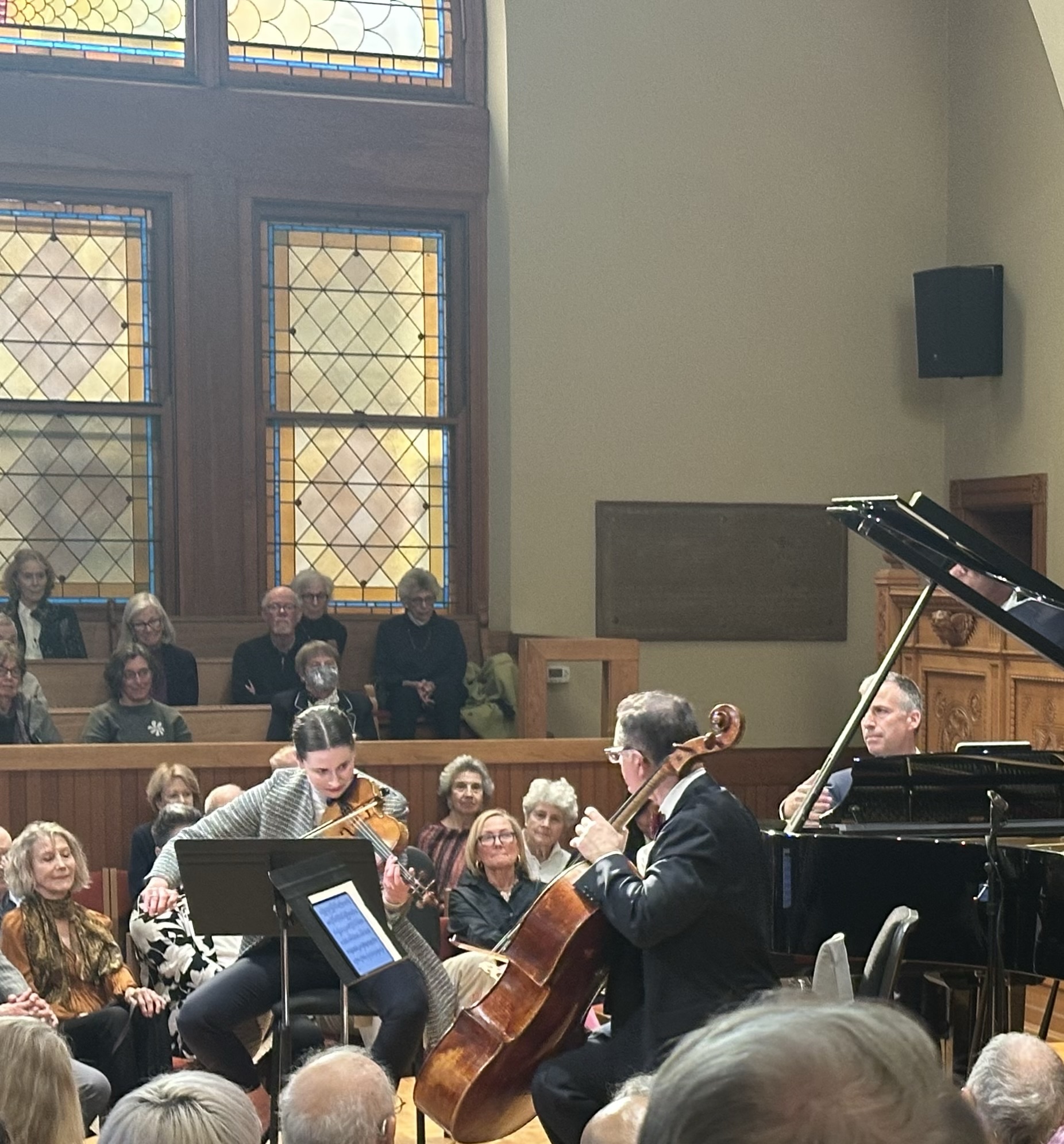
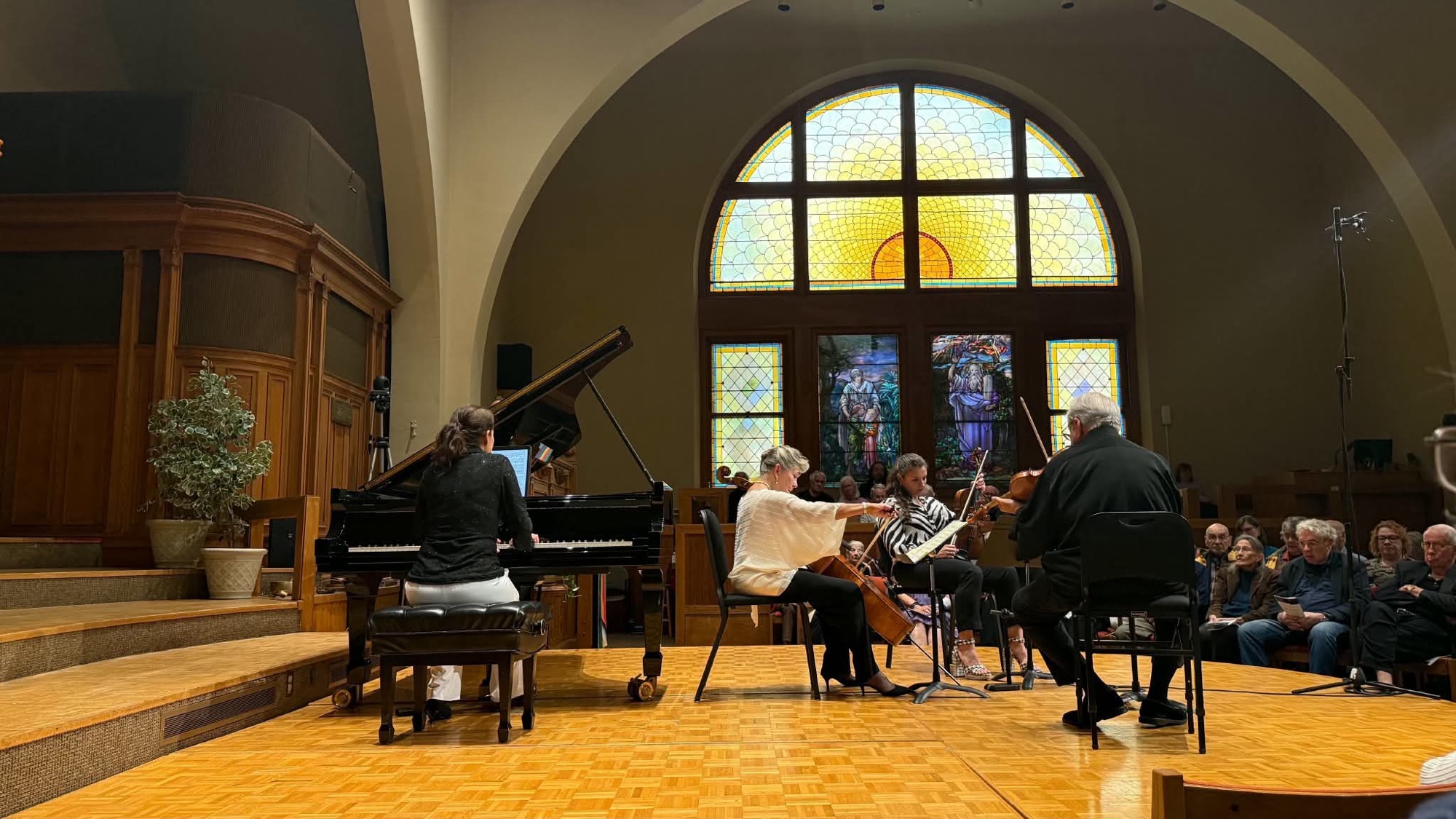
The Linton Chamber Music Series opened its season in the First Unitarian Church/ photo by Michael T. Moore

It’s always a special occasion when co-artistic directors Sharon Robinson, cellist, and Jaime Laredo, violinist, are in town to perform on the Linton Chamber Music Series. Last Sunday and Monday (Oct. 11-12) the couple’s Espressivo! Piano Quartet, with Anna Polonsky and violist Milena Pajaro-van de Stadt, opened the Linton Chamber Music season.

I was at the the Sunday matinee in the First Unitarian Church, to hear the world premiere of Richard Danielpour’s “Epiphanies for String Trio,” as well as piano quartets by Dvořák and Schumann.

Danielpour composed a number of works for Robinson and Laredo (who are married), and also wrote a piano trio for the Kalichstein-Laredo-Robinson Trio, which reigned for 45 years as one of the world’s finest piano trios until the untimely death of its superb pianist, Joseph “Yossi” Kalichstein in 2022. (Opera goers may recall that Danielpour also was the composer for the opera “Margaret Garner,” to Toni Morrison’s libretto in 2005, a Cincinnati Opera co-commission.)

On this occasion, Danielpour, 70, wrote a string trio, dedicating its final movement to Kalichstein’s memory. Scored for violin, viola and cello, it is a co-commission by a consortium of organizations, and was supported locally by Ann and Harry Santen.

Pajaro-van de Stadt (viola) joined Robinson and Laredo for the first performance of “Epiphanies.” Danielpour wrote in his program notes that its title “implies a sense of discovery and revelation.” He wrote it at a time when he was turning 70, adding, “In reviewing the joys and sorrows that life inevitably brings, I realized that all of this life brings the potential for new discoveries and understandings.”

Like many of his chamber music works, the outer movements were slow. The first, “Adagio cantabile,” opened with a well-crafted fugue. As I have come to appreciate in his music, his gift for lyricism was always at the fore. The string trio warmly intoned these lines, which were broken only by a brief moment of intensity before subsiding. In the radiant setting colored by the church’s Tiffany stained glass windows, it was a meditative experience.

My favorite movement, though, was the “Vivace leggiero.” The musicians played with an attractive lightness in this dance-like movement, which was highlighted by a counterpoint of pizzicatos. To me, its somewhat muted atmosphere reminded me of the Impressionists. The finale, “Adagietto,” featured a reflective melody for Laredo’s violin, and unfolded like an elegy. It was quite moving.
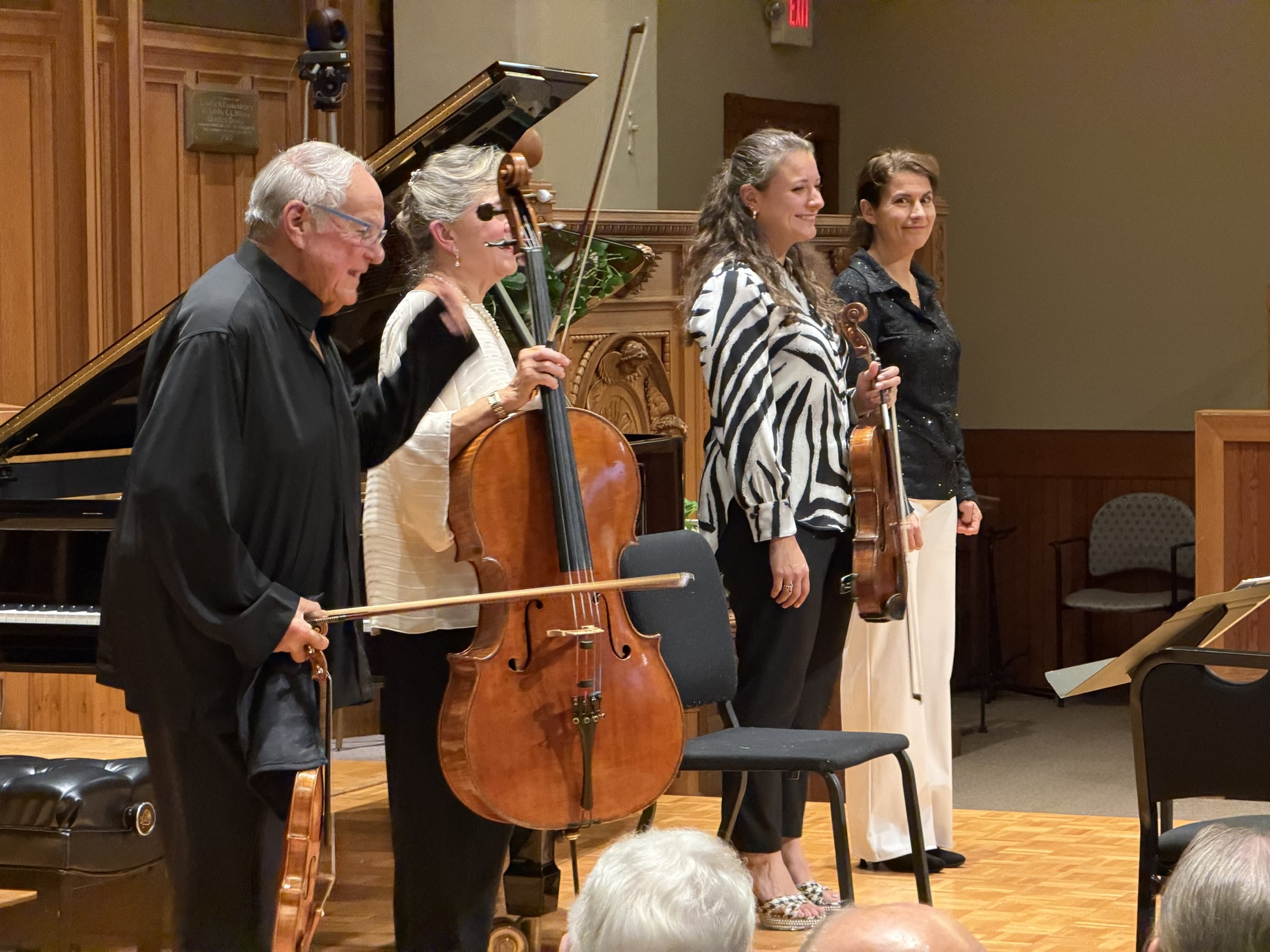
The first half also included a rarity: Dvořák’s Quartet No. 1 in D Major, Op. 23. Indeed, the quartet was playing it for the first time. The composer was 34 and at the start of his career. He was just beginning to merge Czech folk tunes and rustic dances and rhythms into his music, and this piece offered a window into his process that would be refined in his great works-to-come, such as the American Quartet and the Dumky Trio.

It was just three movements. I found great joy listening to Polonsky’s marvelous touch in this work, and also in the Schumann. The pianist’s runs sparkled, and she played with weight, yet never overpowered her colleagues. The second movement was an Andantino with variations, and the players carried on a charming dialogue — sometimes between strings, sometimes between piano and strings. Its final variation had the kind of nostalgic quality that only Dvořák can evoke. The finale, “Allegretto scherzando,” was fleet with moments of virtuosity for the pianist.

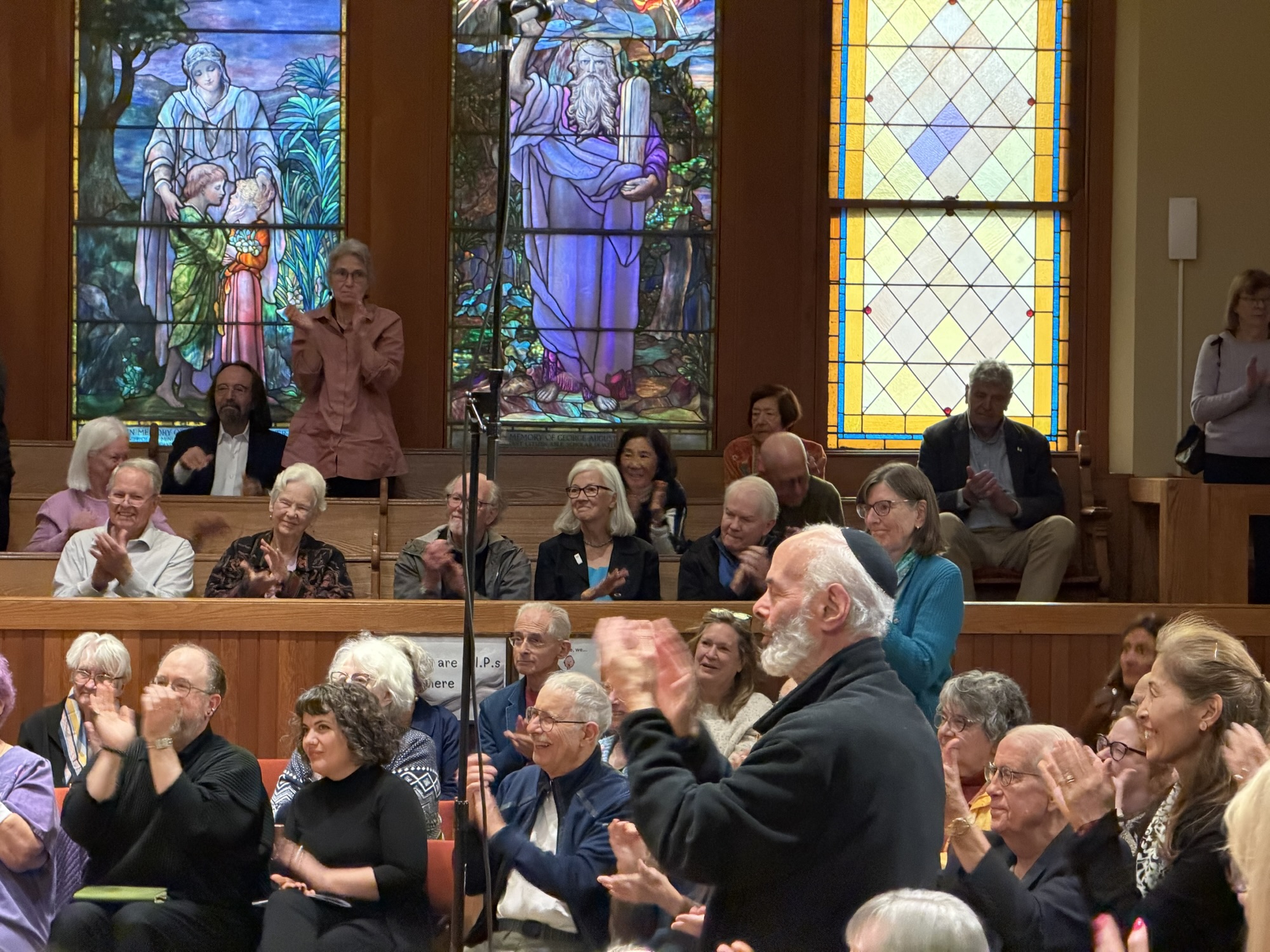
After intermission, we were treated to the afternoon’s most glowing and most polished performance in Schumann’s Piano Quartet in E-flat Major, Op. 47. Of course, Schumann wrote it for his beloved Clara, and it has a wonderful piano part. Robinson also explained to the audience that the score requires the cellist to re-tune her C string down a step to B-flat, before the third movement, and then back again for the fourth. That bit of inside information clearly caught the viewers’ attention in those moments. In the heart of this quartet, “Andante cantabile,” Robinson’s phrasing of the theme truly sang, and her tone was glorious. Her expressive beauty was matched by the other members of the quartet as the theme was traded between instruments.
Coming up: I know you’ll want to hear the Balourdet String Quartet perform Amy Beach’s String Quartet, as well as her Theme and Variations with flutist Demarre McGill, as well as Ravel and Joan Tower, Nov. 1-2. Information: lintonmusic.org.


Kronos Quartet rivets in Cincinnati program

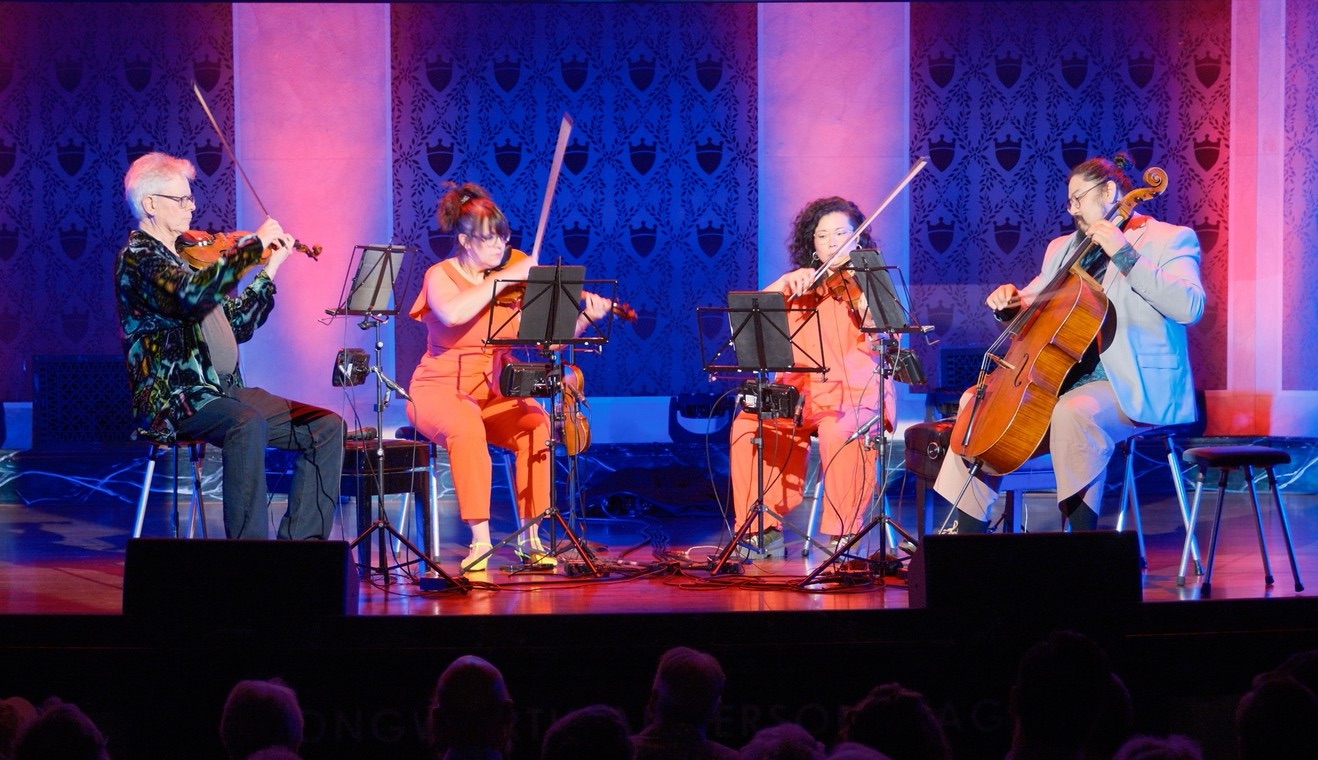
The Kronos Quartet in Memorial Hall. Photo thanks to J.P. Leong

At 53, the Kronos Quartet has a vast catalog of music of our time. On Tuesday (Sept. 29), the Kronos opened the Chamber Music Cincinnati season with a thought-provoking, compelling and sometimes humorous program in Memorial Hall. Each piece on their substantial program of 10 works (and two encores) was written or arranged for the quartet.

The summit of the evening was Philip Glass’ String Quartet No. 5, written in 1991 for the Kronos, a nod to the close relationship the quartet has had with Glass, now in his 90th birthday season.

Founding violinist David Harrington was joined by his new colleagues Gabriela Díaz (violin), Ayane Kozasa (viola) and Paul Wiancko (cello). Memorial Hall was packed with longtime fans of the quartet, as well as students, some of whom had studied with Kozasa at CCM. True to their commitment to education and mentoring, they had spent time working with young musicians at Walnut Hills High School.

As is usual in the quartet’s groundbreaking programs, selections were enhanced by video and sound, performed by Brian H. Scott (lighting designer) and Scott Fraser (sound designer). Several pieces were accompanied by historical footage or black-and-white newsreels. Their instruments were amplified, which enabled the musicians to create ethereal soundscapes.Read More »

Ariel Quartet opens its 15th season and a new piano faculty member takes a bow

L to R: Ariel Quartet members violinists Gershon Gerchikov, Alexandra “Sasha” Kazovsky and violist Jan Grüning; pianist Liza Stepanova and Ariel Quartet cellist Amit Even-Tov

It’s hard to believe that the Ariel Quartet has been quartet-in-residence at CCM for 15 years. Lest we ever take this astonishing young ensemble for granted, it’s important to know that their annual concert performances are as fresh, invigorating and insightful as they were when they’d just arrived.

The Ariels – violinists Alexandra “Sasha” Kazovsky and Gershon Gerchikov, violist Jan Grüning and cellist Amit Even-Tov – came together as teenagers in 1998, and three are original members. Lately, their big project has been to record the entire cycle of Beethoven String Quartets. Vol. III is expected out any day on CD and on streaming platforms. Read more about that here.

Their program, titled “Blueprints,” included Haydn’s String Quartet in C major, Op. 33, No. 3 (“The Bird”) and the Pulitzer Prize-winning composer Caroline Shaw’s “Blueprint” in the first half. (The Ariel will reprise these two works on Dec. 8 at Carnegie Hall.)

After intermission, the quartet was joined by CCM’s newest member of the piano faculty, Liza Stepanova, who played superbly in Shostakovich’s Piano Quintet in G minor, Op. 57.

The small Werner Recital Hall at CCM was jam-packed with faculty members, students, patrons and loyal fans of the quartet. They opened with Haydn’s Quartet Op. 33, No. 3, subtitled “The Bird” – either for its chirping opening theme or the trilling duet of the violins in the second movement. Read More »

Sparkling Streams for instruments and computer

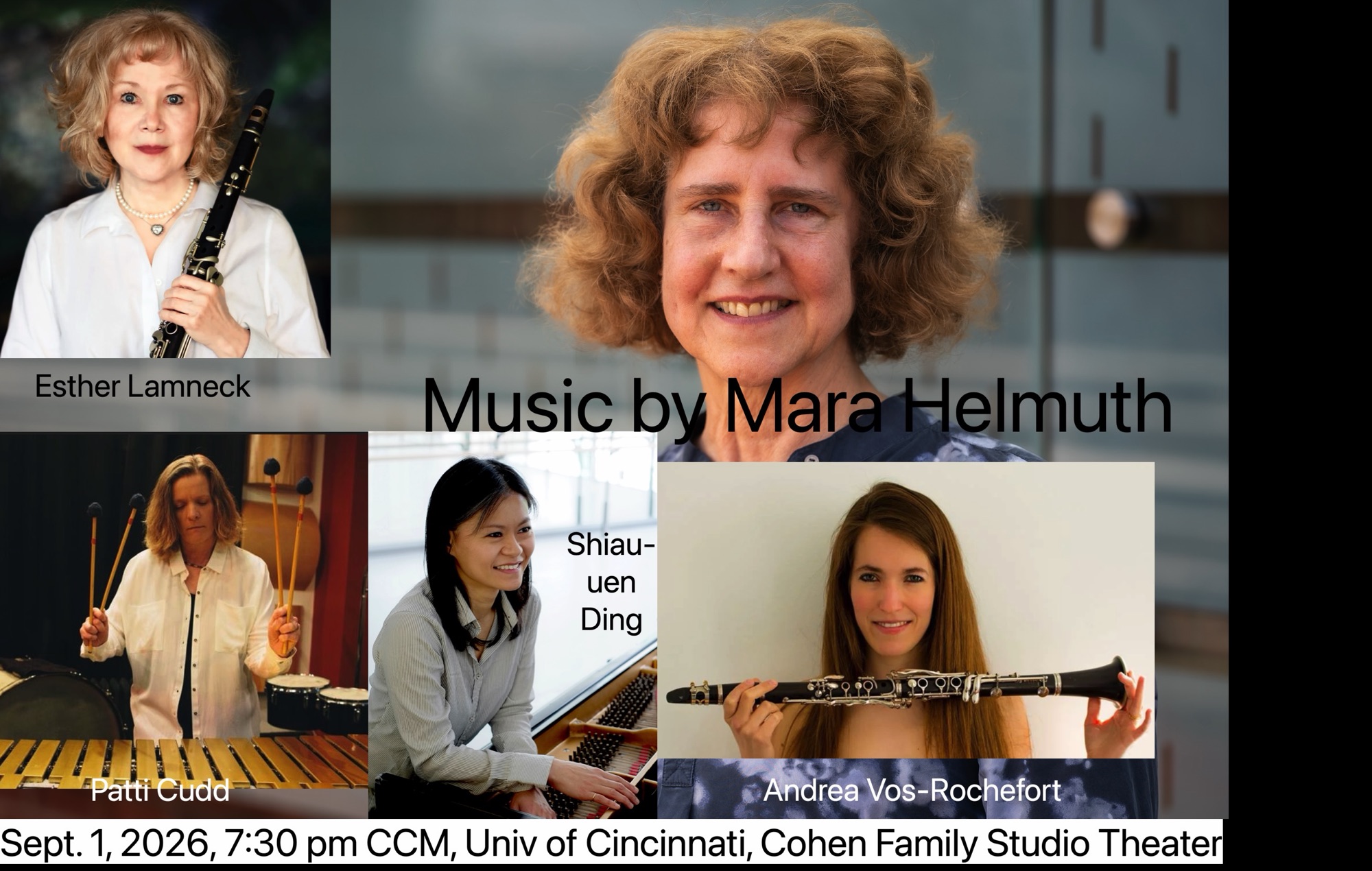
The Fall concert season is fast approaching. One of the first concerts that caught my eye was CCM composer Mara Helmuth’s Faculty Artist Recital titled: SPARKLING STREAMS: Music for Instruments and Computer.

The concert is 7:30 p.m. Sept. 1 in Cohen Family Studio Theater at CCM.

Mara is a pioneer of computer music in Cincinnati, the director of CCM’s Center for Computer Music and a 2025 Guggenheim Fellow. When I was an undergrad at Stanford University, I’d sometimes catch a concert by John Chowning, who set up the first research center for computer-based technology as a means for artistic expression.

Technology has traveled light years since then. You don’t have to be a computer geek to enjoy the sounds that will be created in this concert of multichannel and multimedia works by Helmuth and collaborators.

You will hear two world premieres, multimedia and several environmentally-themed works: “Burren Wind” for tárogató (also known as Turkish pipe); video and 8-channel computer music; “All Alarms Sounding” for piano and electronics; “Night Shimmer” for vibraphone and electronics; “Water Birds” for clarinet and computer music; “Messages from a Hot Rotating Star” (live pulsar data sonification and visuals), and “Wind Blown Rain” for tárogató, video and computer music.

Guest artists are Patti Cudd, percussion; and Esther Lamneck, tarogato; and alumni artists Shiau-uen Ding, piano and Andrea Vos-Rochefort, clarinet.

Estimated run time: 90 minutes
Location: Cohen Family Studio Theater. CCM
Admission: FREE

Impressions on a spring weekend in Cincinnati –Art and Linton Series

I shouldn’t have been astonished when I saw thousands of people Friday night streaming to events in the Washington Park area of Over-the-Rhine. However, this wasn’t about Flying Pig, the great Cincinnati marathon that was happening that weekend, or FC Cincinnati. All those people were going to see Damon Gupton conduct the music of Star Wars with the Cincinnati Pops at Music Hall, as well as to theaters, Memorial Hall, events at the School for Creative and Performing Arts, to Washington Park and to an art opening in a tiny gem of a gallery a few steps from Music Hall.

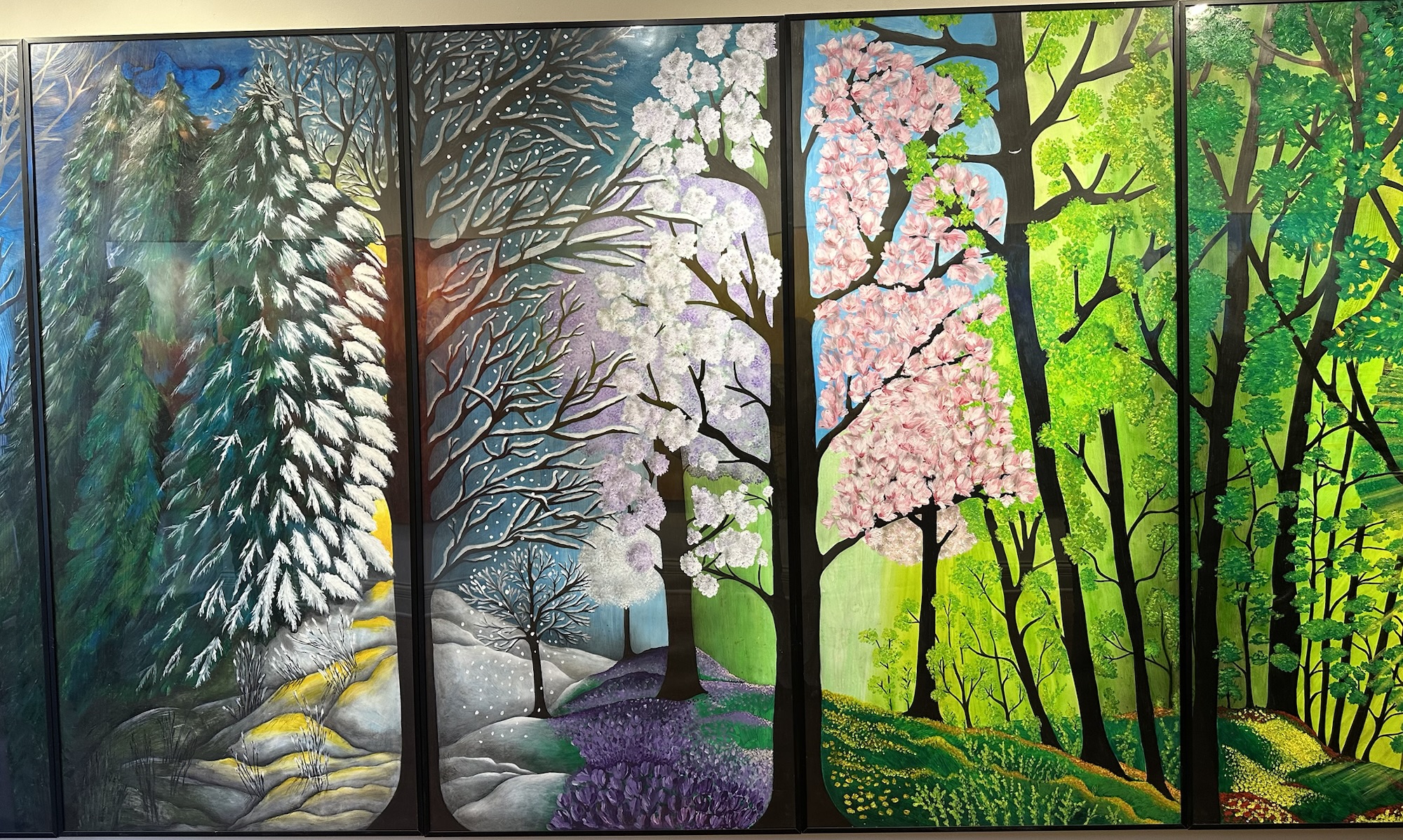
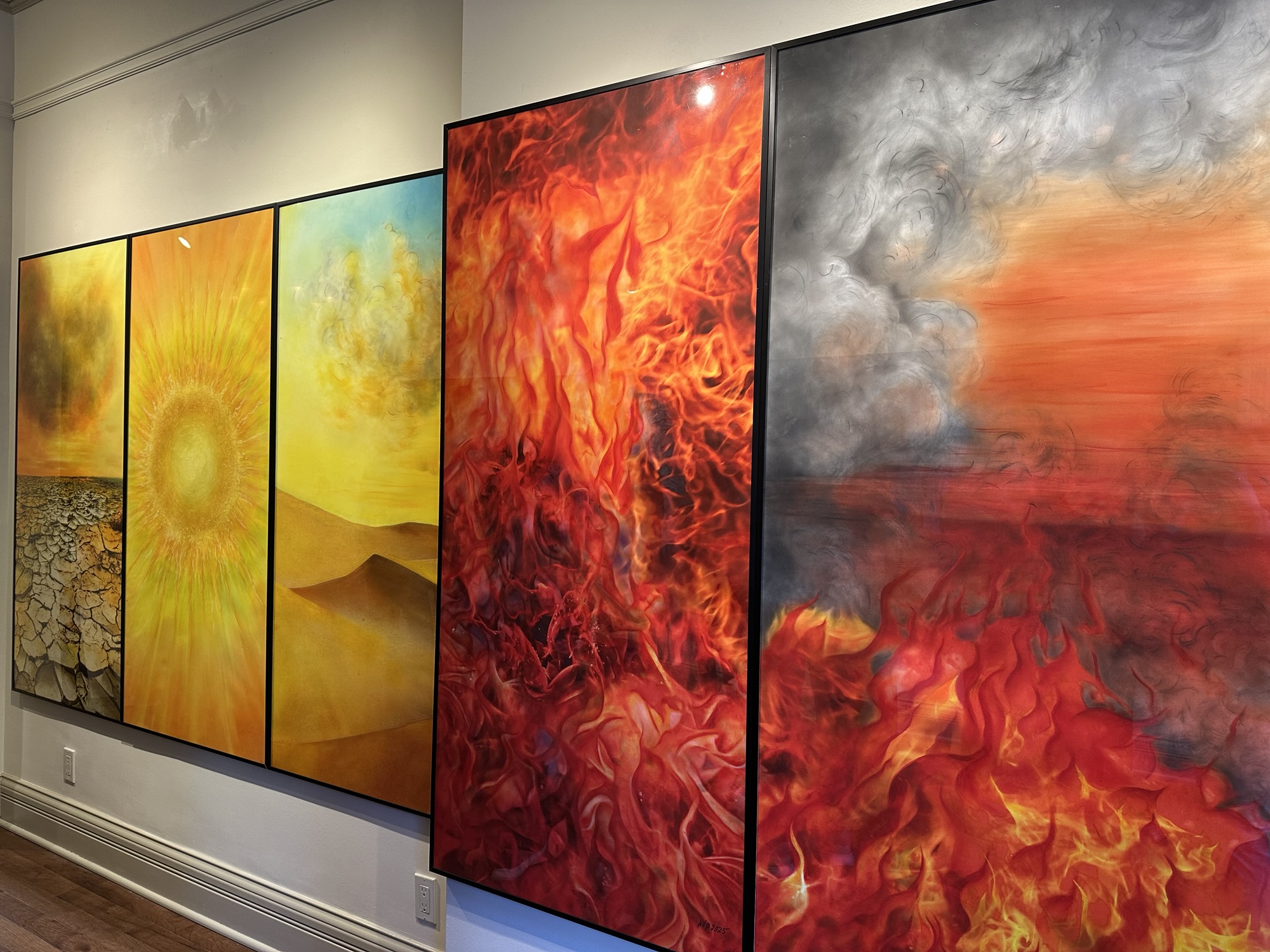
I was heading to Wash Park Art for the opening of a remarkable installation, Anna VanMatre’s “Primary Fundamentals.” This is the U.S. premiere of the exhibition, which had its world premiere in Guiyang, China, a joint commission of the SKYSEA Museum of Art and the Xiyun Academy Gallery in 2025.

In this series, Anna explores the fundamentals that sustain our life on Earth — water, sun and fire — in stunning, nature-inspired creations that are almost hyper-realistic. (Read about her process in this article I wrote about another exhibition she had at the Auschwitz death camp in her native Poland a few years ago.) Anna’s husband, Rick VanMatre, saxophonist and professor emeritus of Jazz Studies at the University of Cincinnati College-Conservatory of Music, created new music to accompany the exhibition’s opening.

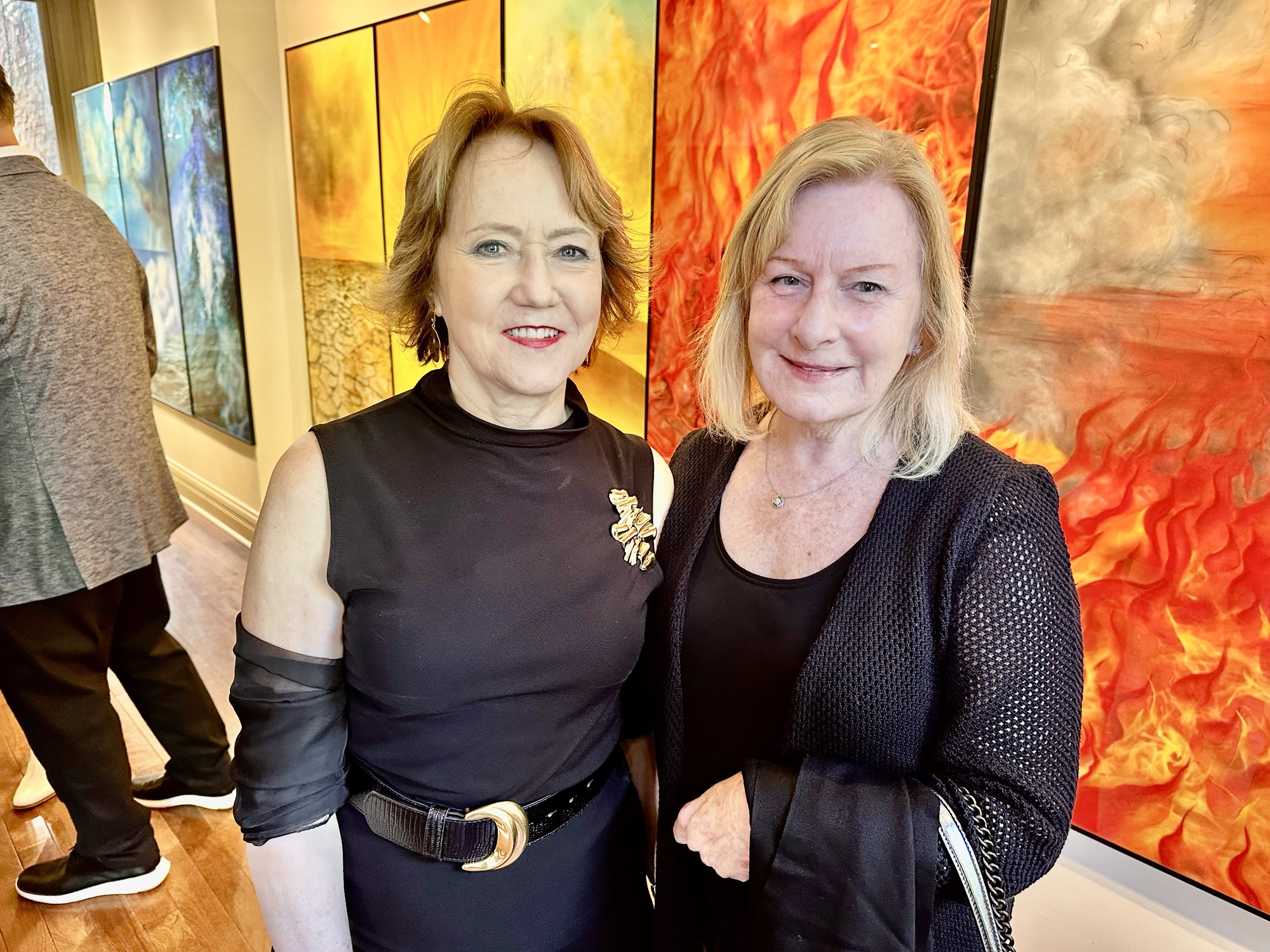
The author with the artist

Coming up: Anna will be giving an Artist Talk, 6 p.m. May 21 at the gallery, 1215 Elm Street. It runs through June 13. info: washparkart.com.

And on Sunday (May 3), I attended the final program of the Linton Chamber Series in Avondale’s First Unitarian Church. Besides the sun streaming in through its Tiffany windows, I’m partial to piano trios, and there were two of them: Beethoven’s Trio in D Major, “Ghost,” and Mendelssohn’s Trio No. 2 in C Minor, with pianist Benjamin Hochman, CSO concertmaster Stefani Matsuo and CSO principal cellist Ilya Finkelshteyn.

Haydn’s Flute Trio in G Major opened the program, featuring the CSO’s retiring principal flute Randolph Bowman, with Finkelshteyn and Hochman.

Each trio was distinctive and inspiring in its own way. The Haydn made a delightful opener, and I especially enjoyed the fleet, light articulation of each player. What is there to say about Beethoven? It was utterly profound, absorbing and played with breathtaking artistry. And what a treat it was to hear Mendelssohn’s “other” piano trio, written after the more familiar D Minor, and the last chamber piece he wrote. It is difficult for the pianist, and yet it was so brilliantly performed by Hochman, who balanced “fairy” lightness with moments of massive sonority at the Steinway. I could see Matsuo and Finkelshteyn smiling through these movements. For an encore, they played the unforgettable second movement of Mendelssohn’s D Minor Piano Trio.

Hochman told us he was last here 20 years ago, to appear with the CSO and the Linton. I hope he returns.

This program repeats tonight at Congregation Beth Adam in Loveland. Linton also announced next year’s season under its artistic directors Jaime Laredo and Sharon Robinson. More information here: lintonmusic.org.

Just a week earlier, more than 4,500 people attended the CSO’s two sold-out performances of “The Firebird” with giant puppets. Here’s my review, free to read, with thanks to the Cincinnati Business Courier.

Israeli Chamber Project’s harrowing trip to Cincinnati

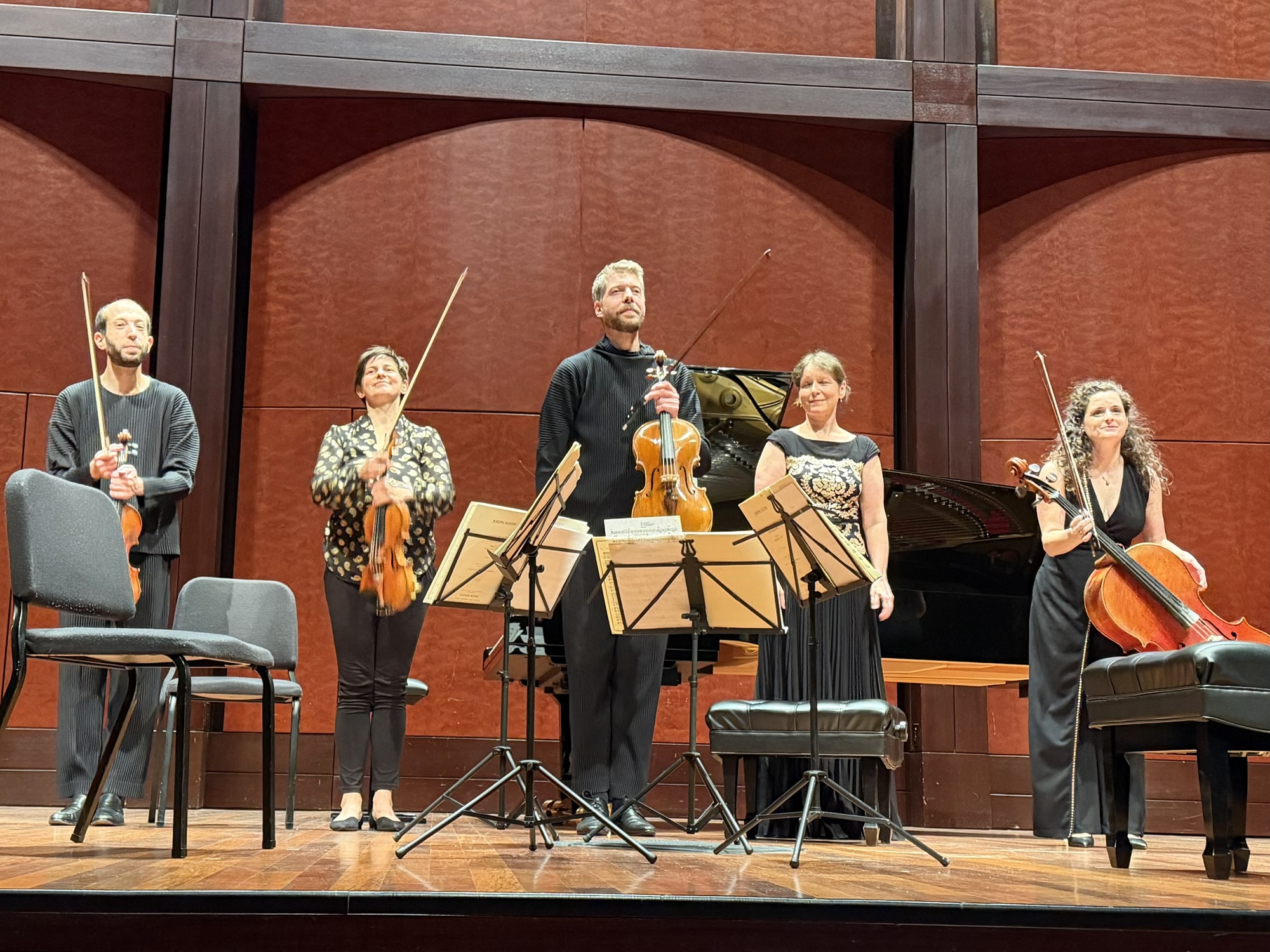
The Israeli Chamber Project with violinist Antje Weithaas played Chamber Music Cincinnati this week.

Imagine being a touring musician while your country is at war. Clarinetist Tibi Cziger and his wife cellist Michal Korman were in a safe room with their three children in Tel Aviv when their home was hit and damaged by a bomb from Iran. The couple, members of the Israeli Chamber Project, were on the brink of their North American tour. They quickly decided that Korman would stay home with their traumatized children, while Cziger would travel to the U.S.

So began an odyssey just to get here. Cziger, who is founder and artistic director of the Israeli Chamber Project, and flutist Guy Eshed, principal flutist of the Israel Philharmonic Orchestra, flew from Tel Aviv to Athens to Zurich to Chicago. (The others were coming from New York, Georgia and Germany.) From Chicago, the musicians were unable to get a flight to Cincinnati. The group, based in Israel and New York, had already been forced to make changes with some substitute players for their first two tour performances due to their travel woes. They decided to drive.

The fact that they arrived on time for their Chamber Music Cincinnati performance on March 24 in Memorial Hall was nothing short of a miracle. Their performance was not only a feat of superb artistry and virtuosity, but also of grit, determination and even courage. The audience stood for lengthy ovations at its conclusion.

For the tour, the ensemble joined with the distinguished violinist Antje Weithaas, now a professor at Berlin’s Hochschule fur Musik, and named “Instrumentalist of the Year” at Germany’s 2025 Opus Klassic. Besides Cziger and Eshed, the ensemble was rounded out by violinist Itamar Zorman (winner of the 2013 Avery Fisher Career Grant and the 2011 International Tchaikovsky Competition); violist Guy Ben-Ziony (currently visiting professor at the Robert Schumann University of Music and Media in Düsseldorf); and pianist Assaff Weisman, a graduate of The Juilliard School where he now teaches. Cellist James Kim admirably stepped in at the last minute to play for Michal Korman for the whole tour. He is on the faculty of University of Georgia’s Hugh Hodgson School of Music and cellist of the Lysander Piano Trio.

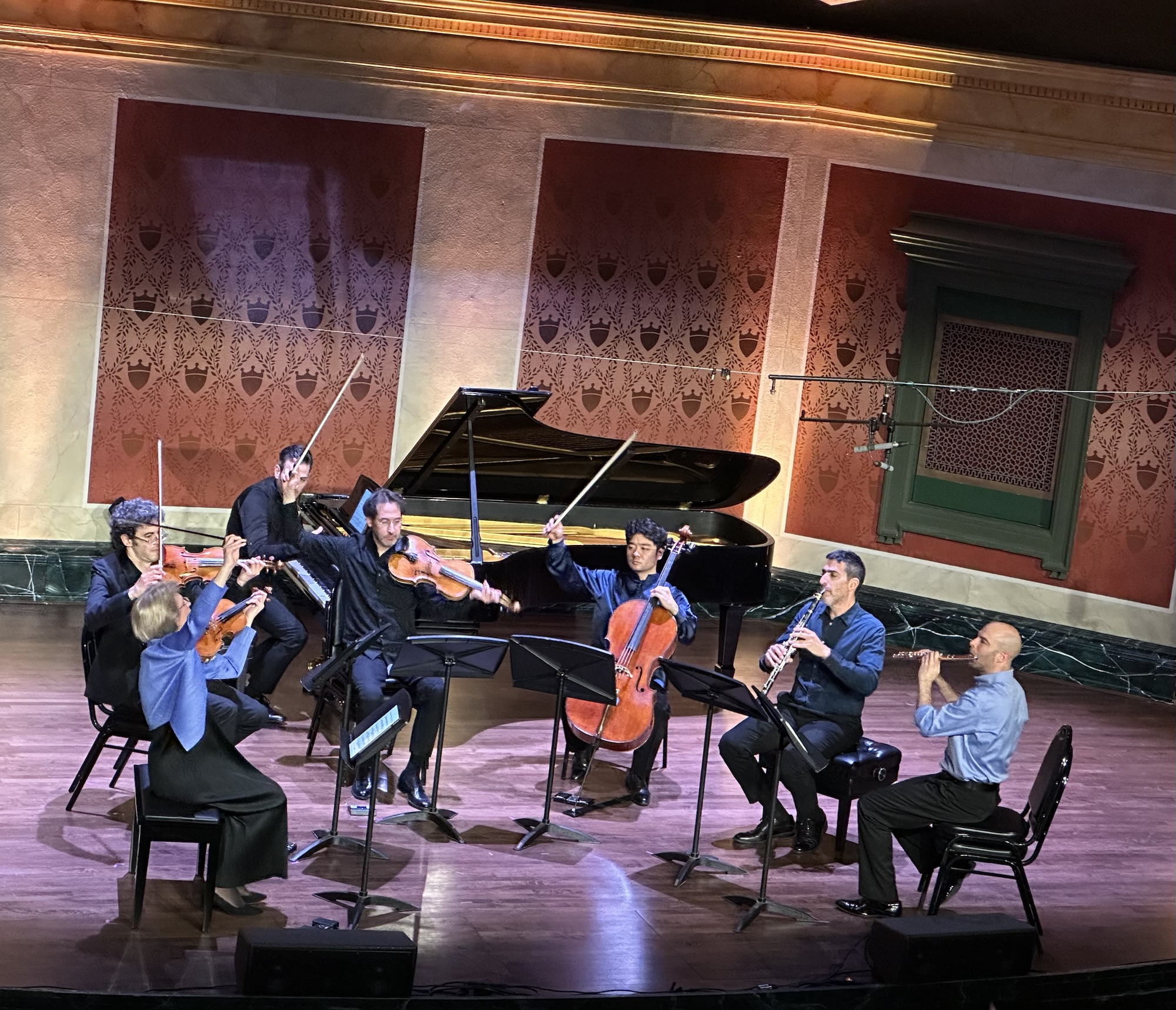
They opened with Bernard Hermann’s “Souvenir de Voyage” for clarinet and string quartet. The first movement’s theme, a haunting tune set against lush strings, was ideal for the rich timbre of Cziger’s clarinet. Clarinet and violin traded themes much of the time, and their phrases were were tinged with nostalgia in the slow movement, Berceuse. The evocative finale was inspired by J.M. W. Turner’s Venetian watercolors, and began in the two violins, almost like a Kreisler miniature. Hermann, of course, is revered for his film scores, and these souvenirs were like small cinematic gems, and a wonderful discovery.Read More »

2025 Year in Review

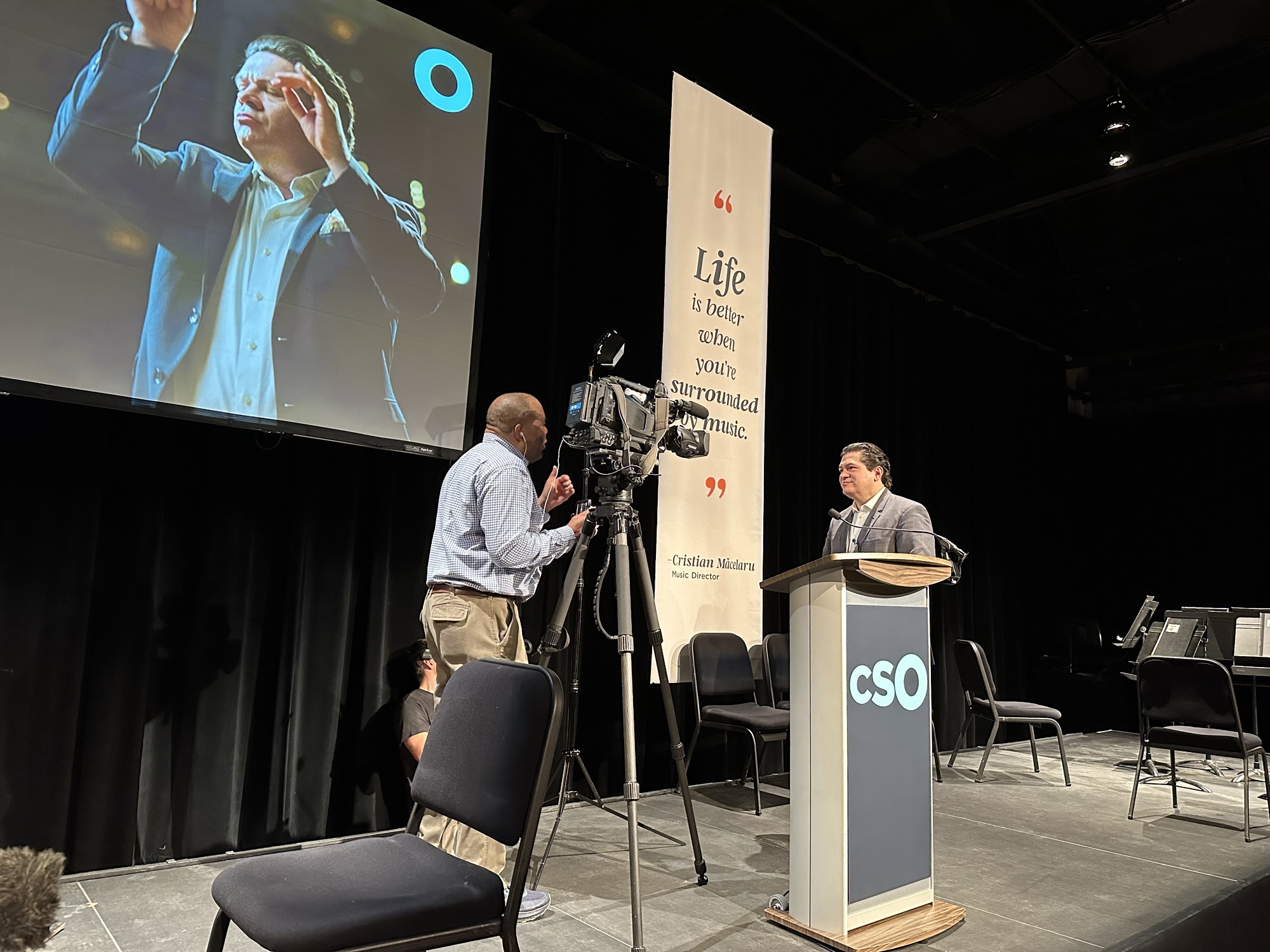
Meeting the Maestro last February

It’s always amazing to look back at the wealth of Cincinnati’s arts that we enjoy every year. There were important new arts leaders and new and improved venues. In comings and goings, the new dean of the University of Cincinnati College-Conservatory of Music, Peter Jutras, was busy hiring what seems like a record number of new faculty members. The Cincinnati Symphony Orchestra, too, has hired many new musicians that we are all still getting to know. And early this month, the Contemporary Arts Center’s Christina Vassallo announced she will soon be departing from her role as director. She will become executive director of the Pew Center for Arts & Heritage in Philadelphia.

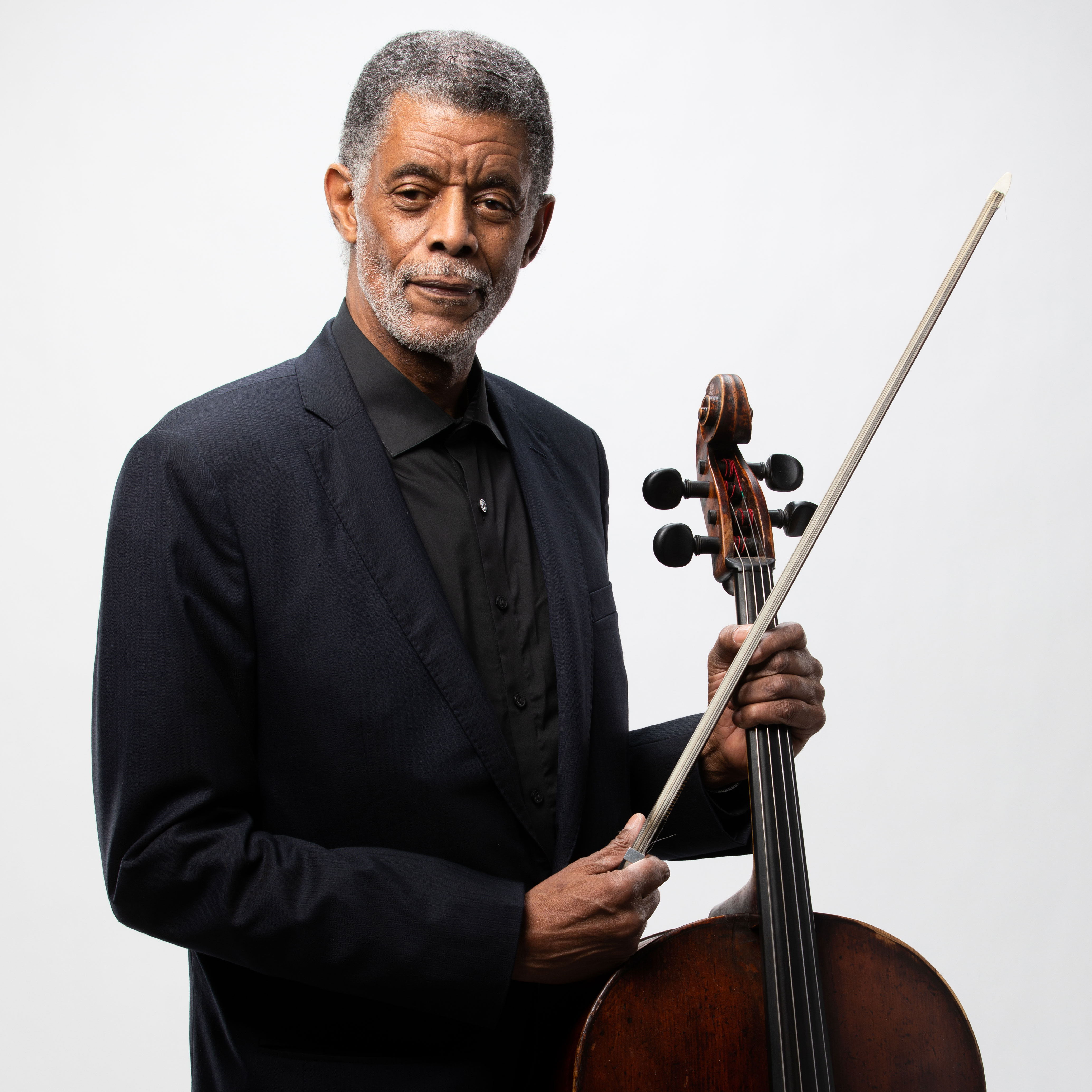
Assistant principal cellist Norman Johns performed with the CSO for 50 years.

Among those who left us in 2025 was cellist Norman Johns, an inspiring musician, a trailblazer and a role model. He shared his gifts as a teacher, chamber music coach and mentor to legions of students in Cincinnati for most of the 50 years that he performed in the Cincinnati Symphony Orchestra. Here is a small tribute to this musical giant.

Sadly, the Cincinnati Symphony also lost its much-admired principal trombonist Cristian Ganicenco. He was 58, and passed away on the eve of Cristian Măcelaru’s first concert as CSO music director. The two shared their homeland of Romania. Here is one of many tributes.

Below are some of my favorite performances, art exhibitions, newsmakers and more!

Welcoming new leaders

New maestro at the CSO –– In February, audiences had a taste of a new vision at the Cincinnati Symphony Orchestra in a powerful performance of the familiar Symphony No. 9, “From the New World” under the baton of then-music director-designate Cristian Măcelaru. This season, 2025-26, audiences are getting to know the Romanian-American maestro in his first season as the CSO’s 14th music director.

New leadership at Cincinnati Ballet — For his first season since being named artistic director, Cincinnati Ballet’s Cervilio Miguel Amador curated selections that include four world premieres, the regional premiere of “The Great Gatsby,” the return of “Swan Lake” (coming up in February) and “Director’s Vision: Liberty in Motion,” celebrating the evolution of American choreography in honor of America’s 250th birthday. We can’t wait to see his vision moving forward.

Alyssa Wang. Robert Torres Photography

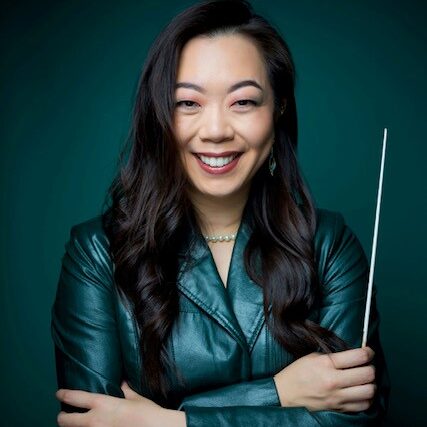
A woman on the podium — This year, Cincinnati Ballet welcomed Alyssa Wang as its new music director, succeeding Carmon DeLeone, a local legend who retired after more than 50 years. I enjoyed watching her conduct “The Nutcracker” last week, and look forward to seeing more of her work.

Read More »

Megan Moore impresses in recital, including new work by Jake Heggie

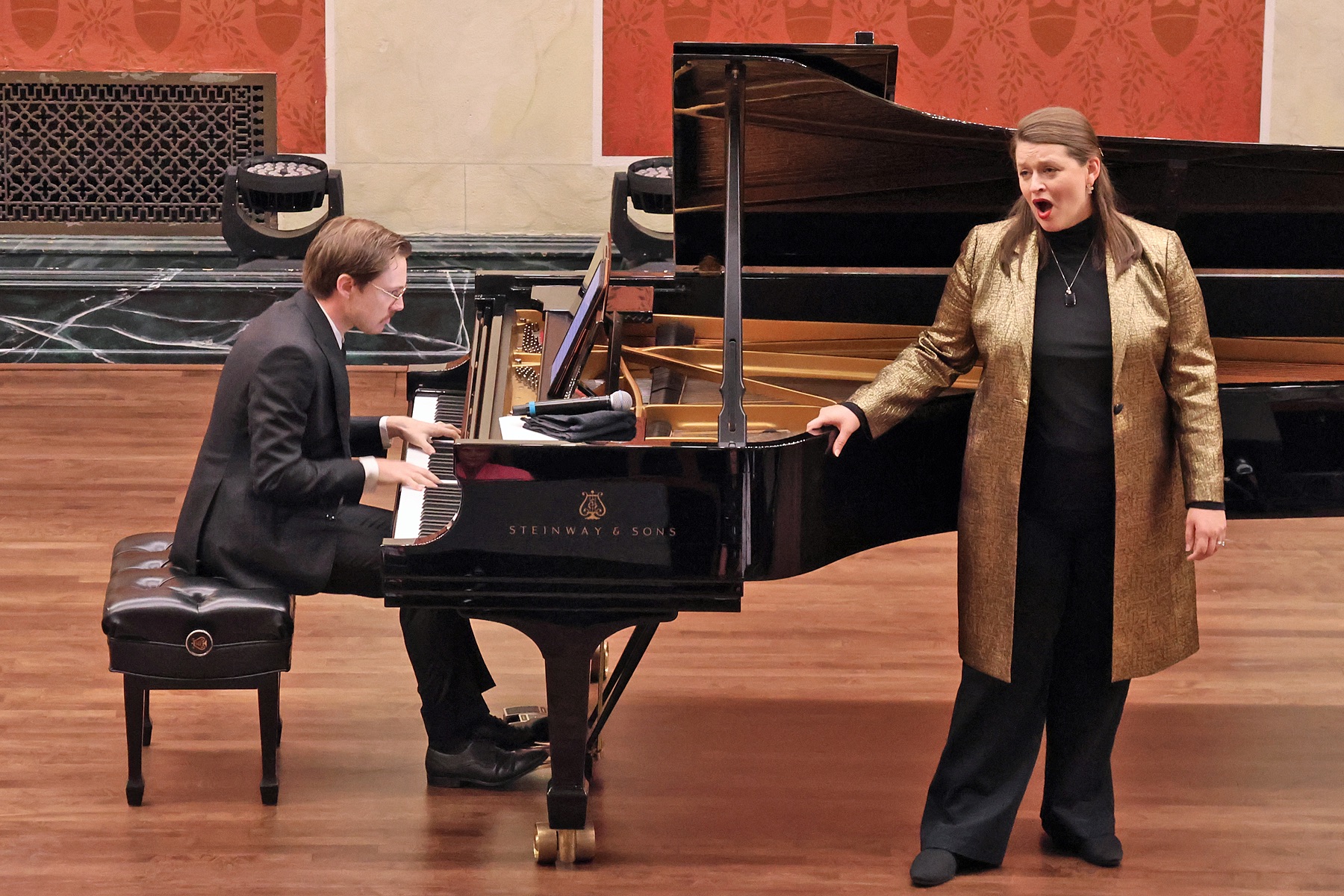
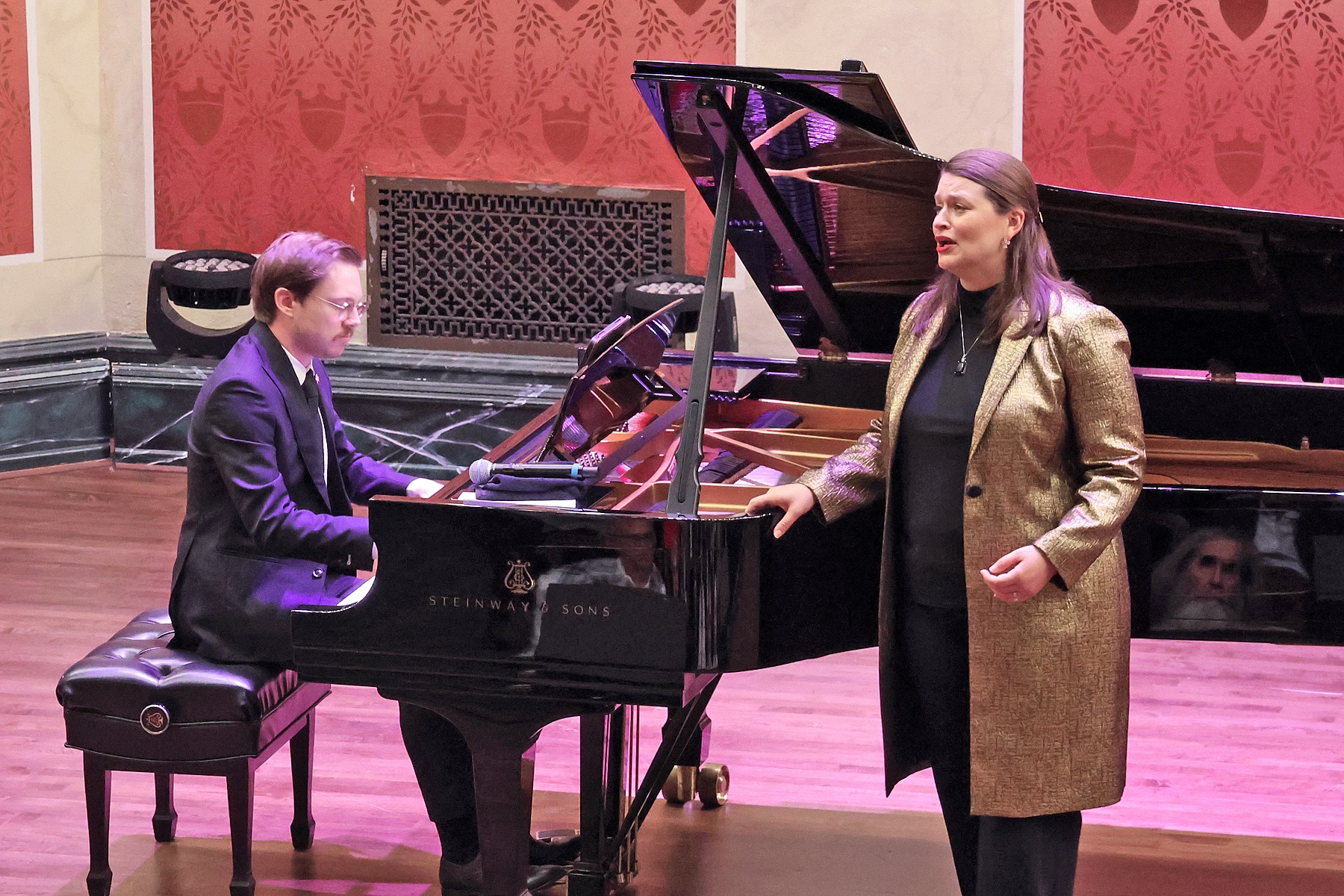
Mezzo-soprano Megan Moore with pianist Francesco Barfoed; photo by Gayna Bassin

Mezzo-soprano Megan Moore brought a substantial, varied program to Matinee Musicale on Oct. 12 in Memorial Hall. It was her professional recital debut in the Queen City, although the singer, a native of West Chester and a Lakota West and Miami University grad, sang on Cincinnati Music Hall’s stage at age 14 with the May Festival Youth Chorus under the baton of James Conlon. “I thought I was a rock star,” she said, praising the foundation in the arts that she had received here. Now she enjoys an international career, which includes singing Rosina in “The Barber of Seville” with Seattle Opera and the Metropolitan Opera, and her company and role debut this season as Octavian in “Der Rosenkavalier” at New Orleans Opera.

Her exellent piano collaborator was Danish-born Francesco Barfoed, whom she met when both were at Juilliard. Their program included the second performance of a new song cycle by Jake Heggie, which, she told me later, he tailored to her voice. They gave its world premiere in April at the Morgan Library in New York, presented by the George and Nora London Foundation for Singers.

This was Moore’s first recital since having a baby via C-section seven weeks ago, which was an astonishing feat considering the control needed and the artistry she displayed. A large contingent of friends and family (and baby, too) were on hand, including former high school and college teachers.Read More »

Borrowed Landscape, a narratorio

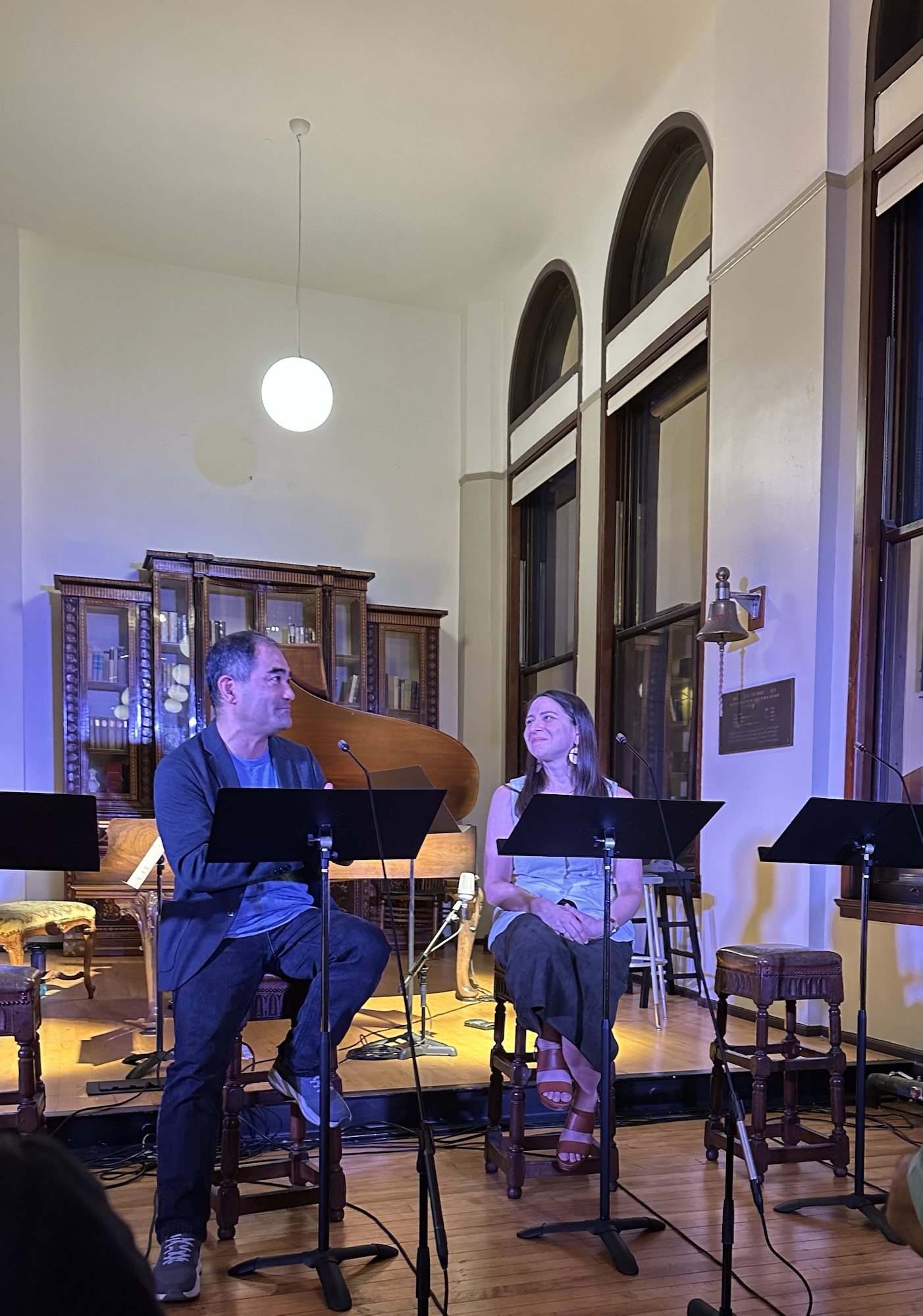
Brianna Matzke interviewed composer Dai Fujikura after the performance of his “Borrowed Landscape”

I witnessed an extraordinary work of “performance art” on Monday night (Sept. 29). The Cincinnati ensemble concert nova, now led by Brianna Matzke, presented the Cincinnati premiere of “Borrowed Landscape” by Dai Fujikura, to texts by the German playwright duo Tauchgold, at the Mercantile Library. Concert nova presented it as a memorial to the 80th anniversary of the bombing of Hiroshima and Nagasaki, in partnership with the Peace Resource Center at Wilmington College.

“Borrowed Landscape” tells the stories of three remarkable instruments and their owners, all connected to the war. There was a famous Stradivarius violin, which had gone silent in Budapest, a double bass from Poland, which was being restored years after its former owner had fled the Holocaust, and a Baldwin upright piano, which had survived the bombing of Hiroshima, although its young owner, Akiko, had not. Fujikura orchestrated his piano trio for violin, bass and piano according to their stories.Read More »

CCM-based Poiesis String Quartet wins Banff Competition

Photo by Eden Davis

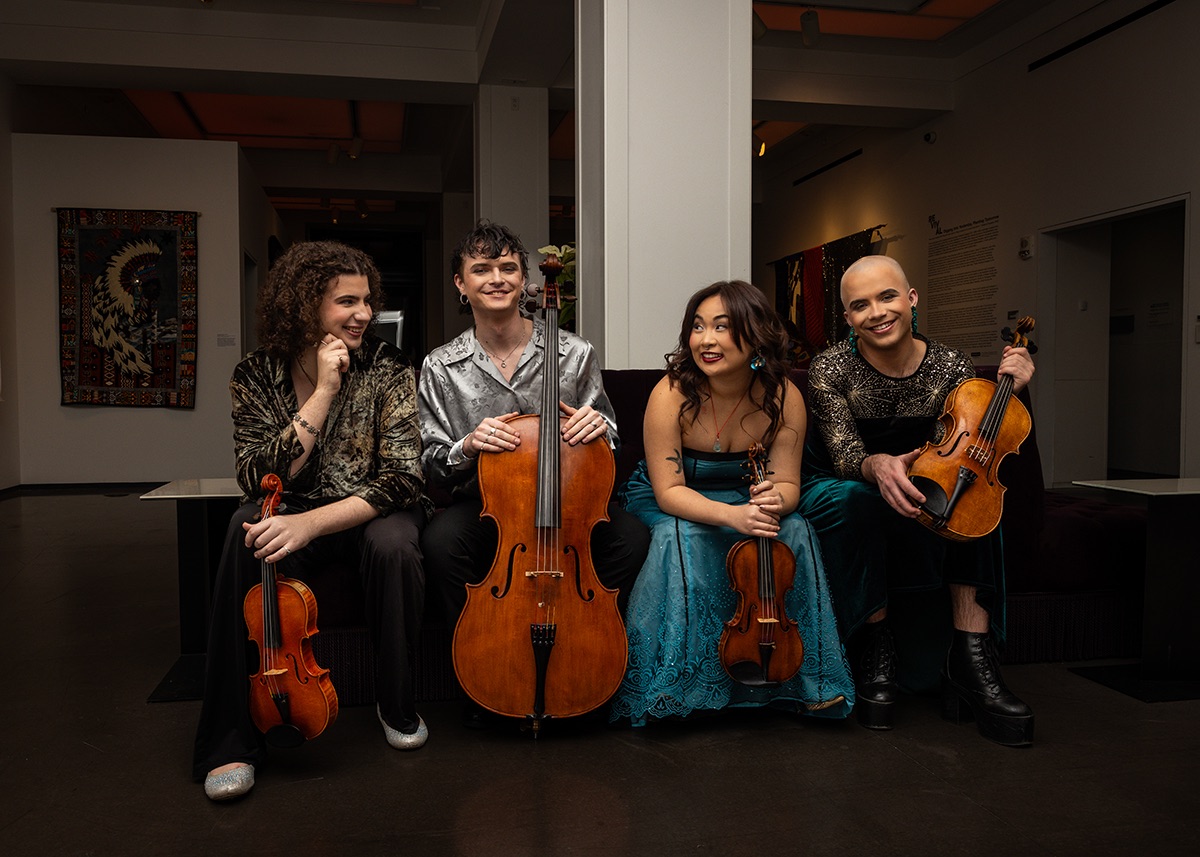
One of the world’s finest young string quartets is right here in Cincinnati. On Aug. 31, the Poiesis String Quartet, graduate string quartet-in-residence at the University of Cincinnati College Conservatory of Music, won the Grand Prize in the prestigious 15th Banff International String Quartet Competition. The prize includes $500,000 CAD in cash, prizes, and career development opportunities, including touring and recording and three-year custom artistic and career development program.

The quartet is currently being mentored at CCM by the Ariel Quartet. Its members are: Sarah Ying Ma on violin, Max Ball on violin, Jasper de Boor on viola, and Drew Dansby on cello.  They are graduates of Oberlin College & Conservatory.

Nine international string quartets competed this year, in what is described as “one of the most competitive in the competition’s four-decade history.” The competition reports that competitors travelled to Banff from their home bases in Asia, Europe, and North America, with players hailing from 14 different countries.

The name Poiesis derives from ancient Greek and means “to make.” The ensemble focuses on expanding the quartet repertoire with new works by emerging composers.

Competition jury members include Marie Chilemme, Jonathan Crow, Eugene Drucker, Honggang Li, Milena Pajaro-van de Stadt, Eckart Runge, and David Ying.

The quartet will present their fall recital at 6:45 p.m. Oct. 2 in Werner Recital Hall. Free.