
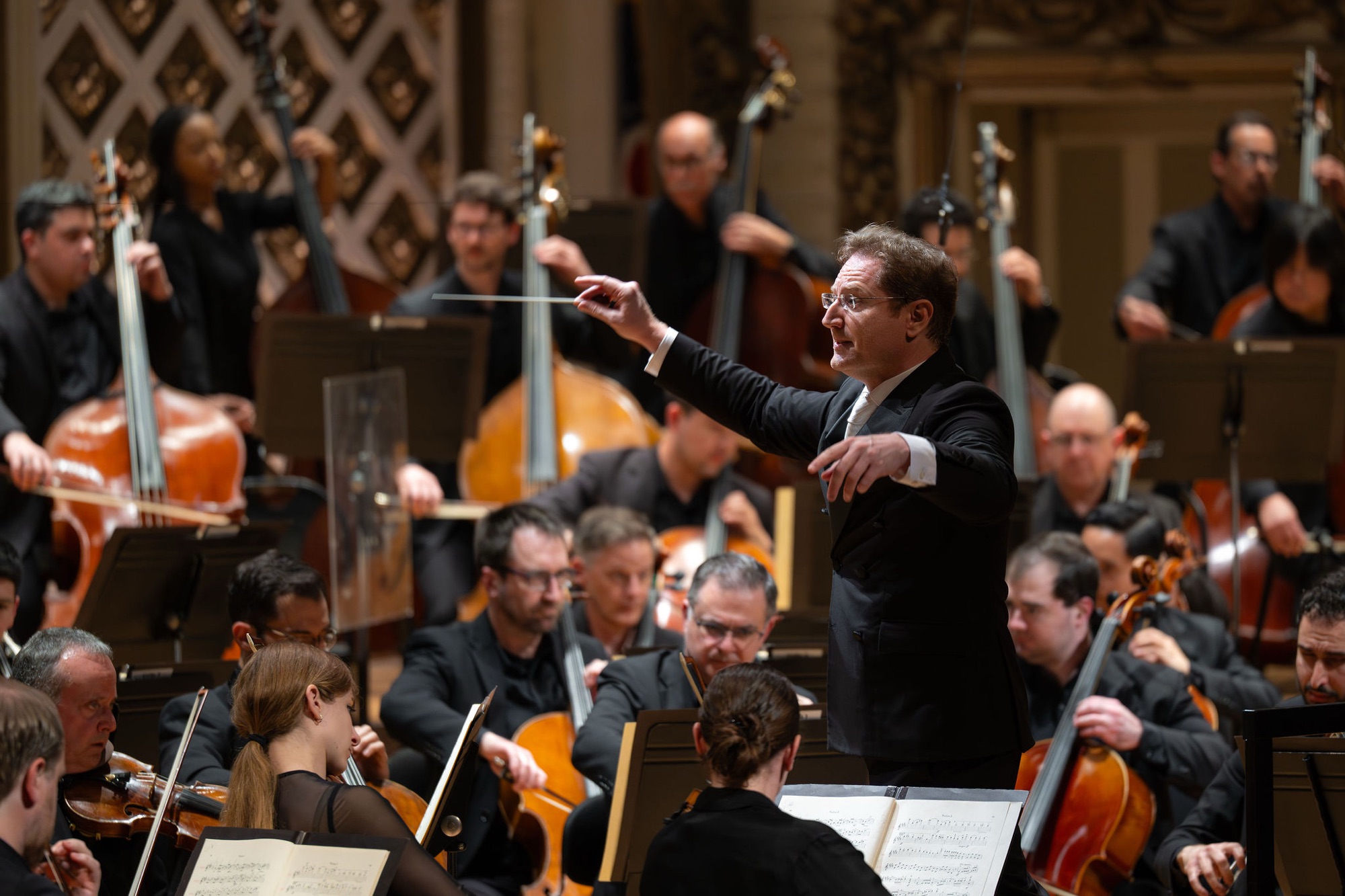
An explosive standing ovation answered the Cincinnati Symphony Orchestra’s performance of Rachmaninoff’s Symphony No. 2 conducted by Ramón Tebar at Saturday’s concert in Music Hall (April 11). The enthusiasm for Rachmaninoff’s arch-romantic symphonic masterpiece was not surprising. But this response went on for many minutes, calling Tebar back to the stage several times, until finally the conductor went into the orchestra to shake the hands of each principal player and acknowledge each section of the orchestra.
The gifted Spanish conductor made a welcome return to the orchestra with a program of emotional power and lyricism. He opened with the CSO’s first performance of American composer Margaret Brouwer’s “Pulse” and concluded with Rachmaninoff’s Second Symphony in E Minor.
Equally engaging was the return of Canadian violinist James Ehnes in Max Bruch’s “Scottish” Fantasy. Just before launching into his encore (J.S. Bach’s Preludio from Partita No. 3 in E Major, BWV 1006), Ehnes spoke movingly about feeling nostalgic as he was turning 50 this year. The CSO was one of the first orchestras to support him early in his career, with his debut in 1995, he said, adding, “I’m grateful to be brought here.”
The orchestra has been sounding exceptional all season, and this was a concert that showcased their artistry.
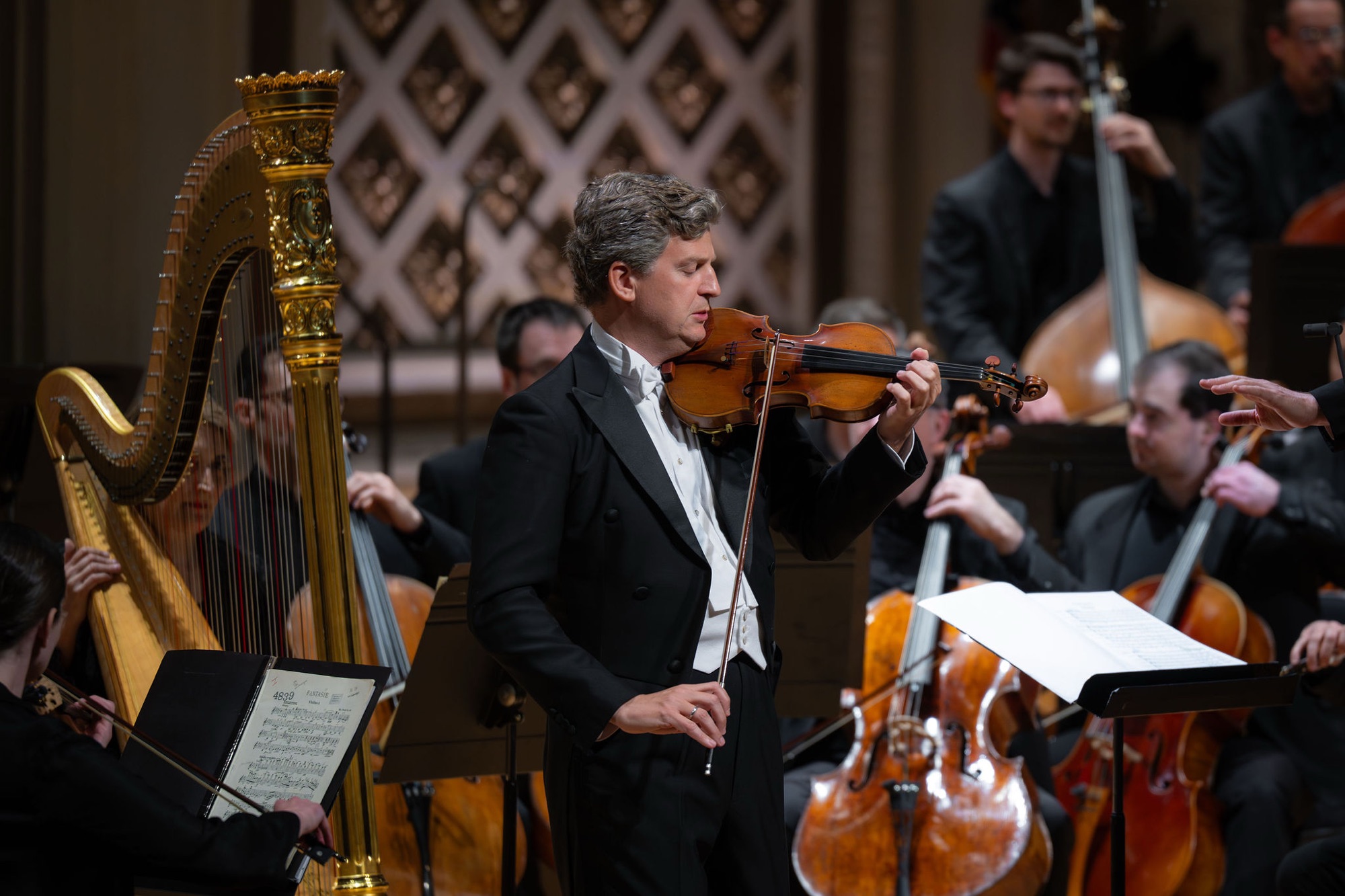
Ehnes is currently professor of violin at Indiana University, and a visiting professor and honorary fellow of the Royal Academy of Music in London. His distinguished career has taken him around the globe and his extensive discography has resulted in two Grammy Awards, three Gramophone Awards and 12 Juno Awards. For his birthday year, the native of Brandon, Manitoba, Canada is performing a recital tour of every Canadian province and territory. According to his website, next week he’ll be on a European tour with the Vancouver Symphony.
This was a somewhat rare outing of Bruch’s tuneful “Scottish” Fantasy, which is not heard nearly as often as Bruch’s Violin Concerto in G Minor. It was inspired by the Scottish novelist Sir Walter Scott, and its themes are all Scottish folk tunes. The prominent role for the harp, performed by principal harpist Gillian Benet Sella, pays homage to Scottish tradition, depicting “an old bard” in the opening, and accompanying the violinist’s Scottish tunes. For this occasion, Sella was centerstage, just behind the podium.
Ehnes communicated with a rich, glowing sound in these wonderful melodies. I enjoyed his beauty of line, ravishing sound (he often played with a romantic vibrato) and effortless technique. He is an elegant musician, and he displayed such an easy virtuosity, you hardly noticed the technical demands he was navigating.
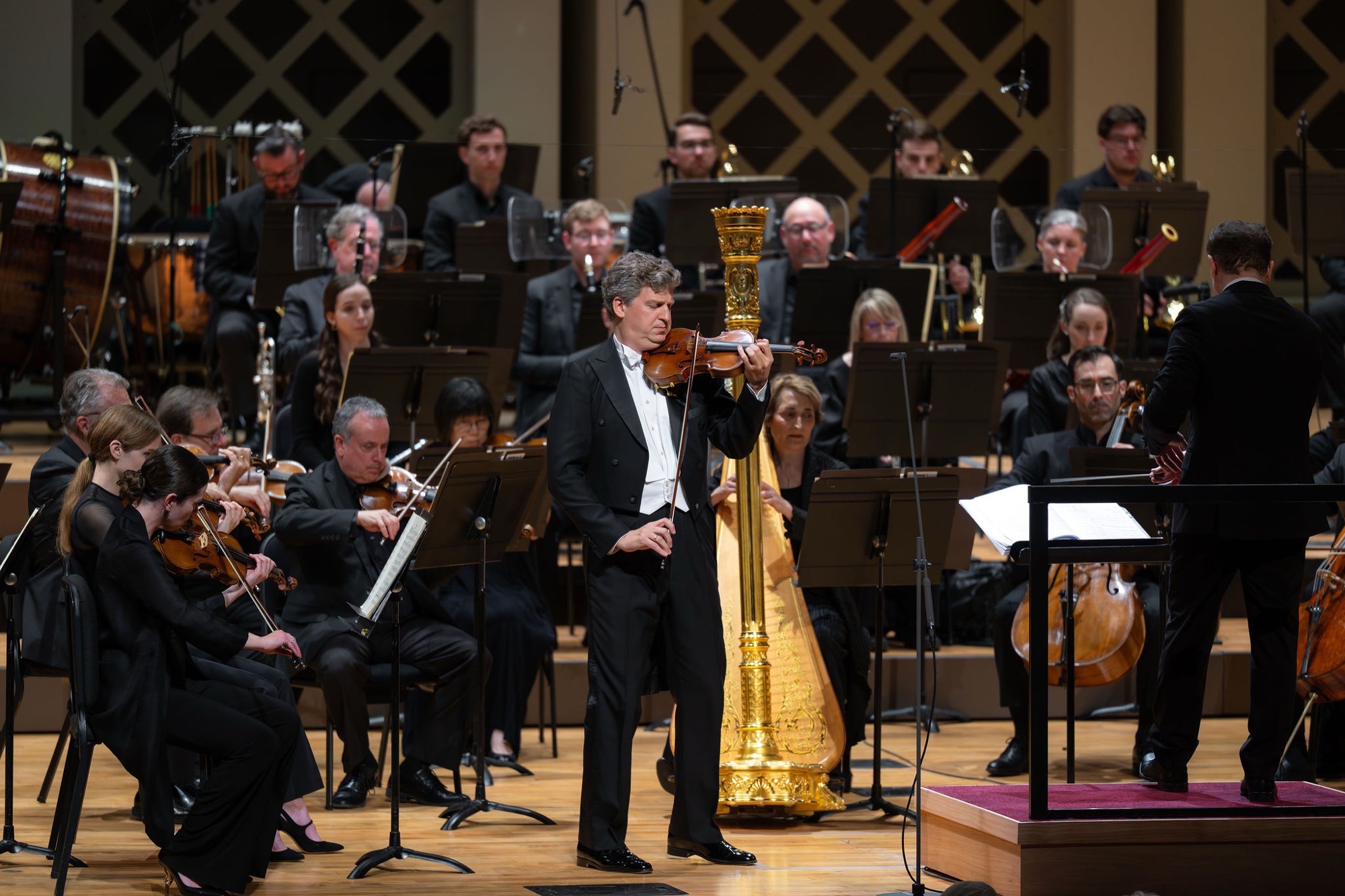
His phrases were deeply expressive, often rising to impassioned peaks. In the second movement, an animated scherzo, he carried on a delightful dialogue with associate principal flutist Henrik Heide. His phrases were deeply felt in the poignant set of variations of the third movement, on the folksong, “I’m Down for Lack of Johnnie.” And the “warrior” finale was exhilarating. Tebar and the orchestra were excellent partners.
Rachmaninoff’s Symphony No. 2 in E Minor, which came after intermission, is the best-loved of the Russian composer’s three symphonies. It can be viewed as a spiritual journey that begins in the depths of darkness and ends in a joyous finale. The hour-long symphony flies by, because the journey takes the listener through one glorious melody after another.
Leading from memory, Tebar knew just how to bring out the orchestra’s strengths. He emphasized the darkness of the opening, leaning into the depth of the basses to create a moody atmosphere, followed by a haunting, desolate solo in English horn (Christopher Philpotts). The conductor allowed each orchestral solo to emerge from Rachmaninoff’s vast texture. The music was also vividly dramatic, such as the bursts of timpani (Patrick Schleker) accompanied by the trombones.
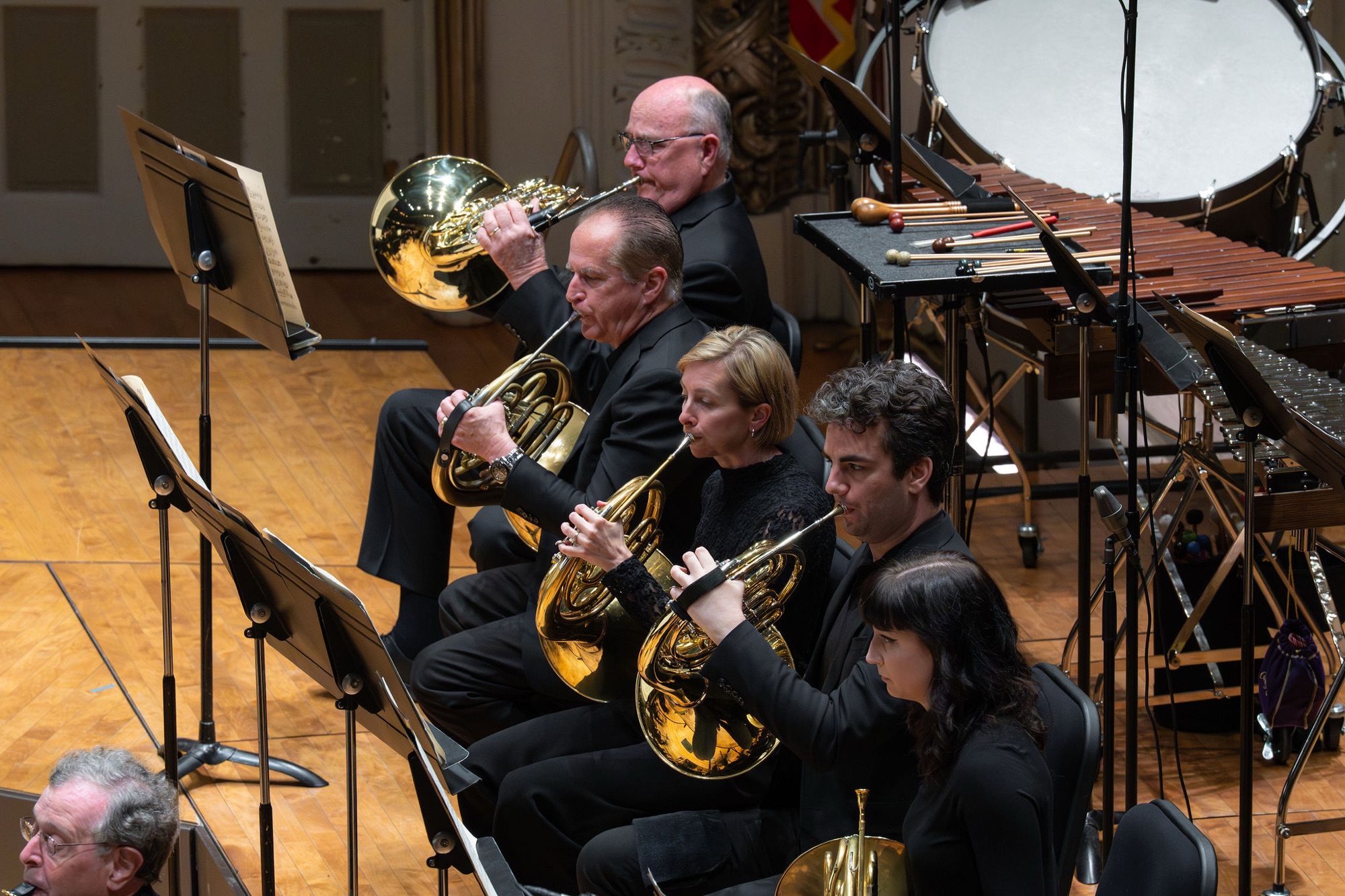 He took a very brisk tempo in the scherzo, where rhythms were pointed. The horns played superbly, and the two “trio” sections were galvanizing, first with staccato strings, and secondly with a quirky march featuring the trombones and tuba. Following the electrifying scherzo, the slow movement unfolded like a deep sigh. It was unforgettable, starting with principal clarinetist Christopher Pell’s exquisite melody, and the plush sound of the strings. It was all beautifully conducted and deeply stirring and no one in the audience breathed.
Tebar mopped his brow before exuberantly leaping onto the finale, a festive contrast. I’m not sure I’ve heard such crisp articulation in this movement. The music grew to a huge climax, and you could almost feel the visceral impact of the brass and percussion sections. Listeners rose to their feet with a roar.
The program opened with Margaret Brouwer’s short orchestral work “Pulse.” The composer, who was born in Ann Arbor in 1940, has garnered many accolades and is championed by conductors such as Marin Alsop, whose recording of works by Brouwer came out on Naxos in 2024. “Pulse” was commissioned and premiered in 2003 by David Wiley and the Roanoke Symphony Orchestra.
It was an endlessly inventive work of rhythmic pulses, which began with brief motives that ricocheted across the orchestra and steadily built over a long crescendo. There were episodes of powerful drumming and other effects for the percussion section, as well as a melody over a bagpipe-like drone. A section of eerie glissandos in the strings and glimmering colors on vibraphone represented what the composer called a mysterious “spirit motive.” The work was well-crafted, syncopated and bright, and made me want to sample more from this composer. Tebar and the orchestra gave it an excellent reading.
The CSO continues its season April 17 and 18 in Music Hall. Tickets and info: 513-381-3300, cincinnatisymphony.org.
Discover more from janellesnotes
Subscribe to get the latest posts sent to your email.
