
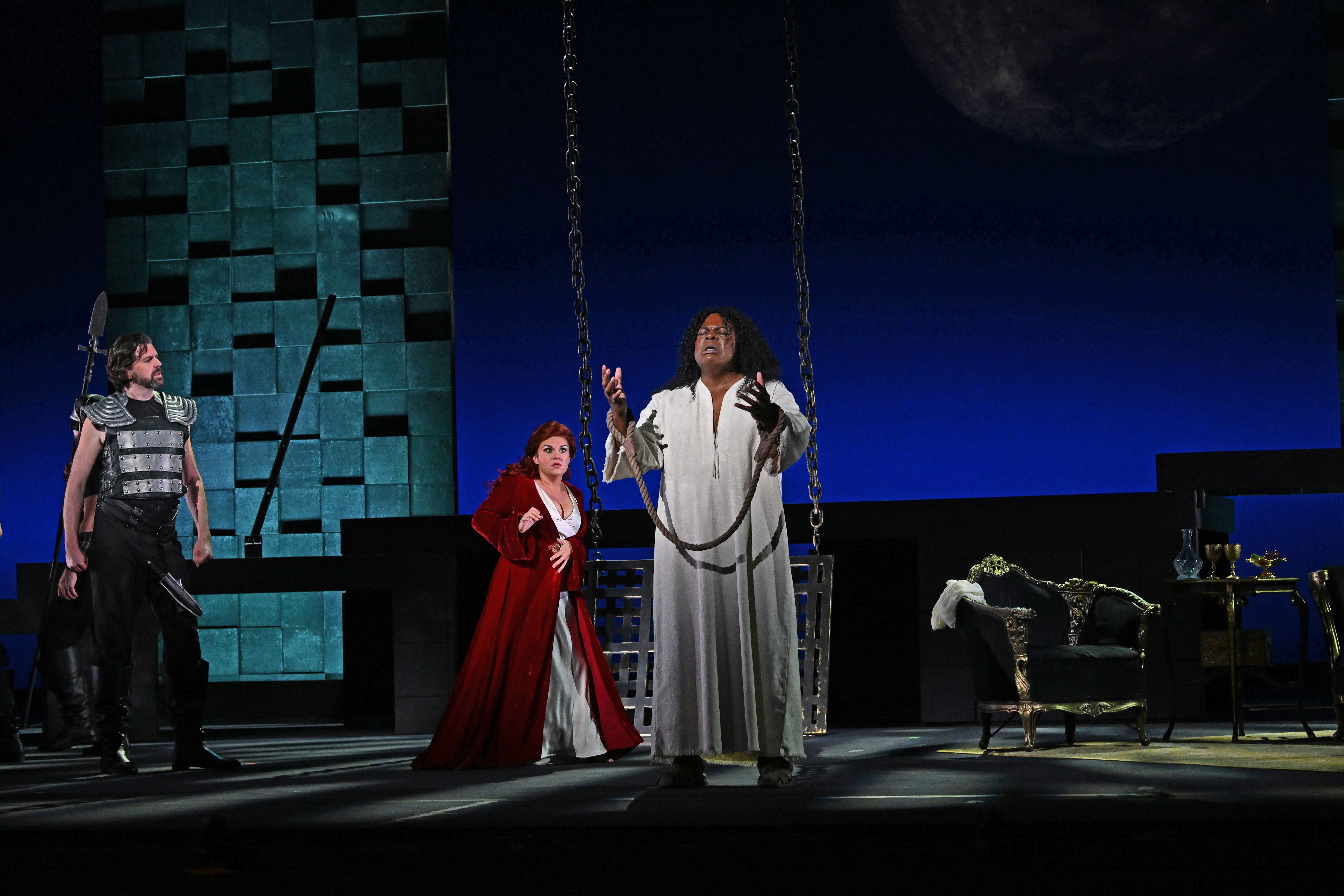
For his opera about the depraved princess Salome who performs the “Dance of the Seven Veils” for Herod in return for the head of John the Baptist on a platter, Richard Strauss wanted “a 16-year-old princess with the voice of an Isolde.”
In her role debut as Salome at Cincinnati Opera on June 18, soprano Kathryn Lewek fit the bill spectacularly with vocal intensity and blazing high notes. She delivered a searing performance, singing with unflagging fervor all the way through her final, lurid moments of necrophilia with the severed head. The audience in Music Hall for the season opener on June 18 was riveted from beginning to end by the production staged by Jose Maria Condemi and conducted by Robert Spano.
“Salome” was last produced by the company in 2000 under then-artistic director Nic Muni. More than 120 years after its premiere, Richard Strauss’ opera “Salome” is still a shocker. The biblical story — which refers to Salome not by name but as the daughter of Herodias — may be found in the New Testament. Jochanaan, the prophet known as John the Baptist, was a prisoner of Herod, the tetrarch of Judea and Salome’s stepfather. It was Oscar Wilde who embellished the story, and Strauss based his 1905 opera on Wilde’s play. Hedwig Lachmann’s German translation of the play forms the libretto, with judicious trims made by Strauss.
The production was from San Diego Opera, which was also staged by Condemi, now a faculty member at the University of Cincinnati College-Conservatory of Music. A single, modernist scenic design (Tim Wallace) served the one-act opera. The palace terrace consisted of large stone pillars and an expansive ramp with steps going down to the floor where the cistern lay. A large, full moon loomed over the proceedings, and Thomas C. Hase’s effective lighting design followed the drama, sometimes bathing the entire stage in blood red. Lavish costumes (Anita Yavich) fit the period.
An exceptional cast told the story. It was Lewek’s second role debut with Cincinnati Opera’s summer festival after making an impressive debut singing Gilda in Verdi’s “Rigoletto” last year.
Lewek, as Salome, dashed impetuously onstage (coming from Herod’s banquet), and instantly became infatuated with the prisoner in the cistern, Jochanaan. She sang with a voice of beauty throughout her range, easily making Strauss’ difficult vocal leaps and tackling the lower register with clarity. She poured out her feelings in long, rapturous streams of love for Jochanaan’s skin, his hair, his lips, eventually crawling on her belly to grovel at his feet.
Lewek’s Salome was a lusty young woman, who cruelly taunted the holy man while spreading her legs before him. More than just desiring to kiss his lips, her obsession was sexual. Even when not singing, she could be seen erotically writhing with Jochanaan’s discarded blindfold between her legs.
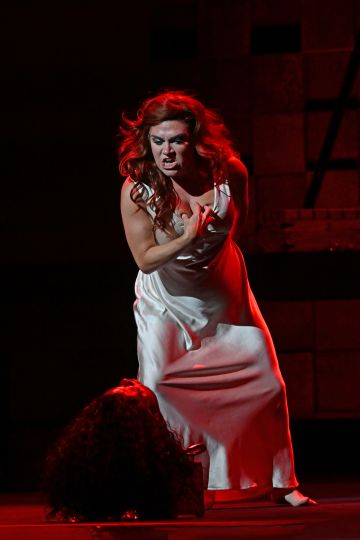
Her final monologue, in which she receives Jochanaan’s head on a charger, was stomach-churning. The soprano performed it like a depraved mad scene, holding up the head, and lying with it as she cradled and kissed the grisly object. For this gruesome moment, Strauss wrote some of his most ecstatic music for both the soprano and orchestra. Even Lewek’s highest notes, sung pianissimo, were exquisite.
The scene was further accentuated by the remarkable likeness of Walker’s facial features and wig. The head was achieved with a 3D printer by Cincinnati company 3DCincy, and you can watch the video here.
In his company debut, bass-baritone Alfred Walker was brilliant as the imprisoned prophet. His presence was formidable and commanding, and he wielded a powerful, sonorous voice as he sang against the orchestra’s resonant horns. Despite Salome’s pleas for a kiss, he spurned her stoically and thundered, “Niemals!” (never), calling her “daughter of Sodom.” With arms outstretched, the holy man sang of the man of Galilee in mellifluous phrases.
Tenor Chad Shelton was a fine singing actor, ideal for the lascivious stepfather who, in Condemi’s vision, provided a bit of comic relief. The audience even sometimes chuckled out loud at his tipsy acting. He was something of a caricature, puzzled by the happenings around him – why did he always hear beating wings? – hen-pecked by Herodias, an old man with an obsession for young girls. His mounting horror at his step-daughter’s behavior climaxed when she made her demand, stepped on the jewel box he was holding, yanked his head back and climbed astride him with the silver platter.
Mezzo-soprano Michelle DeYoung’s Herodias was both regal and incensed at her husband. She navigated the extreme ranges of her vocal parts with powerful, if edgy top notes, while approving of her daughter’s demand for the head of John the Baptist.
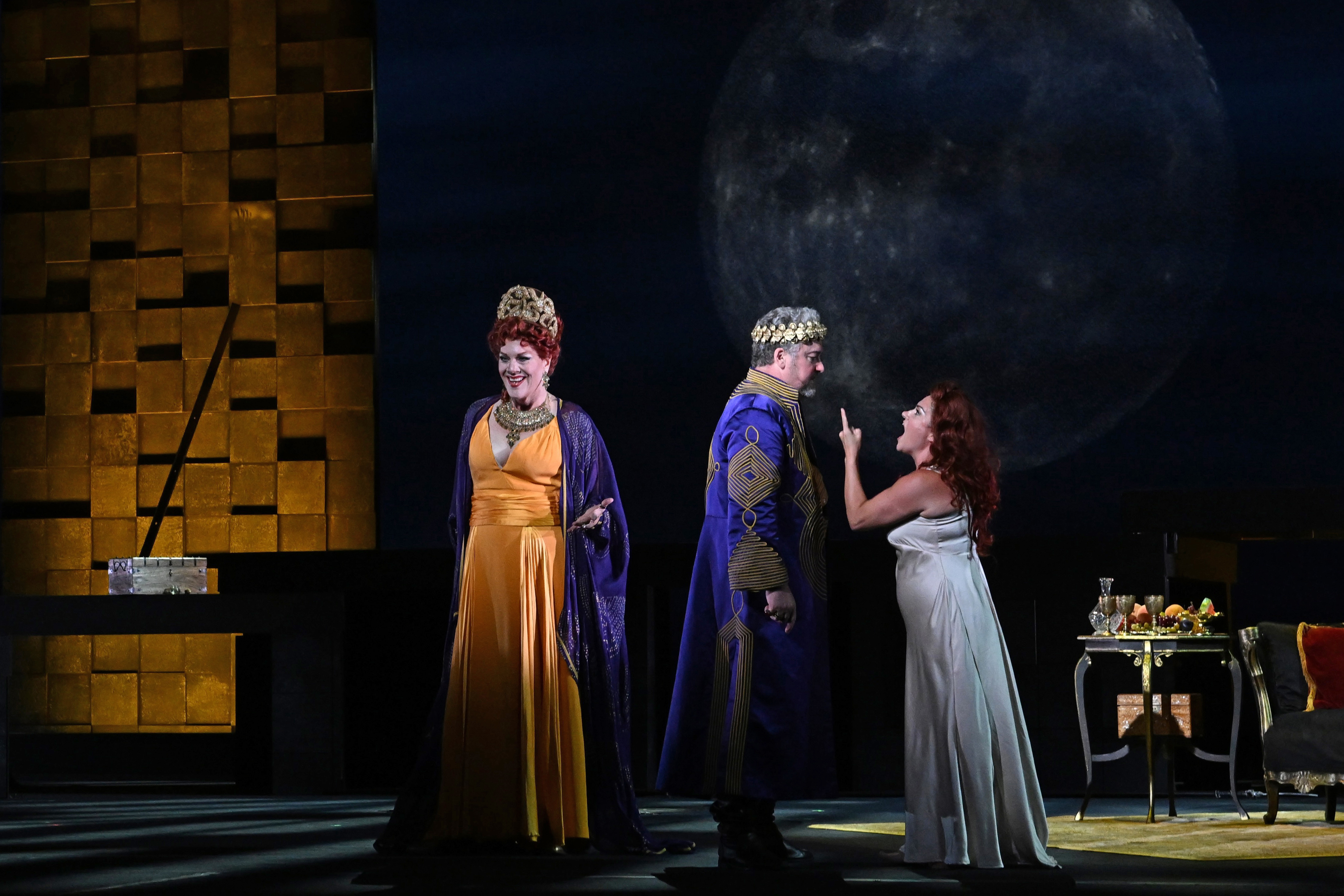
Lewek).
It was a pity that Narraboth, captain of the guard, had such a short life. Tenor Zach Borichevsky sang ardently of Salome’s beauty. When he finally succumbed to her seduction, their intimate caresses suggested that perhaps they already had a history together. (In real life, Borichevsky and Lewek are married.)
There were strong performances in small roles, including the Page who was smitten with Narraboth (Emily Cotton), and the Nazarenes (Thomas Dreeze and Alexander Gushrowski) who sang movingly about Christ’s miracles.
Salome is an intensely demanding role for the soprano, who is on the stage nearly the entire time, and must not only sing, but also dance. Some great sopranos in history have opted to outsource to a professional dancer what is possibly the most famous dance in opera, “Dance of the Seven Veils.” In this production, Condemi instead staged a “backstory” of Salome’s purportedly abused childhood. Two Cincinnati Ballet dancers, Sydney Caggiano and Amanda Pérez Duarte, performed as the princess’s young selves to choreography by Cincinnati Ballet’s Erina Noda.
As the young Salome, they cradled her doll, put on makeup and later displayed more sensuality. Herod was always lurking around. As the music swelled, the current Salome furiously threw these childhood items in Harod’s face, then dragged her mother, Herodias, to his side, and held up her mirror to them. (Similar backstory concepts have been staged by other companies, notably the Met in 2025.) There was nary a veil in sight. It might explain Salome’s psychotic behavior at age 16, but personally, I missed the dance.
Musically, the opera has been called a “stage tone poem,” because of the continuous music and the lavish orchestrations penned by Strauss, who was at the time more famous for his tone poems. The music is tonal, but Strauss pushed boundaries harmonically, with chromaticism and dissonances that still succeed in adding theatrical impact.
In the orchestra pit, the distinguished conductor Robert Spano led a masterful account of Strauss’ score with 77 musicians of the Cincinnati Symphony Orchestra. He propelled the drama so that tension and momentum never sagged, while also illuminating vivid details in the more intimate, chamber-like writing. And although the orchestra could summon mighty Straussian peaks, the voices onstage were never overpowered. The musicians of the orchestra played magnificently.
The performance repeats at 7:30 p.m. June 20 in Music Hall. Tickets: cincinnatiopera.org; 513-241-2742
Discover more from janellesnotes
Subscribe to get the latest posts sent to your email.

Fantastic review! Your vivid description will help us follow the action tonight. I am really looking forward to this performance. I remember the 2020 performance, which was a revelation about the decadence that was clearly percolating in pre-Weimar Germany.
LikeLiked by 1 person
Loved the review. Loved Lewek’s voice. I also missed the dance but Condemni’s approach worked. Sent from my iPhoneOn Jun 20, 2026,
LikeLiked by 1 person
WOW! We went Saturday and Kathryn nailed it. Between this and last year’s Gilda I think she’s one of the best sopranos in the business. I’m in the Opera Guild and met her and her husband at the Meet & Greet. They are both wonderful people. The dance was novel. My wife didn’t like it but I comprehended what the production was trying to say about Salome’s abuse as a child.
Thanks for a really wonderful review, Janelle. I appreciate you continuing to review the arts in Cincinnati.
LikeLiked by 1 person