
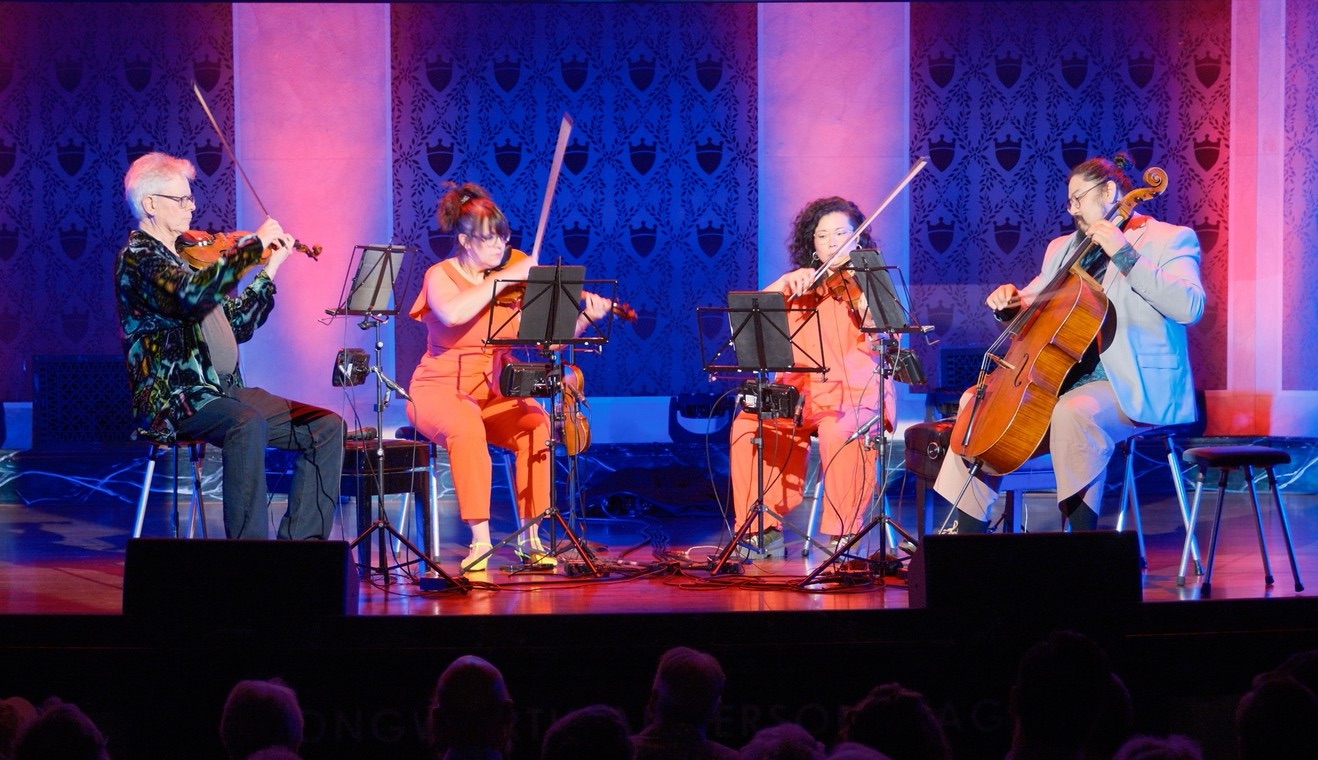
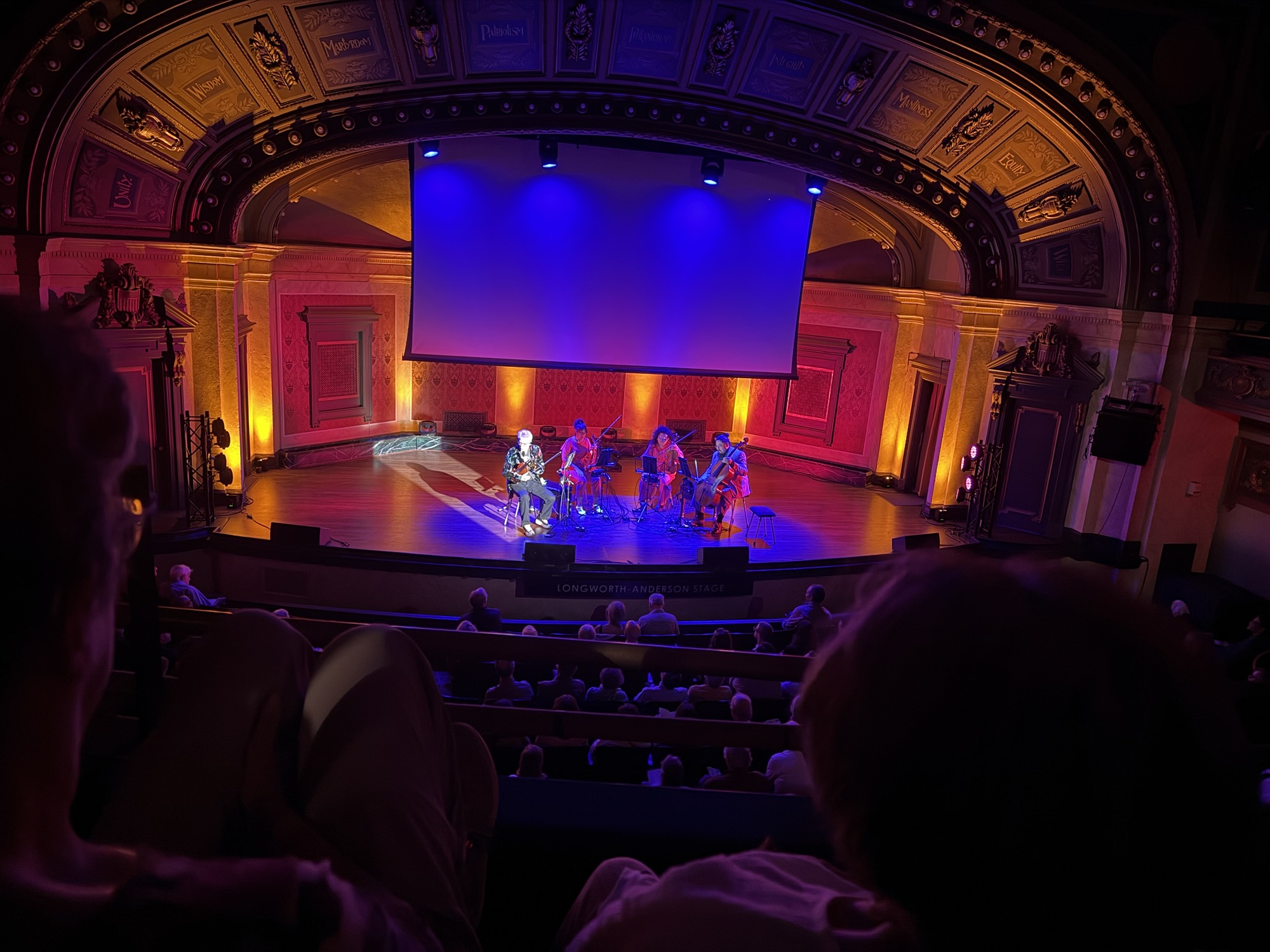
At 53, the Kronos Quartet has a vast catalog of music of our time. On Tuesday (Sept. 29), the Kronos opened the Chamber Music Cincinnati season with a thought-provoking, compelling and sometimes humorous program in Memorial Hall. Each piece on their substantial program of 10 works (and two encores) was written or arranged for the quartet.
The summit of the evening was Philip Glass’ String Quartet No. 5, written in 1991 for the Kronos, a nod to the close relationship the quartet has had with Glass, now in his 90th birthday season.
Founding violinist David Harrington was joined by his new colleagues Gabriela Díaz (violin), Ayane Kozasa (viola) and Paul Wiancko (cello). Memorial Hall was packed with longtime fans of the quartet, as well as students, some of whom had studied with Kozasa at CCM. True to their commitment to education and mentoring, they had spent time working with young musicians at Walnut Hills High School.
As is usual in the quartet’s groundbreaking programs, selections were enhanced by video and sound, performed by Brian H. Scott (lighting designer) and Scott Fraser (sound designer). Several pieces were accompanied by historical footage or black-and-white newsreels. Their instruments were amplified, which enabled the musicians to create ethereal soundscapes.
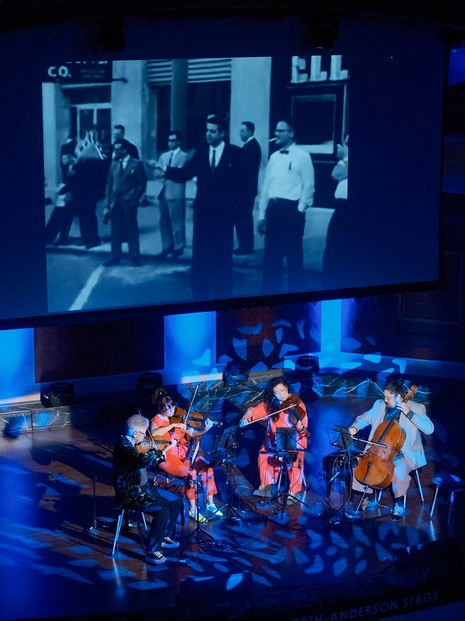
They opened with Sun Ra’s “Outer Spaceways Incorporated” (1971) by a pioneer of jazz and Afrofuturism, which included electrified upward glissandos for the quartet and recorded voices.
The powerful imagery of Black people marching peacefully during the Civil Rights Movement made an indelible impression in Zachary James Watkins’ “Peace Be Till” (2017). The ensemble played long-breathed phrases, moving together in a somber elegy. The heart-stopping backdrop of images included the famous protest marches for voting rights over the Edmund Pettus Bridge in Selma, Ala.
Trevor Weston’s arrangement of “Kumbayah” offered a poignant yet also joyful contrast. Its soundtrack included a 1926 performance by Henry Wylie, who sang in Gullah. The stunning artistry of Nina Simone was celebrated in her deeply moving song, “For All We Know” of 1961, arranged by Jacob Garchik, and the Simone-inspired “Zungo,” by Babatunde Olatunji, also arranged by Garchik for the quartet. In both, violist Kozasa’s phrases stood out for their depth of feeling.
The eclectic program in the first half peaked with “Glorious Mahalia,” composed in 2017 by Stacy Garrop. Here the quartet performed a soundtrack underscoring recordings of Studs Terkel’s eye-opening interviews with Mahalia Jackson for WFMT. Garrop’s score was inflected with the blues as Jackson discussed a colorful range of topics. The music was more dissonant and strident as she spoke of the indignities she’d suffered as a Black person. The piece climaxed on a video of Jackson’s own, powerful performance of the spiritual, “Sometimes I feel like a motherless child.”
After intermission, Neil Young was evoked in his greatest protest song, “Ohio,” arranged by cellist Wiancko. The mix in this half included an earthy Trinidad song, “A Shout,” and Bob Dylan’s “Hard Rain.”
Harrington spoke about the genesis of the Dylan arrangement. He was called by the Nobel Committee to perform a concert for its Inaugural Nobel Laureate Assembly for the Prevention of Nuclear War in 2025 , timed for the 80th anniversary of the Trinity Test. Recorded voices included those of Pussy Riot, Willlie Nelson, Laurie Anderson and Ringo Starr. It was thoughtful and heartbreaking. We were left with the swooshing sound of a nuclear bomb.
After all that we’d heard, Glass’ luminous String Quartet No. 5 dazzled in a much different way. The musicians performed with a full-bodied sound in seamless communication. It was utterly transporting.
Discover more from janellesnotes
Subscribe to get the latest posts sent to your email.
