
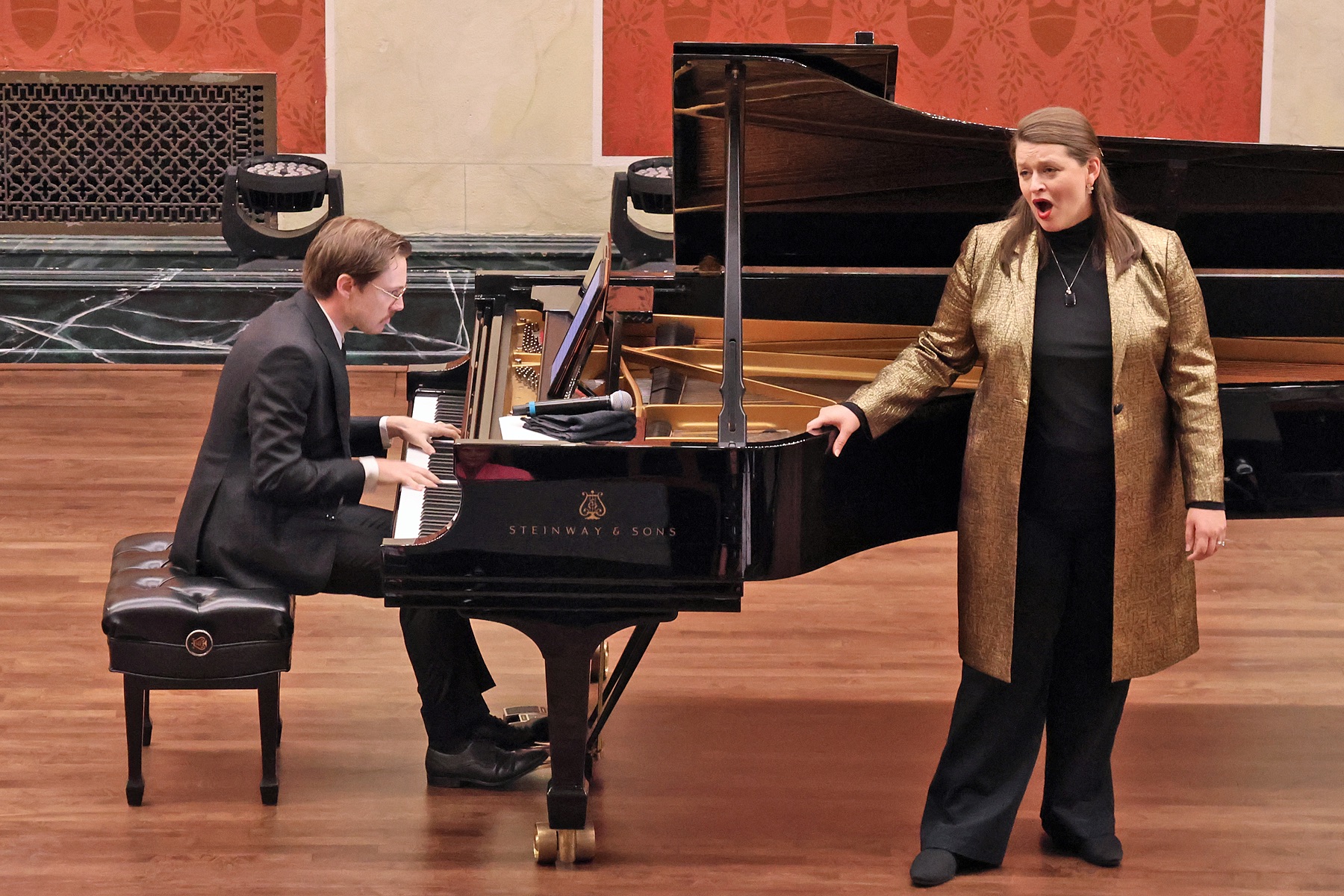
Mezzo-soprano Megan Moore brought a substantial, varied program to Matinee Musicale on Oct. 12 in Memorial Hall. It was her professional recital debut in the Queen City, although the singer, a native of West Chester and a Lakota West and Miami University grad, sang on Cincinnati Music Hall’s stage at age 14 with the May Festival Youth Chorus under the baton of James Conlon. “I thought I was a rock star,” she said, praising the foundation in the arts that she had received here. Now she enjoys an international career, which includes singing Rosina in “The Barber of Seville” with Seattle Opera and the Metropolitan Opera, and her company and role debut this season as Octavian in “Der Rosenkavalier” at New Orleans Opera.
Her exellent piano collaborator was Danish-born Francesco Barfoed, whom she met when both were at Juilliard. Their program included the second performance of a new song cycle by Jake Heggie, which, she told me later, he tailored to her voice. They gave its world premiere in April at the Morgan Library in New York, presented by the George and Nora London Foundation for Singers.
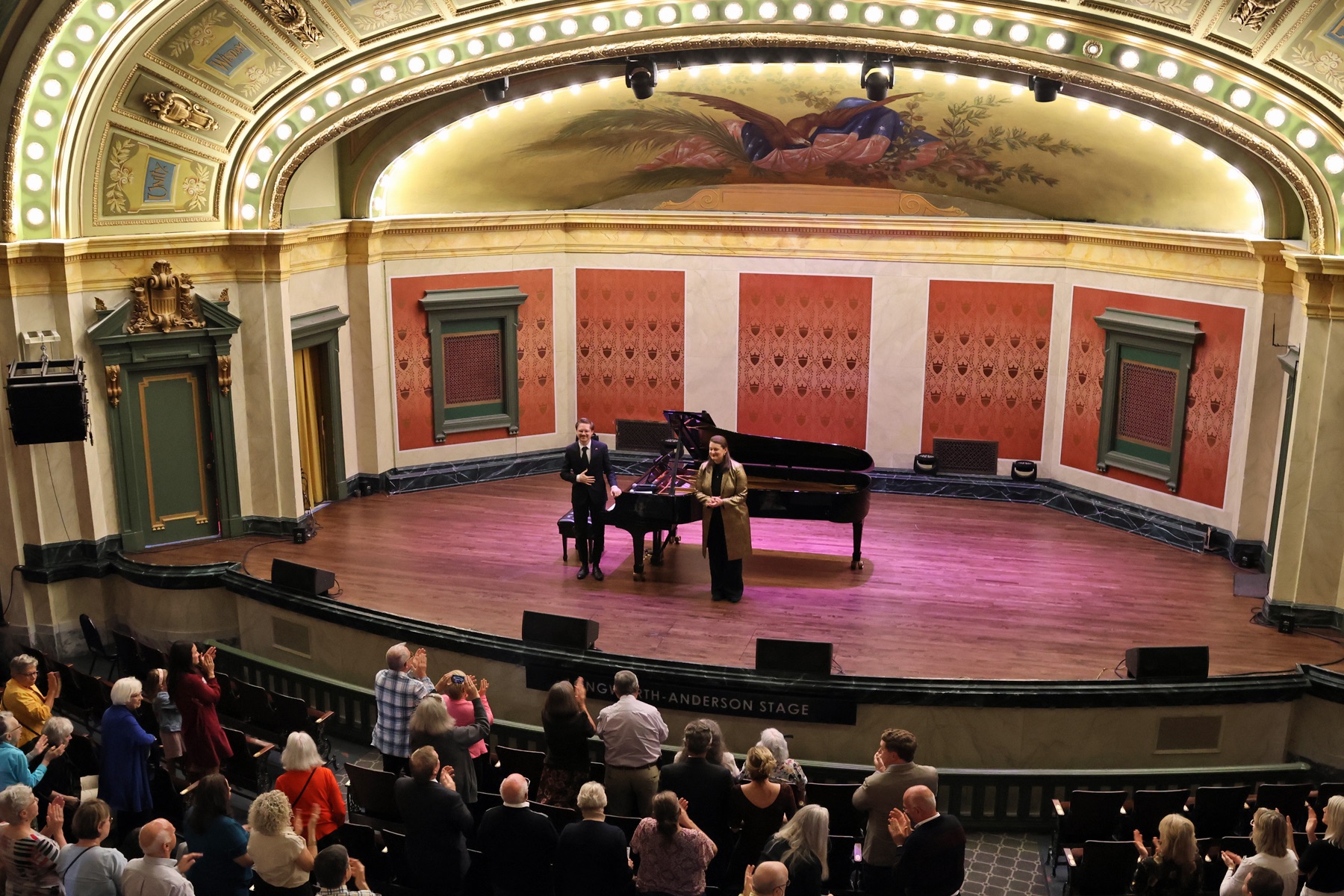
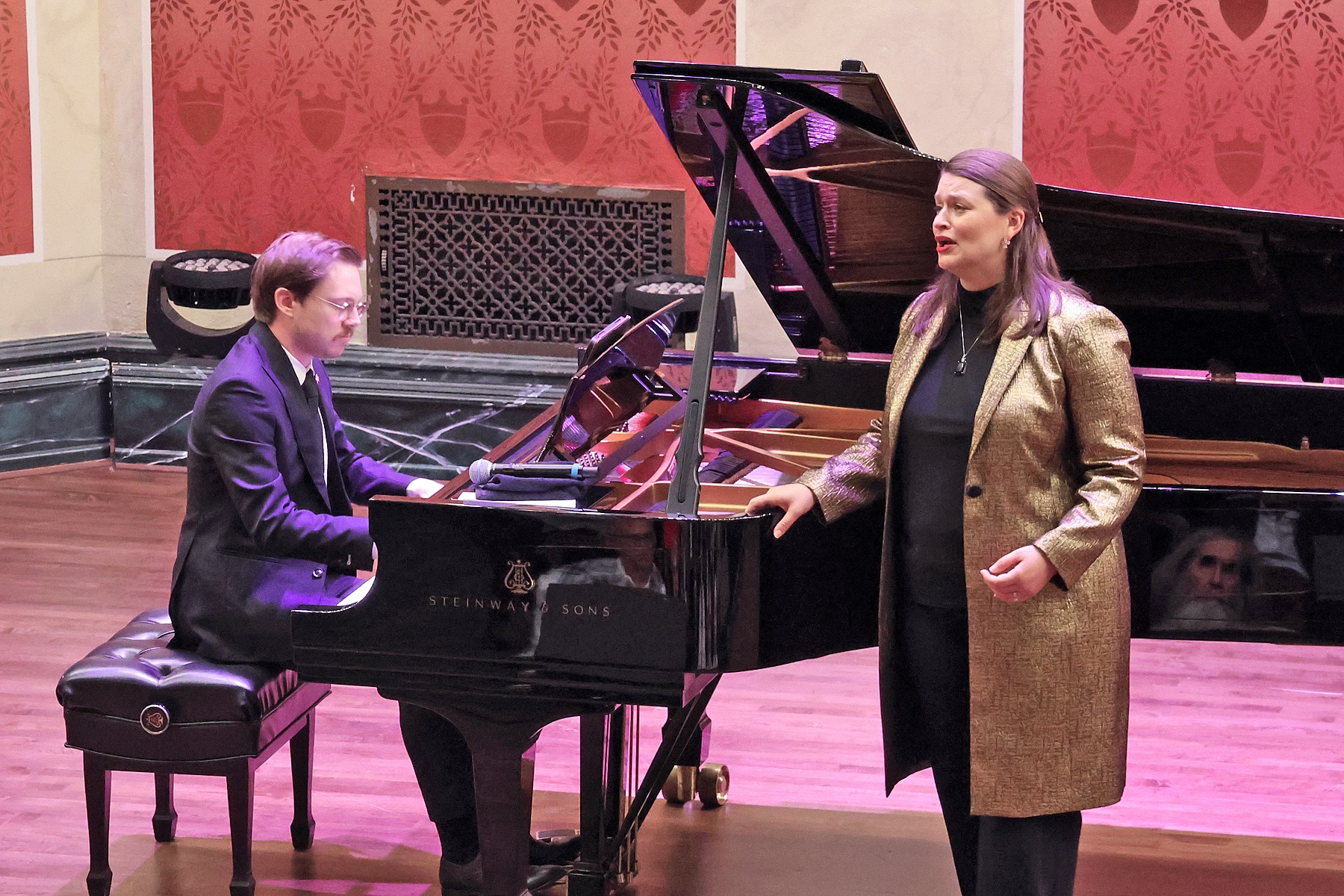 This was Moore’s first recital since having a baby via C-section seven weeks ago, which was an astonishing feat considering the control needed and the artistry she displayed. A large contingent of friends and family (and baby, too) were on hand, including former high school and college teachers.
The program’s first half spanned the 20th century with some rarely-heard works by women composers as well as Prokofiev’s “Five Poems of Anna Akhmatova.” Her sumptuous voice was on display off the bat in two songs by Undine Smith Moore, whose many songs were inspired by Black spirituals. I was enchanted by her rendition of 17th-century composer Barbara Strozzi’s “L’eraclito amoroso.” Her vocal color and sighing phrases vividly expressed the text of a woman weeping because of her unfaithful lover, while Barfoed provided clear and stylish accompaniment. Three songs by Cecile Chaminade, sung in French and capped by a flirtaceous “Sombrero,” were a treat, thanks to the singer’s engaging personality the pianist’s lightness of touch.
In the next set, Prokofiev paid homage to one of Russia’s most significant poets, Anna Akhmatova, who suffered many tragedies during the Stalinist regime. Moore sang the cycle in Russian, and her phrases had a poignant quality. She approached the last, “The grey-eyed king,” with a dark vocal color and quiet intensity.
The second half was a bit more traditional, opening with songs by Schumann. “Mondnacht” (Moonlight) was full of atmosphere, and she began its phrases singing pianissimo. The pianist echoed the mood with the most delicate playing. Songs by Sibelius, sung in Swedish, were also richly atmospheric, and the singer communicated their tales expressively over Barfoed’s lush chords.
The story behind Heggie’s song cycle, “Crossing Borders: Passages from Nora Schapiro’s Diary (1940-1943)” is as breathtaking as his music. Its text, arranged by Gene Scheer, is from the diary of Nora London, the longtime president of the Foundation that had been founded by her late husband, the distinguished bass-baritone George London.
Moore explained to listeners that after Nora died at age 98 in 2022, her family discovered a locked, leather-bound diary containing a history that she had never shared. The entries start in January 1940, when Nora was a teenager living in Paris with her secular Jewish family. As the Nazis marched on Paris, she had an hour to pack and flee, leaving her privileged life behind. As Rafael de Acha writes in the program notes, “her diary describes her life as a stateless refugee going from country to country.”
Nora’s obvious fear and the danger of the time were palpable in the first song, “Suitcases (Paris).” Moore repeated the word “courage” multiple times, against powerful chords in the piano. In the second, “Crossing Borders (Lisbon),” Nora’s texts involved waiting for long periods at borders, asking, “Where am I going to go? What’s to become of me? Where is it going to end?” against anxious piano figures and deep chord clusters.
As always, Heggie’s writing was vivid, lyrical and cinematic. In the final song, “To My Diary (New York),” Nora wrote, “I have filled your pages,” adding that she was still searching for her star. The work ended with a wordless vocalise, and Moore’s performance was deeply moving. Barfoed was a seamless and sensitive collaborator.
For an encore Moore offered Marc Blitzstein’s sweet tune from a little-known 1959 musical, “Juno,” called “I wish it so.”
Discover more from janellesnotes
Subscribe to get the latest posts sent to your email.
