
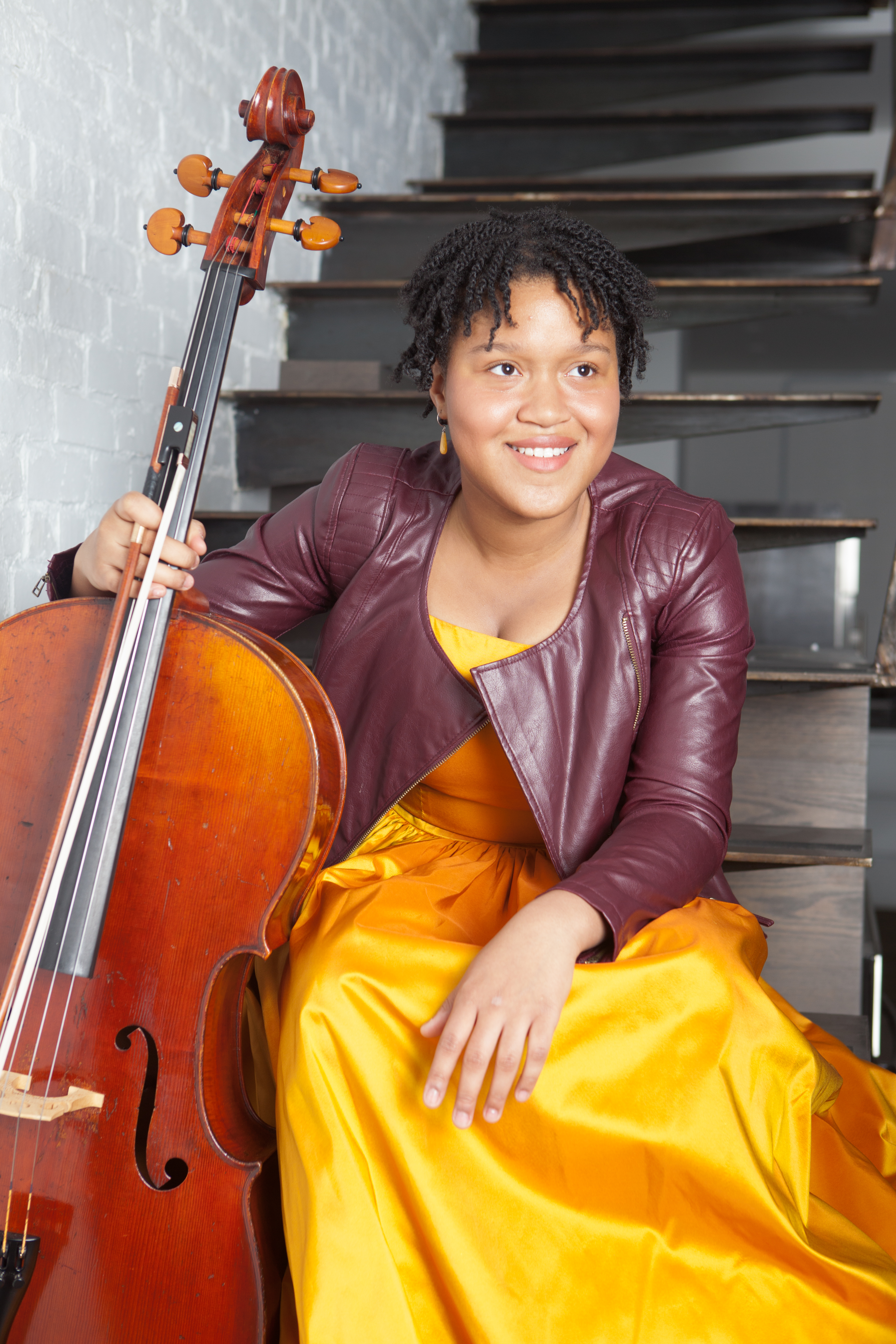
I caught up with rising star cellist Sujari Britt, who has been studying in Finland, via email in time to ask a few questions before she makes her Cincinnati debut with the Cincinnati Chamber Orchestra next weekend, Aug. 6 and 8.
Question: Please tell us a little bit about your musical journey. Why did you decide to study cello in Finland at the Sibelius Academy?
Answer: I began my cello travels at the age 4 after studying for a bit on piano and violin. At age 20, it is humbling to reflect that for the past decade-and-a-half I have devoted my time to exploring classical cello literature, techniques and approaches.
I believe it is time well-spent! I remain grateful for the incredible support and guidance of my early studies with Professor Marion Feldman (Manhattan School of Music, NYC). I met my current instructor, Professor Martti Rousi (Sibelius Academy, Helsinki, Finland) when he visited MSM for a master class. We were mutually enthralled, and I am thoroughly enjoying my tenure at Sibelius.
Q: How have you gotten through the pandemic, with your studies and performances?
A: COVID-19 has rocked our planet. The health crisis has been far-reaching in distance, and its impact likely will reverberate for time to come. Our world has shifted due to this illness. Across the globe we have suffered from loss, grief, fear, change. On one hand, COVID-19 surfaced the swirling of not knowing; distrusting, and feeling unsafe, uncertain, alone. For many, solitude, loneliness, and panic became our sole companions.
On another hand, the health crisis seemed to pummel us with warning of our need for each other; for kindness, truth, and humanity. I am fortunate to have toughed-out this pandemic in the company of friends, and in the presence of strangers who paused to notice our shared want.
When the pandemic began in earnest, I was on tour in the states. Having completed a few community events, a decision was made to postpone the main concert and remaining events to protect the audience and musicians. That was March 2020. I am thrilled for the upcoming concert with Cincinnati Chamber Orchestra to once again see eyes and know the ears, hearts, and minds that share the space of sound with me. I look forward with hope.
Q: The CCO season shines a light on musicians and composers of color, as well as on women. How do you think concert programs and even classical music institutions are changing, or will change in the future?
A: I genuinely appreciate CCO’s focus on emerging representatives of our shared joy for the classics. To my mind, the wider we open the door, the braver will be the talent, and the deeper the joy at the shattering of glass ceilings.
Q: Do you have particular mentors or people who have inspired you as a cellist?
A: So many “voices” have helped to create my path: My first instructor, Marion Feldman whose continues to support me; I have ongoing contact with Alisa Weilerstein with whom I had the honor of playing at the White House; and my current primary teacher, Martti Rousi, who invited me to expand my perspective through study at Sibelius Academy. Each of these individuals is extremely special to me, and each inspires my enchantment with classical cello. I am also enthralled by the greats: Jacqueline Dupre, YoYo Ma.
Q: What do you love most about playing Tchaikovsky’s Rococo Variations? What would you want the audience to know about that piece?
A: The Variations on a Rococo Theme in A major, Opus 33, is Tchaikovsky’s original theme in the Rococo (Late Baroque) style. The piece is not Late Baroque as the name implies, and instead harkens back to the classical era, a time of Haydn and Mozart, and the compact chamber orchestra. Variations was Tchaikovsky’s first composition for cello and orchestra. The piece has an fascinating history.
Tchaikovsky dedicated the original piece to cellist Wilhelm Fitzenhagen, who took liberties to significantly re-work the piece. Fitzenhagen notably edited the work, changing the sequence of variations and vast amounts of the cello solo, and removing the entire eighth variation. In fact, it was not until the 1950s, some 80 years after its first presentation that Tchaikovsky’s original version was reconstructed and published for the first time.
For me, Variations‘ intrigue resides in its continuity and the challenge of playing almost entirely in thumb position. (The CCO will use the Fitzenhagen version.)
To read more about the CCO Summermusik season, click here.
Information: 513-723-1182, ccocincinnati.org or ccocincinnati.org/faqs
Discover more from janellesnotes
Subscribe to get the latest posts sent to your email.

[…] READ MORE […]
LikeLike