
I was surprised to learn during my visit last weekend to the Tanglewood Festival, celebrating the 150th birthday of Serge Koussevitzky this summer, that the legendary conductor almost came to Cincinnati.
The distinguished music director of the Boston Symphony Orchestra from 1924 to 1949, Koussevitzky was also a composer, a virtuoso of the double bass, champion of new music and influential mentor of dozens of conductors and composers, including Leonard Bernstein and Aaron Copland. In a panel discussion I attended at Tanglewood, he was credited with literally rediscovering American classical music.
But before 1924, the Russian-born conductor was considering posts at the Cincinnati Symphony Orchestra and the Los Angeles Philharmonic. Perhaps his fate was sealed years earlier when Koussevitzky’s onetime teacher and former BSO music director Arthur Nikisch told him that he would oneday be music director of the BSO. (No worries: Cincinnati ended up with Fritz Reiner in 1924 instead.)
The Tanglewood Festival, summer home of the Boston Symphony Orchestra and Boston Pops in Lenox, MA, in the beautiful Berkshires, is a magical place. It has long been on my bucket list. This year, the festival welcomed critics and music journalists for the annual meeting of the Music Critics Association of North America. Our schedule included BSO concerts conducted by music director Andris Nelsons, panel discussions and a terrific Festival of Contemporary Music, curated by composers Steven Mackey and the Cuban-American Pulitzer Prize winning composer Tania León.
(You may recall that our own CSO commissioned León’s 1991 orchestral piece Carabalí, and premiered it in Music Hall and at Carnegie Hall. León told me that she is currently at work on a new piece for the Boston Symphony.)
Koussevitzky, who arrived at the BSO 100 years ago, was a prolific commissioner of new music. According to the BSO, he gave 146 world premieres and 86 U.S. premieres during his tenure. More than 300 works that he conducted in his programs were by Americans. He championed composers such as Stravinsky, Scriabin and Copland, whose music was part of the Koussevitzky 150 Celebration July 26-28 in the Koussevitzky Music Shed, circa 1938, on the verdant campus of Tanglewood. In 1940, he also founded the Tanglewood Music Center, where legions of composers, conductors and performers from Bernstein to Wynton Marsalis and Dawn Upshaw have benefited artistically.
Koussevitzky’s legacy
It may be surprising that Koussevitzky is not better known across America. Part of the reason may be that there are not many recordings readily available. The newest and most extensive biography by Russian musicologist Victor Yuzefovich is only available in Russian. (Translating that would be a good project for someone.)
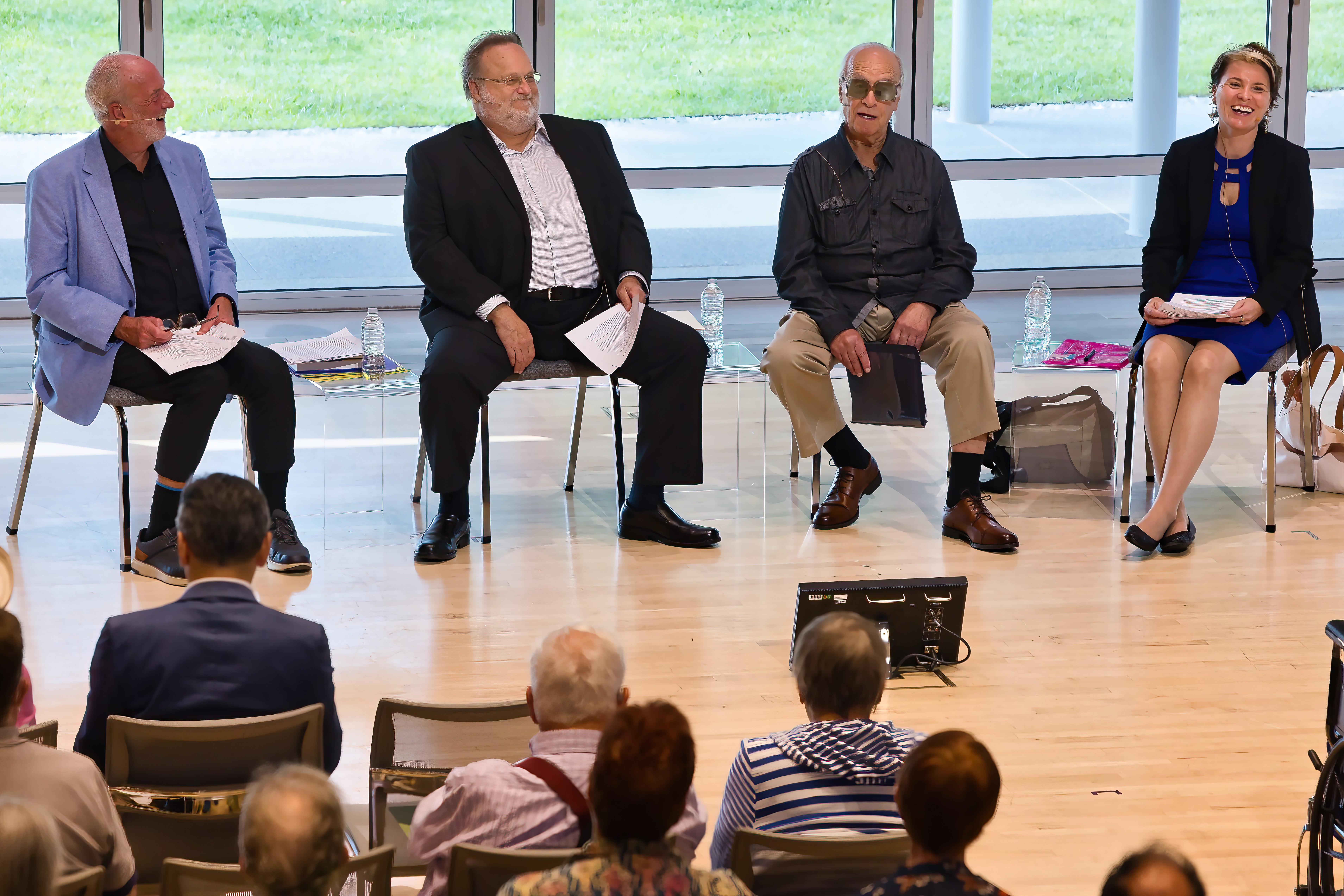
A panel discussion with Yuzefovich, along with author and historian Harlow Robinson and public radio veteran Tom Godell, who established the Koussevitzky Recordings Society, provided unique insights into the man and the maestro.
When Yuzefovich began studying the trove of Koussevitzky archives in the Library of Congress, he discovered that they were disorganized in a jumble of boxes, he told us through his translator Olga Birioukova.
Yuzefovich is the only author who has delved extensively into Koussevitzky’s early life, growing up as the son of a Jewish Klezmer violinist in a small, provincial town in Russia. An accomplished bassist from a young age, Koussevitzky played bass in the Bolshoi Theatre orchestra under its then-conductor Sergei Rachmaninoff.
He was “ambitious,” Yuzefovich said. Koussevitzky established orchestras in Russia and Paris before coming to America, where he dreamed of “developing” his own orchestra. Here, he knew and commissioned nearly every significant American composer. He supported Bartok at the end of the composer’s life by commissioning his Concerto for Orchestra.
“Musicians in his orchestra trembled. He was called a friendly dictator,” Yuzefovich said. A video interview with a musician noted that the conductor “had an obsession with sound.” He strove to achieve a specific tone quality from every musician in his orchestra, even the percussionists.
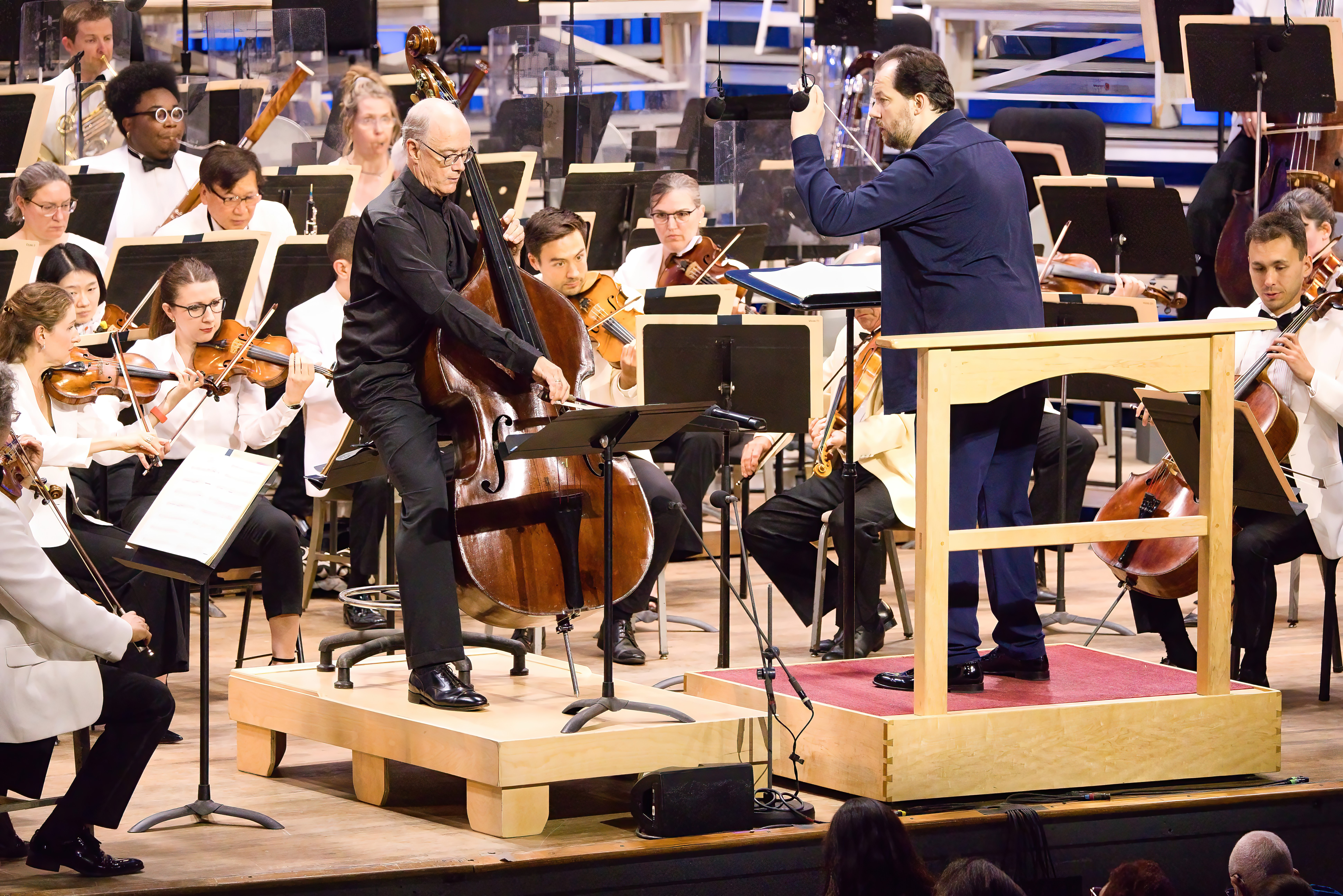
So it was fascinating to hear Koussevitzy’s Concerto for Double Bass in the BSO’s program later that night. It was performed by principal bassist Edwin Barker on Koussevitzky’s own instrument. Barker, who is retiring this year after 47 years, received big cheers from the audience as he took the stage. The concerto was in three movements that unfolded without pause.
The first movement was unmistakeably influenced by Tchaikovsky, in its writing for both the orchestra and the soloist. It was rich with virtuosities for the bassist, and Barker performed them with aplomb. Koussevitzky’s lyrical themes were quite beautiful, and the bassist phrased with feeling in the upper stratosphere of his instrument. The finale brought back the first movement’s Tchaikovsky-like horn motifs, along with bravura writing for the soloist. Nelsons was a sensitive leader in these arch-romantic themes, and his orchestra never overpowered the soloist.
The Library of Congress has posted a wonderful feature on Koussevitzky, with photos. Click here to read.
I’ll post more thoughts about some of the other concerts I heard on this blog. In the meantime, read some impressions by other critics at classicalvoiceamerica.org.
Discover more from janellesnotes
Subscribe to get the latest posts sent to your email.

Loved reading about Tanglewood and Koussivitsky.
<
div>
Sent from my iPhone
<
div dir=”ltr”>
<
blockquote type=”cite”>
LikeLike