
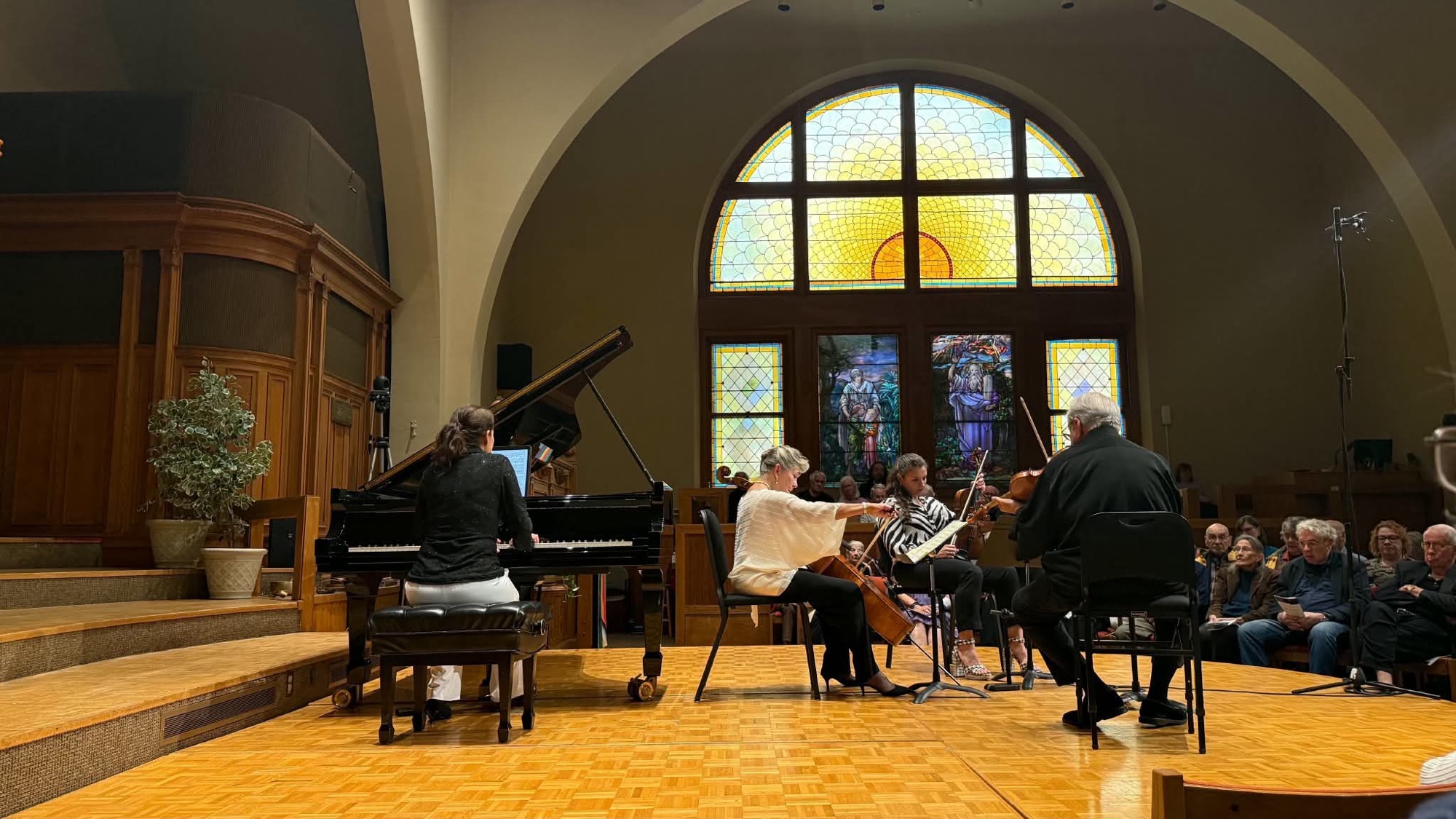
It’s always a special occasion when co-artistic directors Sharon Robinson, cellist, and Jaime Laredo, violinist, are in town to perform on the Linton Chamber Music Series. Last Sunday and Monday (Oct. 11-12) the couple’s Espressivo! Piano Quartet, with Anna Polonsky and violist Milena Pajaro-van de Stadt, opened the Linton Chamber Music season.
I was at the the Sunday matinee in the First Unitarian Church, to hear the world premiere of Richard Danielpour’s “Epiphanies for String Trio,” as well as piano quartets by Dvořák and Schumann.
Danielpour composed a number of works for Robinson and Laredo (who are married), and also wrote a piano trio for the Kalichstein-Laredo-Robinson Trio, which reigned for 45 years as one of the world’s finest piano trios until the untimely death of its superb pianist, Joseph “Yossi” Kalichstein in 2022. (Opera goers may recall that Danielpour also was the composer for the opera “Margaret Garner,” to Toni Morrison’s libretto in 2005, a Cincinnati Opera co-commission.)
On this occasion, Danielpour, 70, wrote a string trio, dedicating its final movement to Kalichstein’s memory. Scored for violin, viola and cello, it is a co-commission by a consortium of organizations, and was supported locally by Ann and Harry Santen.
Pajaro-van de Stadt (viola) joined Robinson and Laredo for the first performance of “Epiphanies.” Danielpour wrote in his program notes that its title “implies a sense of discovery and revelation.” He wrote it at a time when he was turning 70, adding, “In reviewing the joys and sorrows that life inevitably brings, I realized that all of this life brings the potential for new discoveries and understandings.”
Like many of his chamber music works, the outer movements were slow. The first, “Adagio cantabile,” opened with a well-crafted fugue. As I have come to appreciate in his music, his gift for lyricism was always at the fore. The string trio warmly intoned these lines, which were broken only by a brief moment of intensity before subsiding. In the radiant setting colored by the church’s Tiffany stained glass windows, it was a meditative experience.
My favorite movement, though, was the “Vivace leggiero.” The musicians played with an attractive lightness in this dance-like movement, which was highlighted by a counterpoint of pizzicatos. To me, its somewhat muted atmosphere reminded me of the Impressionists. The finale, “Adagietto,” featured a reflective melody for Laredo’s violin, and unfolded like an elegy. It was quite moving.
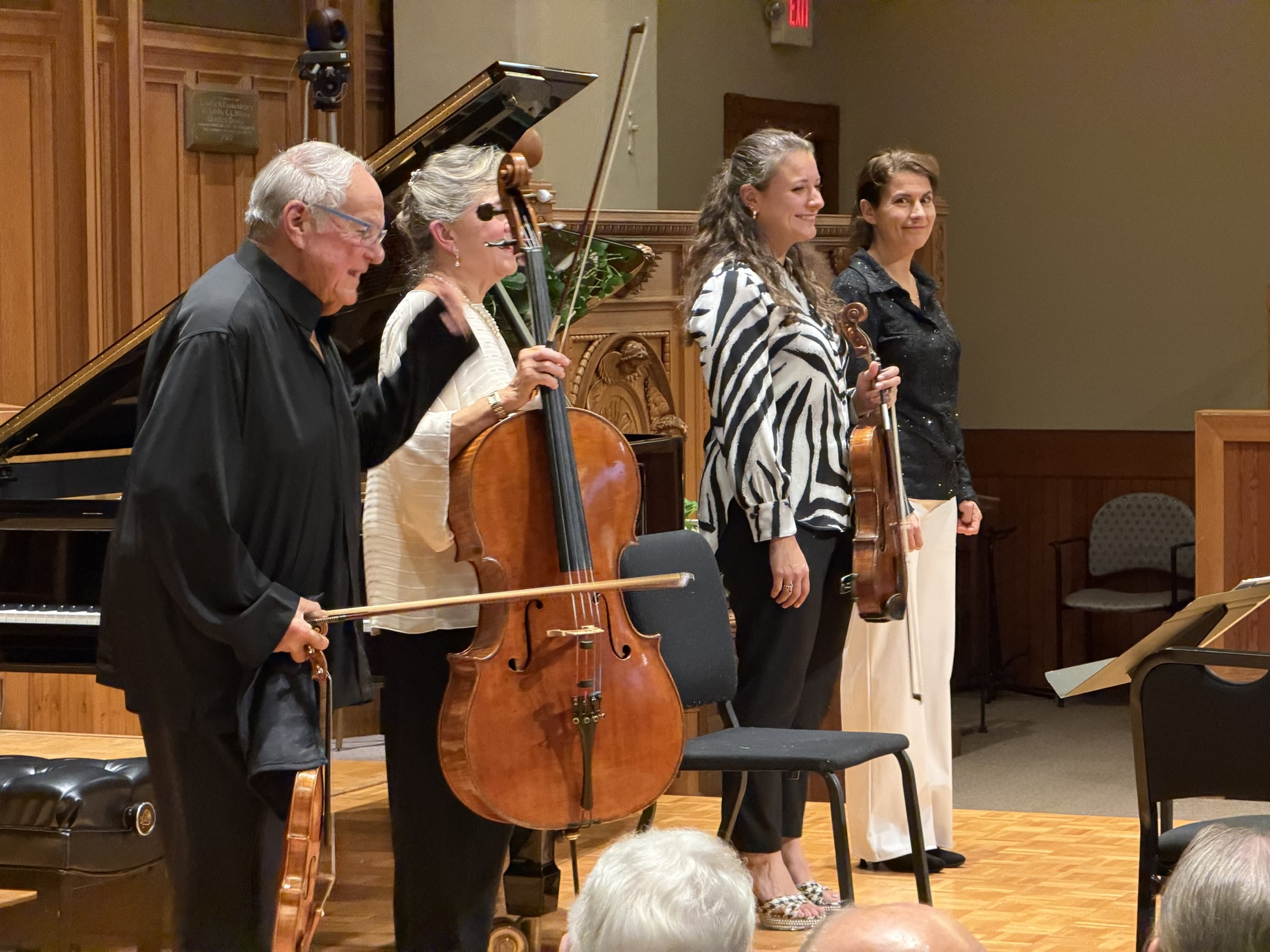 The first half also included a rarity: Dvořák’s Quartet No. 1 in D Major, Op. 23. Indeed, the quartet was playing it for the first time. The composer was 34 and at the start of his career. He was just beginning to merge Czech folk tunes and rustic dances and rhythms into his music, and this piece offered a window into his process that would be refined in his great works-to-come, such as the American Quartet and the Dumky Trio.
It was just three movements. I found great joy listening to Polonsky’s marvelous touch in this work, and also in the Schumann. The pianist’s runs sparkled, and she played with weight, yet never overpowered her colleagues. The second movement was an Andantino with variations, and the players carried on a charming dialogue — sometimes between strings, sometimes between piano and strings. Its final variation had the kind of nostalgic quality that only Dvořák can evoke. The finale, “Allegretto scherzando,” was fleet with moments of virtuosity for the pianist.
After intermission, we were treated to the afternoon’s most glowing and most polished performance in Schumann’s Piano Quartet in E-flat Major, Op. 47. Of course, Schumann wrote it for his beloved Clara, and it has a wonderful piano part. Robinson also explained to the audience that the score requires the cellist to re-tune her C string down a step to B-flat, before the third movement, and then back again for the fourth. That bit of inside information clearly caught the viewers’ attention in those moments. In the heart of this quartet, “Andante cantabile,” Robinson’s phrasing of the theme truly sang, and her tone was glorious. Her expressive beauty was matched by the other members of the quartet as the theme was traded between instruments.
 Coming up: I know you’ll want to hear the Balourdet String Quartet perform Amy Beach’s String Quartet, as well as her Theme and Variations with flutist Demarre McGill, as well as Ravel and Joan Tower, Nov. 1-2. Information: lintonmusic.org.
Discover more from janellesnotes
Subscribe to get the latest posts sent to your email.

Hi Janelle, thank you for sending this. I love your descriptions of the music!!! That pic looks great in the WordPress format too.
It was a wonderful concert.
I met with Milena on Sunday morning to talk with her about our brand new themusicminions commission consortium. We hope to commission a piece for her and Poiesis.
She said that Sharon & Jamie hadn’t played the Dvorak or Schumann for a very long time. So they had 3 intense pieces to learn.
5 hours a day Wednesday through Saturday…. Yikes.
I’m sure I’ll see you soon!
Michael
LikeLike